


From MVP to MVI: Why Startups Are Pivoting to Minimum Viable Intelligence
Venture capital data across major tech hubs shows a clear trend: overall funding rounds have tightened, but capital is concentrating heavily in startups that demonstrate hyper-efficient scaling and autonomous execution. Investors are no longer funding static software wrappers that require endless manual user inputs.
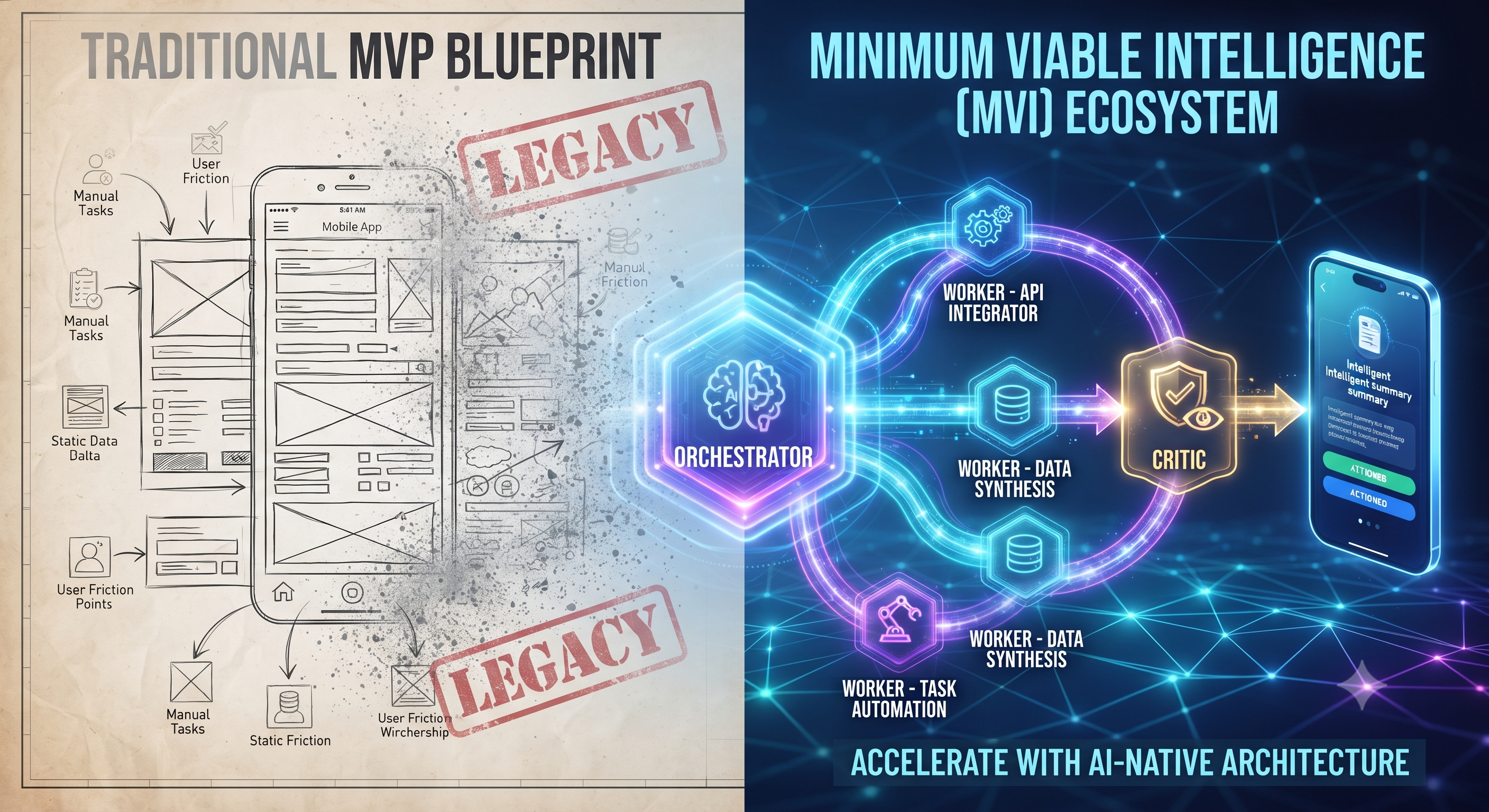
Instead, the market demands AI-native products built around agentic workflows. This transition introduces the concept of Minimum Viable Intelligence (MVI)—launching a product that doesn't just display data, but actively reasons, automates decisions, and solves multi-step workflows out of the box.
Why This Matters
When users experience software that can autonomously plan, execute, and self-correct, traditional CRUD-based apps feel obsolete. If your startup's value proposition relies solely on standard forms and manual workflows, your defensibility is low. Building an MVI forces you to embed core autonomous reasoning into your early release, creating an immediate wedge and a proprietary data moat.
Mini-Tutorial: How to Define and Build Your Startup's MVI
Pivot your product roadmap from basic feature-shipping to intelligence-driven validation using these three steps:
Step 1: Identify an "AI-Essential" Pain Point. Target a workflow that cannot be solved efficiently with traditional code alone—specifically tasks requiring multi-step synthesis, cross-system integration, or real-time adaptation.
Step 2: Architect a Multi-Role Agent Loop. Structure your backend around three core components: an Orchestrator to manage high-level user intent, Workers to execute specific API or database tasks, and a Critic to audit outputs for accuracy and security before displaying them.
Step 3: Measure Problem Resolution Speed, Not Page Views. Optimize your metrics around efficiency. If your autonomous agent resolves a user's complex operational request in seconds without friction, you have validated your MVI.
Discussion Question
Are you currently building traditional software features into your MVP, or have you started integrating autonomous agent loops into your core product architecture? Let’s talk strategy below! 👇
CTA (Join Startup Founders & Entrepreneurs)
Ready to build, scale, and secure funding alongside top innovators? Join Startup Founders & Entrepreneurs today to swap growth playbooks, share pitch decks, and accelerate your venture!
Venture capital data across major tech hubs shows a clear trend: overall funding rounds have tightened, but capital is concentrating heavily in startups that demonstrate hyper-efficient scaling and autonomous execution. Investors are no longer funding static software wrappers that require endless manual user inputs.
Instead, the market demands AI-native products built around agentic workflows. This transition introduces the concept of Minimum Viable Intelligence (MVI)—launching a product that doesn't just display data, but actively reasons, automates decisions, and solves multi-step workflows out of the box.
Why This Matters
When users experience software that can autonomously plan, execute, and self-correct, traditional CRUD-based apps feel obsolete. If your startup's value proposition relies solely on standard forms and manual workflows, your defensibility is low. Building an MVI forces you to embed core autonomous reasoning into your early release, creating an immediate wedge and a proprietary data moat.
Mini-Tutorial: How to Define and Build Your Startup's MVI
Pivot your product roadmap from basic feature-shipping to intelligence-driven validation using these three steps:
Step 1: Identify an "AI-Essential" Pain Point. Target a workflow that cannot be solved efficiently with traditional code alone—specifically tasks requiring multi-step synthesis, cross-system integration, or real-time adaptation.
Step 2: Architect a Multi-Role Agent Loop. Structure your backend around three core components: an Orchestrator to manage high-level user intent, Workers to execute specific API or database tasks, and a Critic to audit outputs for accuracy and security before displaying them.
Step 3: Measure Problem Resolution Speed, Not Page Views. Optimize your metrics around efficiency. If your autonomous agent resolves a user's complex operational request in seconds without friction, you have validated your MVI.
Discussion Question
Are you currently building traditional software features into your MVP, or have you started integrating autonomous agent loops into your core product architecture? Let’s talk strategy below! 👇
CTA (Join Startup Founders & Entrepreneurs)
Ready to build, scale, and secure funding alongside top innovators? Join Startup Founders & Entrepreneurs today to swap growth playbooks, share pitch decks, and accelerate your venture!
From MVP to MVI: Why Startups Are Pivoting to Minimum Viable Intelligence
Venture capital data across major tech hubs shows a clear trend: overall funding rounds have tightened, but capital is concentrating heavily in startups that demonstrate hyper-efficient scaling and autonomous execution. Investors are no longer funding static software wrappers that require endless manual user inputs.
Instead, the market demands AI-native products built around agentic workflows. This transition introduces the concept of Minimum Viable Intelligence (MVI)—launching a product that doesn't just display data, but actively reasons, automates decisions, and solves multi-step workflows out of the box.
Why This Matters
When users experience software that can autonomously plan, execute, and self-correct, traditional CRUD-based apps feel obsolete. If your startup's value proposition relies solely on standard forms and manual workflows, your defensibility is low. Building an MVI forces you to embed core autonomous reasoning into your early release, creating an immediate wedge and a proprietary data moat.
Mini-Tutorial: How to Define and Build Your Startup's MVI
Pivot your product roadmap from basic feature-shipping to intelligence-driven validation using these three steps:
Step 1: Identify an "AI-Essential" Pain Point. Target a workflow that cannot be solved efficiently with traditional code alone—specifically tasks requiring multi-step synthesis, cross-system integration, or real-time adaptation.
Step 2: Architect a Multi-Role Agent Loop. Structure your backend around three core components: an Orchestrator to manage high-level user intent, Workers to execute specific API or database tasks, and a Critic to audit outputs for accuracy and security before displaying them.
Step 3: Measure Problem Resolution Speed, Not Page Views. Optimize your metrics around efficiency. If your autonomous agent resolves a user's complex operational request in seconds without friction, you have validated your MVI.
Discussion Question
Are you currently building traditional software features into your MVP, or have you started integrating autonomous agent loops into your core product architecture? Let’s talk strategy below! 👇
CTA (Join Startup Founders & Entrepreneurs)
Ready to build, scale, and secure funding alongside top innovators? Join Startup Founders & Entrepreneurs today to swap growth playbooks, share pitch decks, and accelerate your venture!

 Arabic
 French
 Spanish
 Portuguese
 Deutsch
 Turkish
 Dutch
Dutch
 Italiano
 Russian
 Romaian
 Portuguese (Brazil)
 Greek
Greek