


Beyond Memorizing Syntax: Building Mental Models for Core CS Concepts in the AI Era
If you spend all your study hours trying to memorize every method in a standard library or every line of boilerplate code, you are training for a test that AI has already aced.
Modern tech education is undergoing a massive transformation. With automated code generation handling routine syntax, engineering value is entirely concentrated on foundational problem-solving, data structures, algorithms, and system architecture. When your code fails or an autonomous agent generates a subtle memory leak, knowing why things work under the hood is what separates great engineers from copy-paste coders.
Why This Matters
AI models are prediction engines, not architectural thinkers. They don't understand trade-offs between time and space complexity, why a database index speeds up queries, or how memory management works across distributed systems. If you don't master these fundamentals during your student years, you won't know how to debug, optimize, or audit what the AI builds for you.
Mini-Tutorial: How to Study Like a Systems Architect
Transform your study sessions from passive memorization to active, foundational engineering with these three steps:
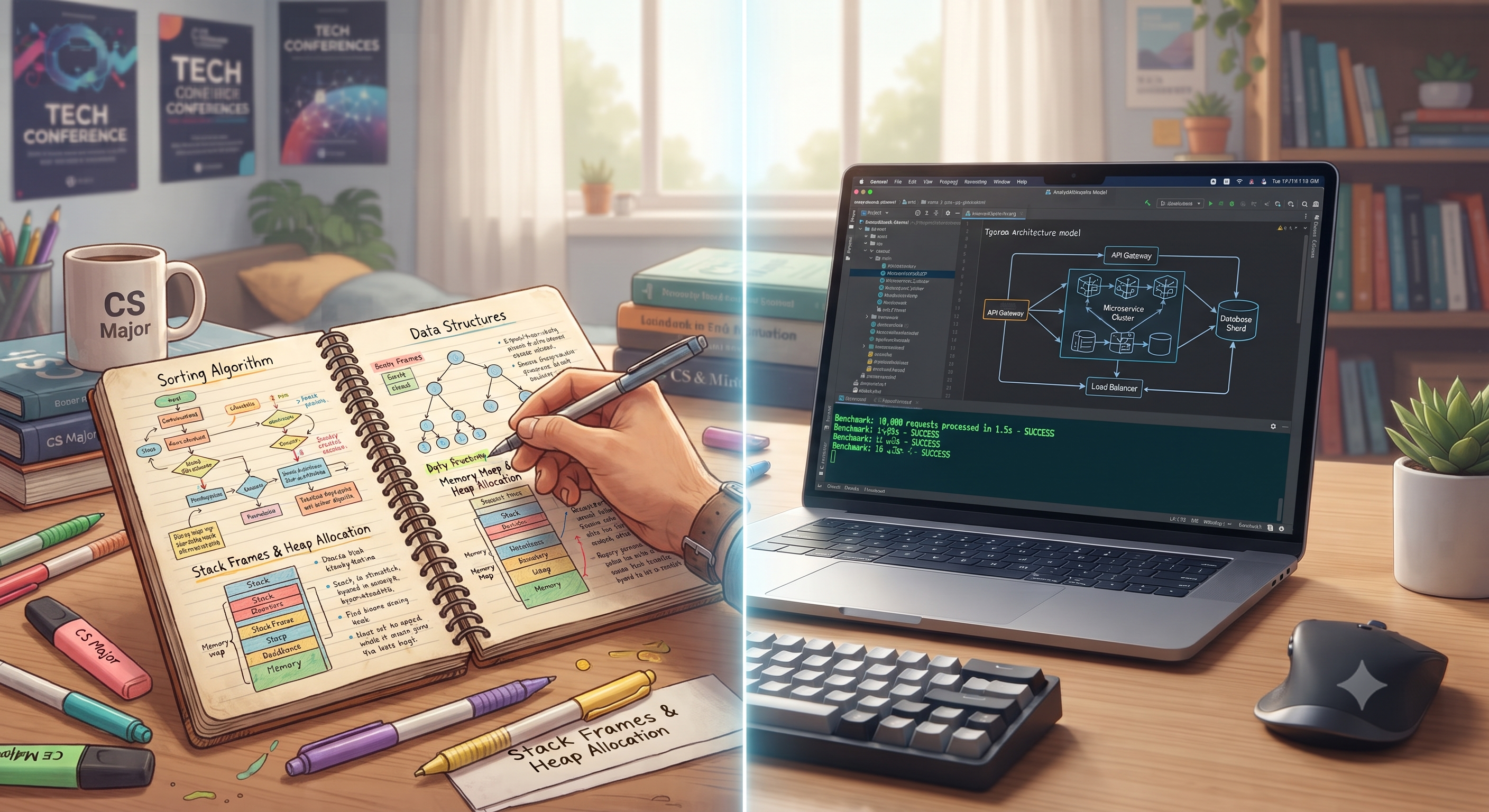
Step 1: Trace Code Execution Manually. Before running a script or asking an AI for help, trace the control flow and state changes on paper or a whiteboard line by line. Build a mental model of how variables occupy memory stack frames.
Step 2: Benchmark Alternative Data Structures. When solving a coding problem, don't just use the first array or list that comes to mind. Compare time and space trade-offs by testing how an O(N) hash map performs against an O(N log N) sorted tree under heavy data loads.
Step 3: Break and Fix Systems Deliberately. Intentionally introduce edge cases into your code—such as null inputs, race conditions, or unhandled exceptions—and study how your application handles the failure before letting an automated tool clean it up.
Discussion Question
Are you focusing more on learning syntax or mastering underlying computer science concepts in your current classes? Let’s share study tips below! 👇
CTA (Join Students in Tech)
Ready to ace your studies, build real-world projects, and connect with peers worldwide? Join Students in Tech today to share learning resources, collaborate on projects, and build your future together!
If you spend all your study hours trying to memorize every method in a standard library or every line of boilerplate code, you are training for a test that AI has already aced.
Modern tech education is undergoing a massive transformation. With automated code generation handling routine syntax, engineering value is entirely concentrated on foundational problem-solving, data structures, algorithms, and system architecture. When your code fails or an autonomous agent generates a subtle memory leak, knowing why things work under the hood is what separates great engineers from copy-paste coders.
Why This Matters
AI models are prediction engines, not architectural thinkers. They don't understand trade-offs between time and space complexity, why a database index speeds up queries, or how memory management works across distributed systems. If you don't master these fundamentals during your student years, you won't know how to debug, optimize, or audit what the AI builds for you.
Mini-Tutorial: How to Study Like a Systems Architect
Transform your study sessions from passive memorization to active, foundational engineering with these three steps:
Step 1: Trace Code Execution Manually. Before running a script or asking an AI for help, trace the control flow and state changes on paper or a whiteboard line by line. Build a mental model of how variables occupy memory stack frames.
Step 2: Benchmark Alternative Data Structures. When solving a coding problem, don't just use the first array or list that comes to mind. Compare time and space trade-offs by testing how an O(N) hash map performs against an O(N log N) sorted tree under heavy data loads.
Step 3: Break and Fix Systems Deliberately. Intentionally introduce edge cases into your code—such as null inputs, race conditions, or unhandled exceptions—and study how your application handles the failure before letting an automated tool clean it up.
Discussion Question
Are you focusing more on learning syntax or mastering underlying computer science concepts in your current classes? Let’s share study tips below! 👇
CTA (Join Students in Tech)
Ready to ace your studies, build real-world projects, and connect with peers worldwide? Join Students in Tech today to share learning resources, collaborate on projects, and build your future together!
Beyond Memorizing Syntax: Building Mental Models for Core CS Concepts in the AI Era
If you spend all your study hours trying to memorize every method in a standard library or every line of boilerplate code, you are training for a test that AI has already aced.
Modern tech education is undergoing a massive transformation. With automated code generation handling routine syntax, engineering value is entirely concentrated on foundational problem-solving, data structures, algorithms, and system architecture. When your code fails or an autonomous agent generates a subtle memory leak, knowing why things work under the hood is what separates great engineers from copy-paste coders.
Why This Matters
AI models are prediction engines, not architectural thinkers. They don't understand trade-offs between time and space complexity, why a database index speeds up queries, or how memory management works across distributed systems. If you don't master these fundamentals during your student years, you won't know how to debug, optimize, or audit what the AI builds for you.
Mini-Tutorial: How to Study Like a Systems Architect
Transform your study sessions from passive memorization to active, foundational engineering with these three steps:
Step 1: Trace Code Execution Manually. Before running a script or asking an AI for help, trace the control flow and state changes on paper or a whiteboard line by line. Build a mental model of how variables occupy memory stack frames.
Step 2: Benchmark Alternative Data Structures. When solving a coding problem, don't just use the first array or list that comes to mind. Compare time and space trade-offs by testing how an O(N) hash map performs against an O(N log N) sorted tree under heavy data loads.
Step 3: Break and Fix Systems Deliberately. Intentionally introduce edge cases into your code—such as null inputs, race conditions, or unhandled exceptions—and study how your application handles the failure before letting an automated tool clean it up.
Discussion Question
Are you focusing more on learning syntax or mastering underlying computer science concepts in your current classes? Let’s share study tips below! 👇
CTA (Join Students in Tech)
Ready to ace your studies, build real-world projects, and connect with peers worldwide? Join Students in Tech today to share learning resources, collaborate on projects, and build your future together!

 English
 Arabic
 French
 Spanish
 Portuguese
 Deutsch
 Turkish
 Dutch
Dutch
 Italiano
 Russian
 Romaian
 Greek
Greek