


From Static Dashboards to Semantic Context: Designing Data Pipelines for AI Agents
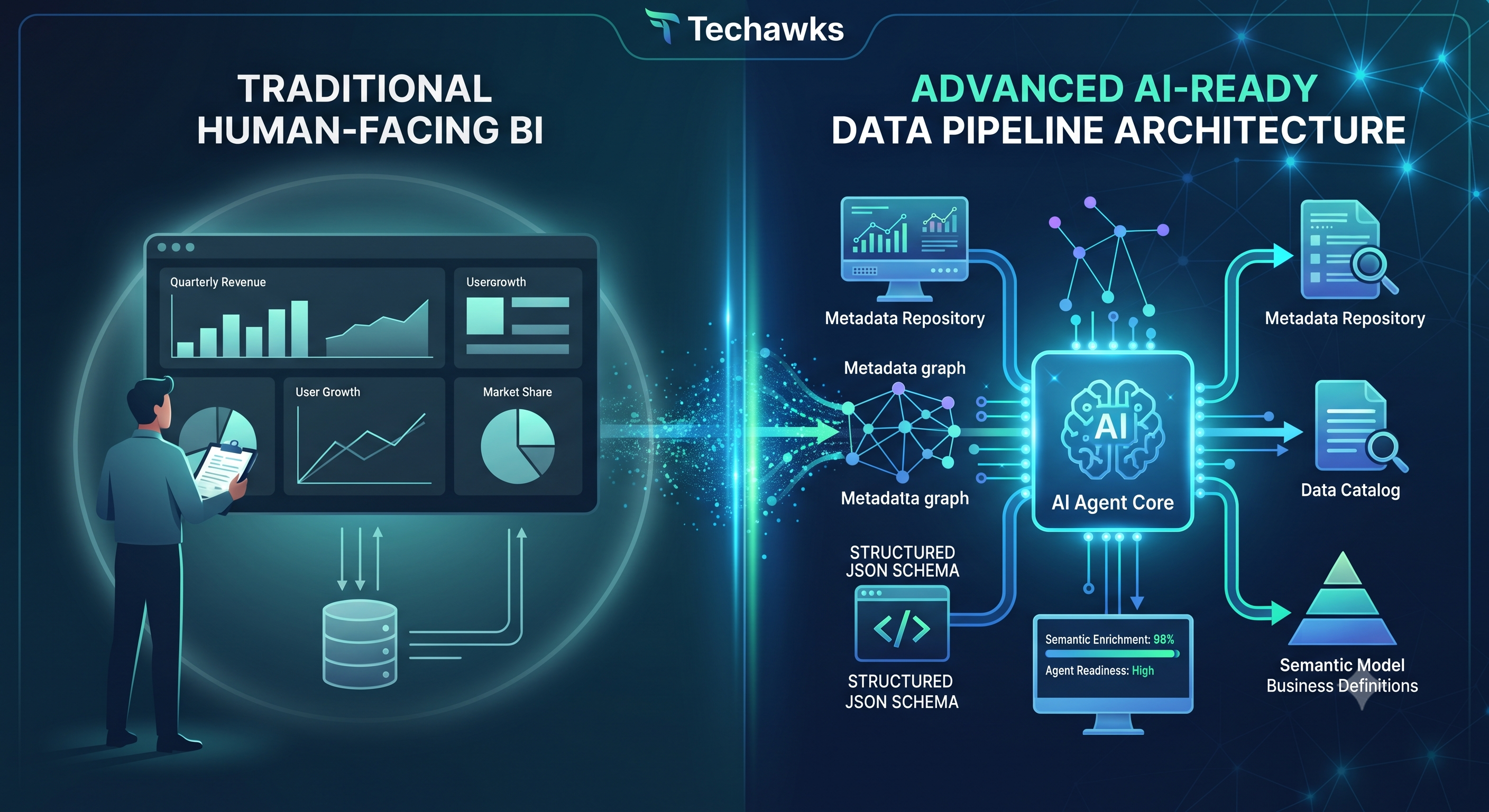
The modern data stack is undergoing a massive transformation. While traditional analytics pipelines were built to serve human analysts through structured SQL queries and pre-aggregated dashboards, today a significant portion of data consumers are autonomous AI agents.
An LLM or autonomous agent doesn't understand implicit company naming conventions, hidden tribal knowledge, or isolated database joins. When data lacks explicit context, agents hallucinate relationships, misinterpret metrics, or fail silently during complex multi-step reasoning tasks.
Why This Matters
Data reliability is no longer just about row counts and uptime; it is about context engineering. To make your data warehouse or lakehouse AI-ready, you must embed rich, semantic metadata alongside your raw and transformed data tables. Without active metadata management, your transition into agentic analytics will stall out at the query layer.
Mini-Tutorial: Building an AI-Ready Semantic Context Layer
Upgrade your data architecture for agentic workflows by implementing these three steps:
Step 1: Codify Business Definitions in Version-Controlled Semantic Models. Move away from tribal knowledge. Use tools like dbt semantic layers or structured YAML definitions to explicitly document what metrics mean, how they are calculated, and what business rules apply.
Step 2: Automate Active Metadata Tracking. Implement observability and lineage tooling (such as Monte Carlo or open-source equivalents) that automatically tracks data freshness, schema evolution, and usage patterns so agents know when data can be trusted.
Step 3: Expose Structured APIs, Not Just Flat Tables. Provide AI agents with clean, typed retrieval endpoints and semantic search layers (such as vector embeddings mapped to your data catalog) rather than dumping raw schema dumps into context windows.
Discussion Question
How is your team adapting data pipelines to support autonomous AI agents alongside traditional human-facing BI dashboards? Let’s talk architecture below! 👇
CTA (Join Data Science & Analytics)
Ready to master modern data stacks, analytics engineering, and AI integration? Join Data Science & Analytics today to connect with top practitioners, swap architecture patterns, and elevate your data craft!
The modern data stack is undergoing a massive transformation. While traditional analytics pipelines were built to serve human analysts through structured SQL queries and pre-aggregated dashboards, today a significant portion of data consumers are autonomous AI agents.
An LLM or autonomous agent doesn't understand implicit company naming conventions, hidden tribal knowledge, or isolated database joins. When data lacks explicit context, agents hallucinate relationships, misinterpret metrics, or fail silently during complex multi-step reasoning tasks.
Why This Matters
Data reliability is no longer just about row counts and uptime; it is about context engineering. To make your data warehouse or lakehouse AI-ready, you must embed rich, semantic metadata alongside your raw and transformed data tables. Without active metadata management, your transition into agentic analytics will stall out at the query layer.
Mini-Tutorial: Building an AI-Ready Semantic Context Layer
Upgrade your data architecture for agentic workflows by implementing these three steps:
Step 1: Codify Business Definitions in Version-Controlled Semantic Models. Move away from tribal knowledge. Use tools like dbt semantic layers or structured YAML definitions to explicitly document what metrics mean, how they are calculated, and what business rules apply.
Step 2: Automate Active Metadata Tracking. Implement observability and lineage tooling (such as Monte Carlo or open-source equivalents) that automatically tracks data freshness, schema evolution, and usage patterns so agents know when data can be trusted.
Step 3: Expose Structured APIs, Not Just Flat Tables. Provide AI agents with clean, typed retrieval endpoints and semantic search layers (such as vector embeddings mapped to your data catalog) rather than dumping raw schema dumps into context windows.
Discussion Question
How is your team adapting data pipelines to support autonomous AI agents alongside traditional human-facing BI dashboards? Let’s talk architecture below! 👇
CTA (Join Data Science & Analytics)
Ready to master modern data stacks, analytics engineering, and AI integration? Join Data Science & Analytics today to connect with top practitioners, swap architecture patterns, and elevate your data craft!
From Static Dashboards to Semantic Context: Designing Data Pipelines for AI Agents
The modern data stack is undergoing a massive transformation. While traditional analytics pipelines were built to serve human analysts through structured SQL queries and pre-aggregated dashboards, today a significant portion of data consumers are autonomous AI agents.
An LLM or autonomous agent doesn't understand implicit company naming conventions, hidden tribal knowledge, or isolated database joins. When data lacks explicit context, agents hallucinate relationships, misinterpret metrics, or fail silently during complex multi-step reasoning tasks.
Why This Matters
Data reliability is no longer just about row counts and uptime; it is about context engineering. To make your data warehouse or lakehouse AI-ready, you must embed rich, semantic metadata alongside your raw and transformed data tables. Without active metadata management, your transition into agentic analytics will stall out at the query layer.
Mini-Tutorial: Building an AI-Ready Semantic Context Layer
Upgrade your data architecture for agentic workflows by implementing these three steps:
Step 1: Codify Business Definitions in Version-Controlled Semantic Models. Move away from tribal knowledge. Use tools like dbt semantic layers or structured YAML definitions to explicitly document what metrics mean, how they are calculated, and what business rules apply.
Step 2: Automate Active Metadata Tracking. Implement observability and lineage tooling (such as Monte Carlo or open-source equivalents) that automatically tracks data freshness, schema evolution, and usage patterns so agents know when data can be trusted.
Step 3: Expose Structured APIs, Not Just Flat Tables. Provide AI agents with clean, typed retrieval endpoints and semantic search layers (such as vector embeddings mapped to your data catalog) rather than dumping raw schema dumps into context windows.
Discussion Question
How is your team adapting data pipelines to support autonomous AI agents alongside traditional human-facing BI dashboards? Let’s talk architecture below! 👇
CTA (Join Data Science & Analytics)
Ready to master modern data stacks, analytics engineering, and AI integration? Join Data Science & Analytics today to connect with top practitioners, swap architecture patterns, and elevate your data craft!

 English
 Arabic
 French
 Spanish
 Portuguese
 Deutsch
 Dutch
Dutch
 Italiano
 Russian
 Romaian
 Portuguese (Brazil)
 Greek
Greek