


From Manual YAML Wrangling to Golden Paths: Building Agent-Ready Internal Developer Platforms
As software development velocity surges with the adoption of AI code generation and autonomous agents, traditional DevOps models are hitting a bottleneck. Developers are churning out Kubernetes manifests, Terraform scripts, and cloud configurations faster than operations teams can review them.
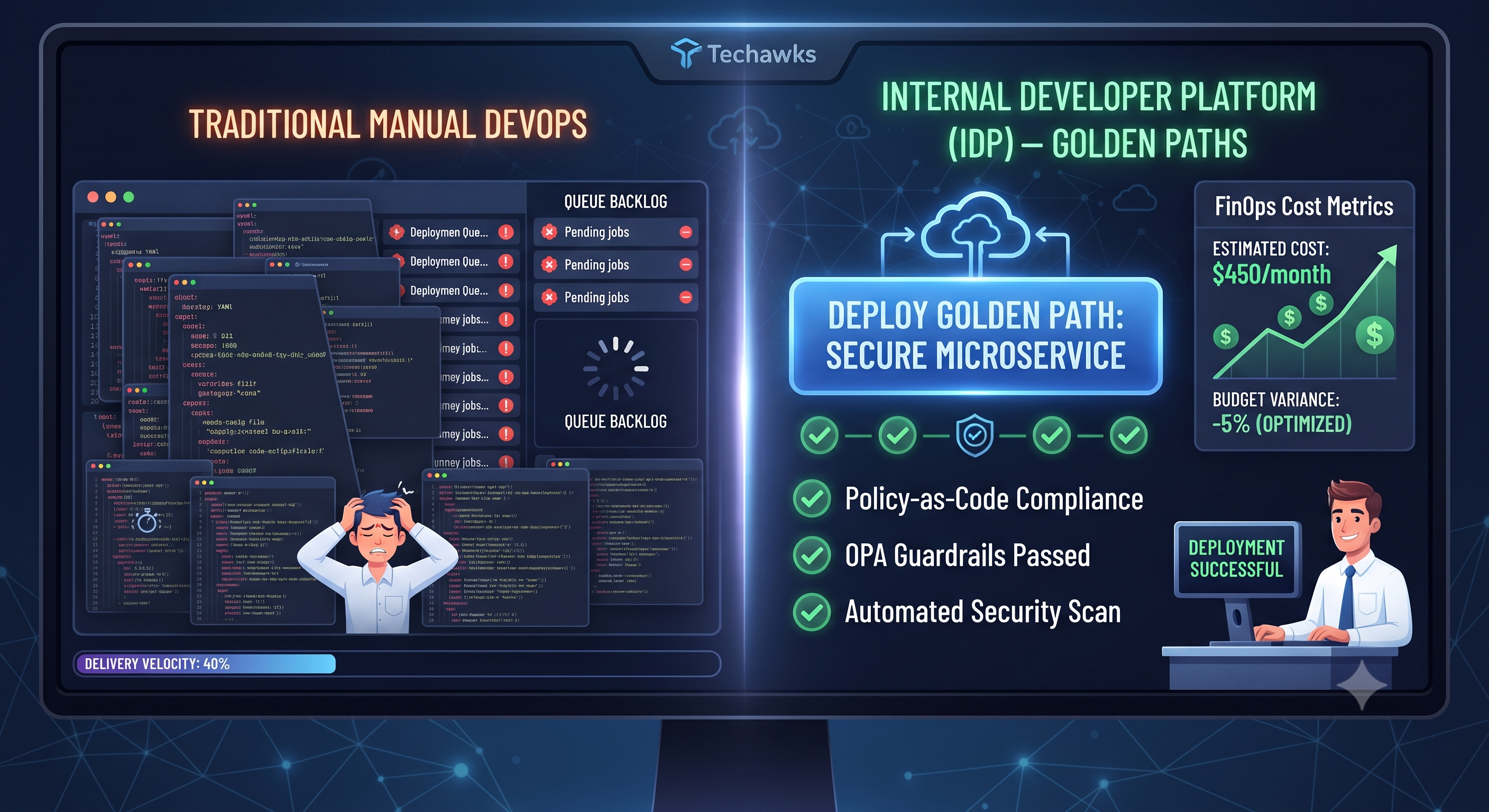
The industry antidote to this friction is Platform Engineering. Rather than treating infrastructure as a series of custom tickets or ad-hoc scripts, mature cloud teams build Internal Developer Platforms (IDPs) that treat developers (and increasingly, AI agents) as primary customers. An IDP turns recurring infrastructure tasks into standardized, self-service "golden paths".
Why This Matters
When non-deterministic AI code generation introduces subtle configuration flaws or missing security constraints, traditional manual reviews fail at scale. A well-architected IDP acts as an automated safety net—embedding security policies, pre-deployment cost gates, and compliance checks directly into the provisioning pipeline.
Mini-Tutorial: Designing Your First Golden Path in an IDP
Streamline your cloud delivery pipeline and protect your production environment by building a standardized self-service workflow:
Step 1: Define Reusable Infrastructure Templates. Package your standard microservice architectures (e.g., a secure container service backed by managed database storage) into version-controlled templates using tools like Backstage or OpenTofu/Terraform modules.
Step 2: Bake Policy-as-Code Guardrails into CI/CD. Integrate policy engines (such as Open Policy Agent or Kyverno) to automatically scan infrastructure code before deployment, blocking configurations that violate encryption, network isolation, or least-privilege IAM rules.
Step 3: Establish Pre-Deployment FinOps Cost Gates. Implement automated cost-estimation checks in your pipeline to flag or block workloads exceeding unit-economic resource thresholds before they hit cloud environments.
Discussion Question
Are you building Internal Developer Platforms at your organization, or is your team still relying on traditional ticketing and manual infrastructure provisioning? Let’s share architecture strategies below! 👇
CTA (Join Cloud, DevOps & Open Source)
Ready to master platform engineering, cloud-native architecture, and modern infrastructure automation? Join Cloud, DevOps & Open Source today to connect with top engineers, swap open-source tooling playbooks, and scale your cloud career!
As software development velocity surges with the adoption of AI code generation and autonomous agents, traditional DevOps models are hitting a bottleneck. Developers are churning out Kubernetes manifests, Terraform scripts, and cloud configurations faster than operations teams can review them.
The industry antidote to this friction is Platform Engineering. Rather than treating infrastructure as a series of custom tickets or ad-hoc scripts, mature cloud teams build Internal Developer Platforms (IDPs) that treat developers (and increasingly, AI agents) as primary customers. An IDP turns recurring infrastructure tasks into standardized, self-service "golden paths".
Why This Matters
When non-deterministic AI code generation introduces subtle configuration flaws or missing security constraints, traditional manual reviews fail at scale. A well-architected IDP acts as an automated safety net—embedding security policies, pre-deployment cost gates, and compliance checks directly into the provisioning pipeline.
Mini-Tutorial: Designing Your First Golden Path in an IDP
Streamline your cloud delivery pipeline and protect your production environment by building a standardized self-service workflow:
Step 1: Define Reusable Infrastructure Templates. Package your standard microservice architectures (e.g., a secure container service backed by managed database storage) into version-controlled templates using tools like Backstage or OpenTofu/Terraform modules.
Step 2: Bake Policy-as-Code Guardrails into CI/CD. Integrate policy engines (such as Open Policy Agent or Kyverno) to automatically scan infrastructure code before deployment, blocking configurations that violate encryption, network isolation, or least-privilege IAM rules.
Step 3: Establish Pre-Deployment FinOps Cost Gates. Implement automated cost-estimation checks in your pipeline to flag or block workloads exceeding unit-economic resource thresholds before they hit cloud environments.
Discussion Question
Are you building Internal Developer Platforms at your organization, or is your team still relying on traditional ticketing and manual infrastructure provisioning? Let’s share architecture strategies below! 👇
CTA (Join Cloud, DevOps & Open Source)
Ready to master platform engineering, cloud-native architecture, and modern infrastructure automation? Join Cloud, DevOps & Open Source today to connect with top engineers, swap open-source tooling playbooks, and scale your cloud career!
From Manual YAML Wrangling to Golden Paths: Building Agent-Ready Internal Developer Platforms
As software development velocity surges with the adoption of AI code generation and autonomous agents, traditional DevOps models are hitting a bottleneck. Developers are churning out Kubernetes manifests, Terraform scripts, and cloud configurations faster than operations teams can review them.
The industry antidote to this friction is Platform Engineering. Rather than treating infrastructure as a series of custom tickets or ad-hoc scripts, mature cloud teams build Internal Developer Platforms (IDPs) that treat developers (and increasingly, AI agents) as primary customers. An IDP turns recurring infrastructure tasks into standardized, self-service "golden paths".
Why This Matters
When non-deterministic AI code generation introduces subtle configuration flaws or missing security constraints, traditional manual reviews fail at scale. A well-architected IDP acts as an automated safety net—embedding security policies, pre-deployment cost gates, and compliance checks directly into the provisioning pipeline.
Mini-Tutorial: Designing Your First Golden Path in an IDP
Streamline your cloud delivery pipeline and protect your production environment by building a standardized self-service workflow:
Step 1: Define Reusable Infrastructure Templates. Package your standard microservice architectures (e.g., a secure container service backed by managed database storage) into version-controlled templates using tools like Backstage or OpenTofu/Terraform modules.
Step 2: Bake Policy-as-Code Guardrails into CI/CD. Integrate policy engines (such as Open Policy Agent or Kyverno) to automatically scan infrastructure code before deployment, blocking configurations that violate encryption, network isolation, or least-privilege IAM rules.
Step 3: Establish Pre-Deployment FinOps Cost Gates. Implement automated cost-estimation checks in your pipeline to flag or block workloads exceeding unit-economic resource thresholds before they hit cloud environments.
Discussion Question
Are you building Internal Developer Platforms at your organization, or is your team still relying on traditional ticketing and manual infrastructure provisioning? Let’s share architecture strategies below! 👇
CTA (Join Cloud, DevOps & Open Source)
Ready to master platform engineering, cloud-native architecture, and modern infrastructure automation? Join Cloud, DevOps & Open Source today to connect with top engineers, swap open-source tooling playbooks, and scale your cloud career!

 English
 Arabic
 French
 Spanish
 Portuguese
 Deutsch
 Turkish
 Dutch
Dutch
 Italiano
 Russian
 Romaian
 Portuguese (Brazil)