


The Production Incident Checklist: 5 Steps to Systematic Incident Response
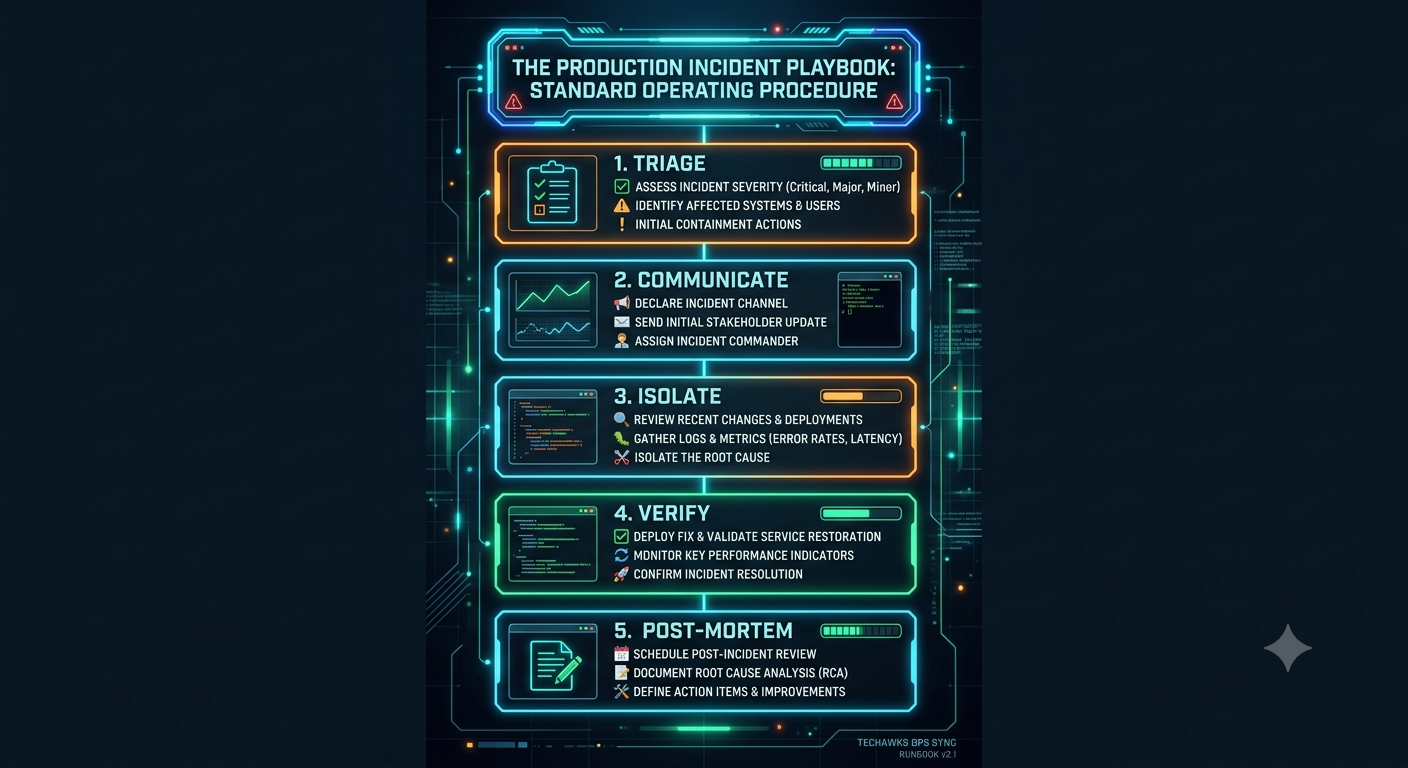
When critical services fail, high-stakes pressure often leads to hasty decisions, making outages longer and worse. Save this Production Incident Response Checklist to keep your team calm, structured, and fast when things break.
🛑 Step 1: Triage & Contain (Stop the Bleeding)
Goal: Restore basic service availability before finding the root cause.
Actions: Roll back immediately: If a deployment happened within the last 2 hours, revert it first—investigate later.
Apply circuit breakers: Degrade non-essential features (e.g., disable recommendations to save core checkout APIs).
Scale up resources: Throw temporary bandwidth or compute power at the issue if traffic spikes are causing bottlenecks.
📢 Step 2: Establish Single-Point Communication
Goal: Prevent multi-channel noise and align internal teams.
Actions: Appoint an Incident Commander (IC) who manages updates, while technical leads focus solely on debugging.
Open a dedicated incident channel or bridge (e.g., #incident-2026-08-05).
Publish an initial status update to stakeholders within 15 minutes, even if it's just: "We are actively investigating."
🔍 Step 3: Isolate the Root Cause
Goal: Locate the point of failure systematically.
Actions: Check recent changes (code deployments, feature flags, infrastructure updates, DB migrations).
Inspect core metrics: Error rates, Latency, Saturation, and Traffic (The 4 Golden Signals).
Isolate external dependencies: Is third-party API latency cascading into your system?
🛠️ Step 4: Verify and Monitor the Fix
Goal: Ensure stability before closing the incident.
Actions: Deploy the hotfix to a staging environment first if time permits, or monitor canary releases closely.
Validate that latency and error rates return to baseline.
Keep heightened monitoring active for at least 1 hour post-fix.
📝 Step 5: Blameless Post-Mortem
Goal: Turn failures into permanent system resilience.
Actions: Focus on system weaknesses, not individual mistakes ("Why did the system allow this invalid input?" vs. "Who pushed this bug?").
Define actionable tickets with assigned owners to prevent recurrence.
Key Takeaways
Mitigate first, debug second: Restoring service to users is always a higher priority than discovering the root cause.
Communication reduces stress: Assigning an Incident Commander keeps developers focused on solving the problem without constant status requests.
Failure is input for resilience: A incident is only wasted if you don't use the post-mortem to fortify your architecture.
CTA
Want to level up your system design and engineering practices with world-class peers?
Join the Techawks General Community today to access exclusive architecture guides, incident runbooks, and actionable technical discussions!
When critical services fail, high-stakes pressure often leads to hasty decisions, making outages longer and worse. Save this Production Incident Response Checklist to keep your team calm, structured, and fast when things break.
🛑 Step 1: Triage & Contain (Stop the Bleeding)
Goal: Restore basic service availability before finding the root cause.
Actions: Roll back immediately: If a deployment happened within the last 2 hours, revert it first—investigate later.
Apply circuit breakers: Degrade non-essential features (e.g., disable recommendations to save core checkout APIs).
Scale up resources: Throw temporary bandwidth or compute power at the issue if traffic spikes are causing bottlenecks.
📢 Step 2: Establish Single-Point Communication
Goal: Prevent multi-channel noise and align internal teams.
Actions: Appoint an Incident Commander (IC) who manages updates, while technical leads focus solely on debugging.
Open a dedicated incident channel or bridge (e.g., #incident-2026-08-05).
Publish an initial status update to stakeholders within 15 minutes, even if it's just: "We are actively investigating."
🔍 Step 3: Isolate the Root Cause
Goal: Locate the point of failure systematically.
Actions: Check recent changes (code deployments, feature flags, infrastructure updates, DB migrations).
Inspect core metrics: Error rates, Latency, Saturation, and Traffic (The 4 Golden Signals).
Isolate external dependencies: Is third-party API latency cascading into your system?
🛠️ Step 4: Verify and Monitor the Fix
Goal: Ensure stability before closing the incident.
Actions: Deploy the hotfix to a staging environment first if time permits, or monitor canary releases closely.
Validate that latency and error rates return to baseline.
Keep heightened monitoring active for at least 1 hour post-fix.
📝 Step 5: Blameless Post-Mortem
Goal: Turn failures into permanent system resilience.
Actions: Focus on system weaknesses, not individual mistakes ("Why did the system allow this invalid input?" vs. "Who pushed this bug?").
Define actionable tickets with assigned owners to prevent recurrence.
Key Takeaways
Mitigate first, debug second: Restoring service to users is always a higher priority than discovering the root cause.
Communication reduces stress: Assigning an Incident Commander keeps developers focused on solving the problem without constant status requests.
Failure is input for resilience: A incident is only wasted if you don't use the post-mortem to fortify your architecture.
CTA
Want to level up your system design and engineering practices with world-class peers?
Join the Techawks General Community today to access exclusive architecture guides, incident runbooks, and actionable technical discussions!
The Production Incident Checklist: 5 Steps to Systematic Incident Response
When critical services fail, high-stakes pressure often leads to hasty decisions, making outages longer and worse. Save this Production Incident Response Checklist to keep your team calm, structured, and fast when things break.
🛑 Step 1: Triage & Contain (Stop the Bleeding)
Goal: Restore basic service availability before finding the root cause.
Actions: Roll back immediately: If a deployment happened within the last 2 hours, revert it first—investigate later.
Apply circuit breakers: Degrade non-essential features (e.g., disable recommendations to save core checkout APIs).
Scale up resources: Throw temporary bandwidth or compute power at the issue if traffic spikes are causing bottlenecks.
📢 Step 2: Establish Single-Point Communication
Goal: Prevent multi-channel noise and align internal teams.
Actions: Appoint an Incident Commander (IC) who manages updates, while technical leads focus solely on debugging.
Open a dedicated incident channel or bridge (e.g., #incident-2026-08-05).
Publish an initial status update to stakeholders within 15 minutes, even if it's just: "We are actively investigating."
🔍 Step 3: Isolate the Root Cause
Goal: Locate the point of failure systematically.
Actions: Check recent changes (code deployments, feature flags, infrastructure updates, DB migrations).
Inspect core metrics: Error rates, Latency, Saturation, and Traffic (The 4 Golden Signals).
Isolate external dependencies: Is third-party API latency cascading into your system?
🛠️ Step 4: Verify and Monitor the Fix
Goal: Ensure stability before closing the incident.
Actions: Deploy the hotfix to a staging environment first if time permits, or monitor canary releases closely.
Validate that latency and error rates return to baseline.
Keep heightened monitoring active for at least 1 hour post-fix.
📝 Step 5: Blameless Post-Mortem
Goal: Turn failures into permanent system resilience.
Actions: Focus on system weaknesses, not individual mistakes ("Why did the system allow this invalid input?" vs. "Who pushed this bug?").
Define actionable tickets with assigned owners to prevent recurrence.
Key Takeaways
Mitigate first, debug second: Restoring service to users is always a higher priority than discovering the root cause.
Communication reduces stress: Assigning an Incident Commander keeps developers focused on solving the problem without constant status requests.
Failure is input for resilience: A incident is only wasted if you don't use the post-mortem to fortify your architecture.
CTA
Want to level up your system design and engineering practices with world-class peers?
Join the Techawks General Community today to access exclusive architecture guides, incident runbooks, and actionable technical discussions!

 English
 Arabic
 French
 Spanish
 Portuguese
 Deutsch
 Turkish
 Dutch
Dutch
 Italiano
 Russian
 Romaian
 Portuguese (Brazil)