


Pre-PMF Engineering: Scrappy Speed vs. Scalable Architecture
Every technical founder faces the same dilemma during the first 12 months: how much engineering rigor is enough, and how much is premature optimization?
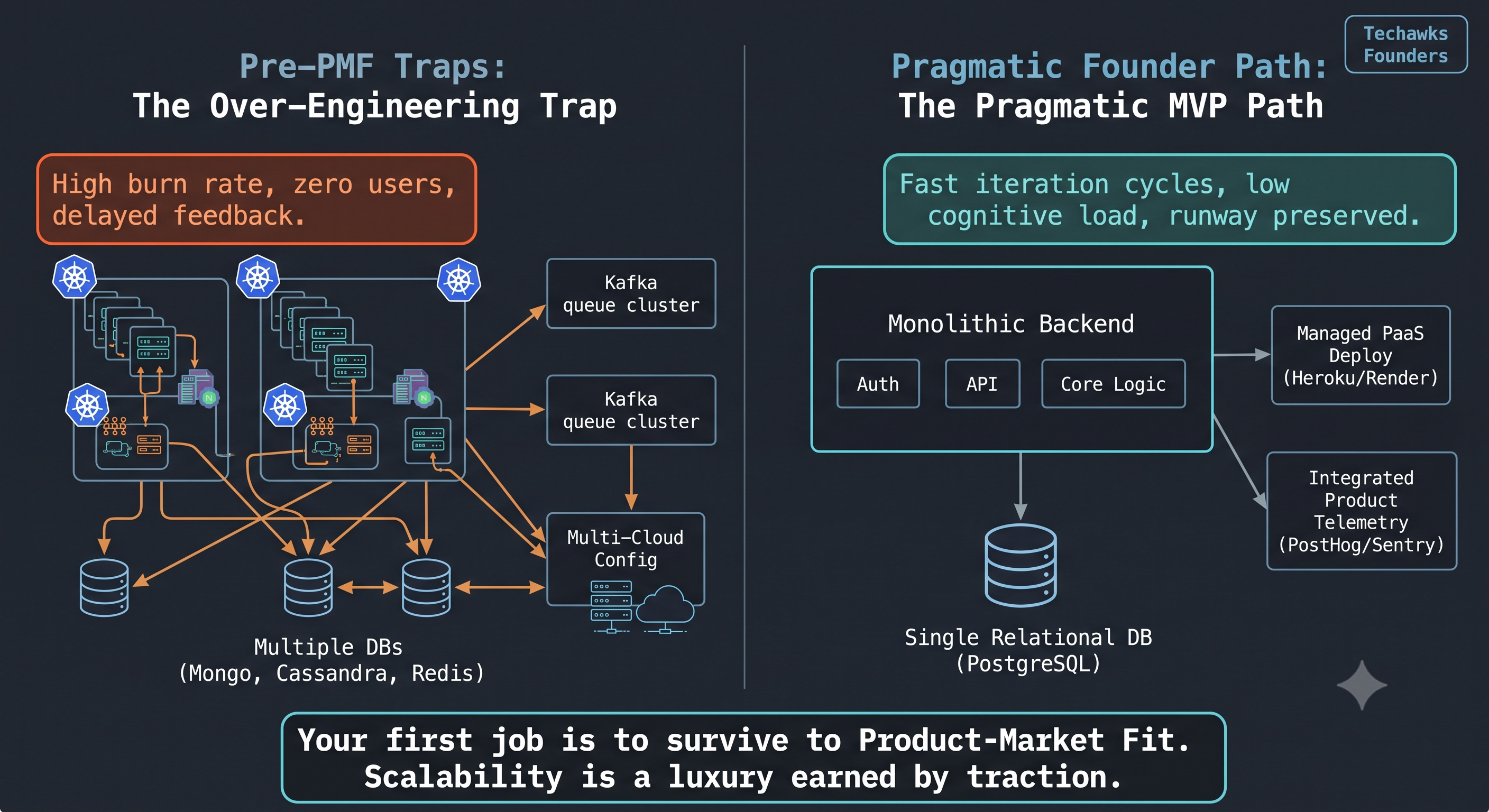
Over-engineer too early, and you burn runway on Kubernetes clusters, CI/CD orchestration, and hyper-abstracted domain services while your competitors ship directly to customers. Under-engineer completely, and the first spike of 1,000 concurrent users or enterprise security questionnaires brings your product crashing down.
Finding the sweet spot between "throwaway prototype" and "foundational core" determines whether a startup survives long enough to scale.
Poll Question:
What is your startup’s guiding technical rule before reaching Product-Market Fit?
A) Boring Tech & Monolith: Proven, boring stack (Postgres + monolithic backend + PaaS) with zero distributed overhead.
B) No-Code / Low-Code First: Validating user workflows entirely via off-the-shelf tools before writing custom backend code.
C) Modular Foundation: Strict domain boundaries and automated test suites from Day 1 to prevent costly rewrites later.
D) Hyper-Scrappy MVP: Shipping fast, messy code directly to production; commit to a complete rewrite once revenue justifies it.
Key Takeaways
Choose boring technology for your core: Use languages, databases, and frameworks your team could debug in their sleep at 2 AM. Your innovation belongs in your product's value proposition, not your infrastructure stack.
Optimize for cycle time, not concurrency: Until you have actual paying customers hitting performance limits, your primary engineering metric is how fast a feature goes from user feedback to production deployment.
Isolate domain logic even in messy code: You don't need microservices to build clean software. Keep modules separated in a single repository so extracting services later doesn't require a ground-up refactor.
Instrument telemetry from Day 1: You can defer performance optimization, but never defer visibility. Basic product analytics and error tracking (e.g., PostHog, Sentry) tell you why users bounce before your runway runs dry.
CTA
Every founder has a battle scar from building too fast or over-engineering too early.
Vote in the poll above and drop your story in the comments: What was the single biggest architectural or tech-stack decision you regretted—or celebrated—during your first year of building?
Every technical founder faces the same dilemma during the first 12 months: how much engineering rigor is enough, and how much is premature optimization?
Over-engineer too early, and you burn runway on Kubernetes clusters, CI/CD orchestration, and hyper-abstracted domain services while your competitors ship directly to customers. Under-engineer completely, and the first spike of 1,000 concurrent users or enterprise security questionnaires brings your product crashing down.
Finding the sweet spot between "throwaway prototype" and "foundational core" determines whether a startup survives long enough to scale.
Poll Question:
What is your startup’s guiding technical rule before reaching Product-Market Fit?
A) Boring Tech & Monolith: Proven, boring stack (Postgres + monolithic backend + PaaS) with zero distributed overhead.
B) No-Code / Low-Code First: Validating user workflows entirely via off-the-shelf tools before writing custom backend code.
C) Modular Foundation: Strict domain boundaries and automated test suites from Day 1 to prevent costly rewrites later.
D) Hyper-Scrappy MVP: Shipping fast, messy code directly to production; commit to a complete rewrite once revenue justifies it.
Key Takeaways
Choose boring technology for your core: Use languages, databases, and frameworks your team could debug in their sleep at 2 AM. Your innovation belongs in your product's value proposition, not your infrastructure stack.
Optimize for cycle time, not concurrency: Until you have actual paying customers hitting performance limits, your primary engineering metric is how fast a feature goes from user feedback to production deployment.
Isolate domain logic even in messy code: You don't need microservices to build clean software. Keep modules separated in a single repository so extracting services later doesn't require a ground-up refactor.
Instrument telemetry from Day 1: You can defer performance optimization, but never defer visibility. Basic product analytics and error tracking (e.g., PostHog, Sentry) tell you why users bounce before your runway runs dry.
CTA
Every founder has a battle scar from building too fast or over-engineering too early.
Vote in the poll above and drop your story in the comments: What was the single biggest architectural or tech-stack decision you regretted—or celebrated—during your first year of building?
Pre-PMF Engineering: Scrappy Speed vs. Scalable Architecture
Every technical founder faces the same dilemma during the first 12 months: how much engineering rigor is enough, and how much is premature optimization?
Over-engineer too early, and you burn runway on Kubernetes clusters, CI/CD orchestration, and hyper-abstracted domain services while your competitors ship directly to customers. Under-engineer completely, and the first spike of 1,000 concurrent users or enterprise security questionnaires brings your product crashing down.
Finding the sweet spot between "throwaway prototype" and "foundational core" determines whether a startup survives long enough to scale.
Poll Question:
What is your startup’s guiding technical rule before reaching Product-Market Fit?
A) Boring Tech & Monolith: Proven, boring stack (Postgres + monolithic backend + PaaS) with zero distributed overhead.
B) No-Code / Low-Code First: Validating user workflows entirely via off-the-shelf tools before writing custom backend code.
C) Modular Foundation: Strict domain boundaries and automated test suites from Day 1 to prevent costly rewrites later.
D) Hyper-Scrappy MVP: Shipping fast, messy code directly to production; commit to a complete rewrite once revenue justifies it.
Key Takeaways
Choose boring technology for your core: Use languages, databases, and frameworks your team could debug in their sleep at 2 AM. Your innovation belongs in your product's value proposition, not your infrastructure stack.
Optimize for cycle time, not concurrency: Until you have actual paying customers hitting performance limits, your primary engineering metric is how fast a feature goes from user feedback to production deployment.
Isolate domain logic even in messy code: You don't need microservices to build clean software. Keep modules separated in a single repository so extracting services later doesn't require a ground-up refactor.
Instrument telemetry from Day 1: You can defer performance optimization, but never defer visibility. Basic product analytics and error tracking (e.g., PostHog, Sentry) tell you why users bounce before your runway runs dry.
CTA
Every founder has a battle scar from building too fast or over-engineering too early.
Vote in the poll above and drop your story in the comments: What was the single biggest architectural or tech-stack decision you regretted—or celebrated—during your first year of building?

 English
 French
 Spanish
 Portuguese
 Deutsch
 Turkish
 Dutch
Dutch
 Italiano
 Russian
 Romaian
 Portuguese (Brazil)
 Greek
Greek