


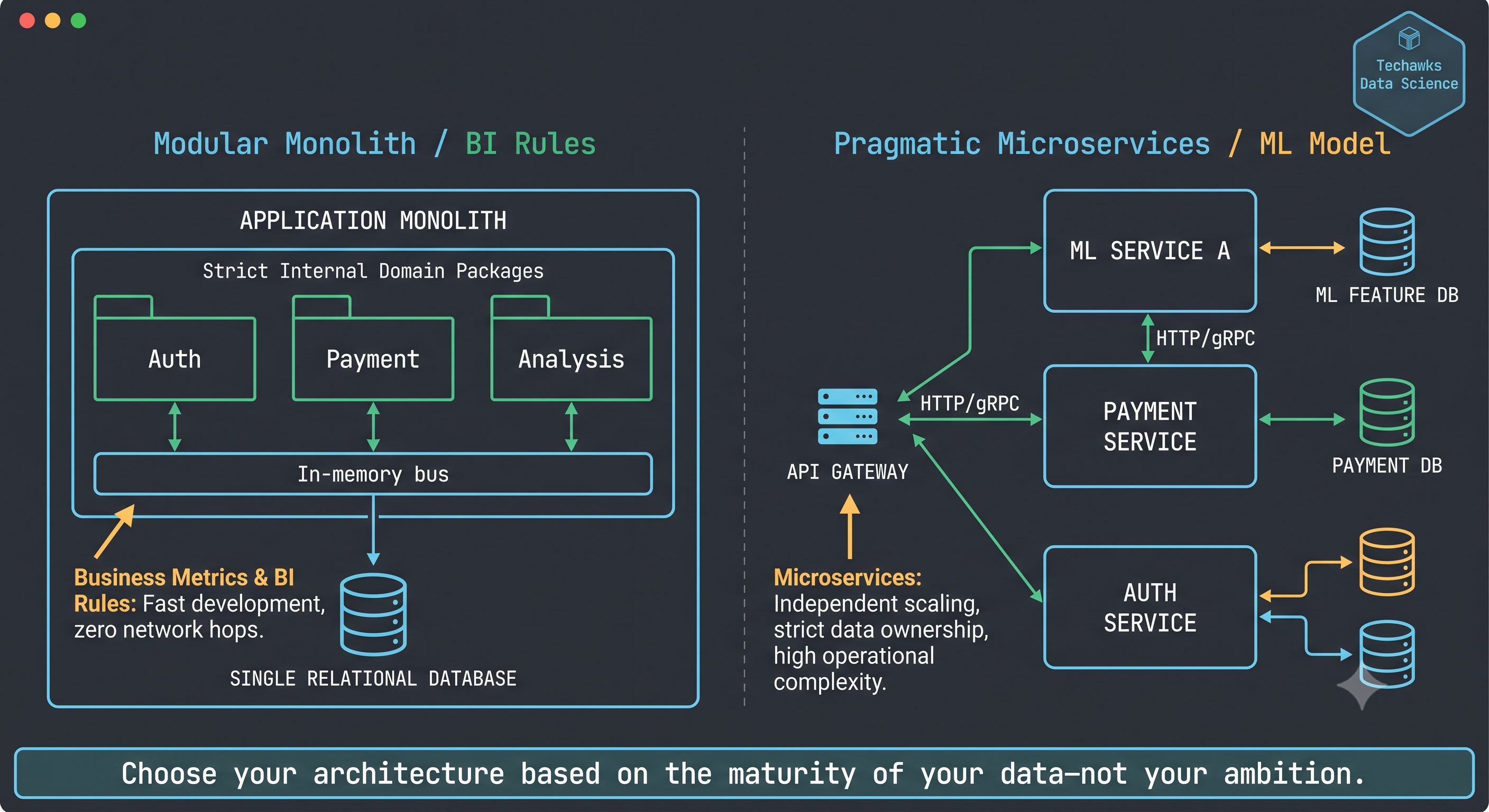
The production bottleneck: Validated business metrics vs. complex model inference.
Across engineering hubs from Mumbai to Silicon Valley, the standard for practical data science has evolved. The most sophisticated model is no longer the default answer to every problem. The real challenge in enterprise ML is determining where a machine learning model actually provides a justified return on inference cost and operational complexity.
Sophisticated, heavy models (think multi-layer deep networks or large ensembles) are fantastic for raw predictive power, but introduce significant operational overhead: higher hardware costs, distributed tracing challenges, eventual-consistency bugs, and increased latency. On the other hand, traditional business intelligence (BI) rules and validated data transformation metrics derived straight from the application database often achieve 90% of the desired result at 1% of the compute cost and complexity.
Poll Question:
What architecture pattern powers your team's primary production predictive system today?
A) Pure Modular Monolith (Single deployable): Strict domain boundaries in an existing application backend (e.g., Python/Go). High local development speed, minimal infrastructure overhead.
B) BI / Domain-Driven Metrics: Business rules, KPIs, and data definitions validated by analysts and encoded directly in application code (SQL, stored procedures, or ETL code), rather than ML inference.
C) Pragmatic Microservices: ML model running as an independent microservice, broken down strictly by independent team ownership and clear API contracts.
D) Serverless / Event-Driven: Predictive functions (e.g., AWS Lambda, GCP Functions) triggered by system events for asynchronous or low-throughput inference.
Key Takeaways
Premature model deployment is technical debt: Complex models require dedicated platform engineers for monitoring, distributed tracing, and specialized hardware (GPUs/TPUs). Ensure the prediction benefit justifies the operational cost.
Validate business metrics first: Before splitting service-oriented architecture, invest in defining clean, idempotent business rules derived from the source of truth (the application database). A single robust SQL definition for active_user or high_risk_transaction often solves the problem without ML.
Divide by team boundaries, not data entities: The core principle of microservices is organizational scaling (Conway’s Law). Microservices are a scaling pattern for teams, not necessarily for code. If two components are constantly modified by the same developers and share a data schema, they belong in a modular monolith, not separate services.
Avoid the "Distributed Monolith" trap: If Service A fails when Service B is deploying, or if your ML microservice directly reads the production application’s PostgreSQL schema, you have the operational overhead of microservices without the benefit of autonomy.
CTA
Build cleaner data systems with us.
Cast your vote above. Then, share your analysis in the comments: At what threshold of complexity or traffic did your organization decide to migrate from deterministic business logic/modular monolithic code into standalone, data-intensive microservices for machine learning?
Across engineering hubs from Mumbai to Silicon Valley, the standard for practical data science has evolved. The most sophisticated model is no longer the default answer to every problem. The real challenge in enterprise ML is determining where a machine learning model actually provides a justified return on inference cost and operational complexity.
Sophisticated, heavy models (think multi-layer deep networks or large ensembles) are fantastic for raw predictive power, but introduce significant operational overhead: higher hardware costs, distributed tracing challenges, eventual-consistency bugs, and increased latency. On the other hand, traditional business intelligence (BI) rules and validated data transformation metrics derived straight from the application database often achieve 90% of the desired result at 1% of the compute cost and complexity.
Poll Question:
What architecture pattern powers your team's primary production predictive system today?
A) Pure Modular Monolith (Single deployable): Strict domain boundaries in an existing application backend (e.g., Python/Go). High local development speed, minimal infrastructure overhead.
B) BI / Domain-Driven Metrics: Business rules, KPIs, and data definitions validated by analysts and encoded directly in application code (SQL, stored procedures, or ETL code), rather than ML inference.
C) Pragmatic Microservices: ML model running as an independent microservice, broken down strictly by independent team ownership and clear API contracts.
D) Serverless / Event-Driven: Predictive functions (e.g., AWS Lambda, GCP Functions) triggered by system events for asynchronous or low-throughput inference.
Key Takeaways
Premature model deployment is technical debt: Complex models require dedicated platform engineers for monitoring, distributed tracing, and specialized hardware (GPUs/TPUs). Ensure the prediction benefit justifies the operational cost.
Validate business metrics first: Before splitting service-oriented architecture, invest in defining clean, idempotent business rules derived from the source of truth (the application database). A single robust SQL definition for active_user or high_risk_transaction often solves the problem without ML.
Divide by team boundaries, not data entities: The core principle of microservices is organizational scaling (Conway’s Law). Microservices are a scaling pattern for teams, not necessarily for code. If two components are constantly modified by the same developers and share a data schema, they belong in a modular monolith, not separate services.
Avoid the "Distributed Monolith" trap: If Service A fails when Service B is deploying, or if your ML microservice directly reads the production application’s PostgreSQL schema, you have the operational overhead of microservices without the benefit of autonomy.
CTA
Build cleaner data systems with us.
Cast your vote above. Then, share your analysis in the comments: At what threshold of complexity or traffic did your organization decide to migrate from deterministic business logic/modular monolithic code into standalone, data-intensive microservices for machine learning?
The production bottleneck: Validated business metrics vs. complex model inference.
Across engineering hubs from Mumbai to Silicon Valley, the standard for practical data science has evolved. The most sophisticated model is no longer the default answer to every problem. The real challenge in enterprise ML is determining where a machine learning model actually provides a justified return on inference cost and operational complexity.
Sophisticated, heavy models (think multi-layer deep networks or large ensembles) are fantastic for raw predictive power, but introduce significant operational overhead: higher hardware costs, distributed tracing challenges, eventual-consistency bugs, and increased latency. On the other hand, traditional business intelligence (BI) rules and validated data transformation metrics derived straight from the application database often achieve 90% of the desired result at 1% of the compute cost and complexity.
Poll Question:
What architecture pattern powers your team's primary production predictive system today?
A) Pure Modular Monolith (Single deployable): Strict domain boundaries in an existing application backend (e.g., Python/Go). High local development speed, minimal infrastructure overhead.
B) BI / Domain-Driven Metrics: Business rules, KPIs, and data definitions validated by analysts and encoded directly in application code (SQL, stored procedures, or ETL code), rather than ML inference.
C) Pragmatic Microservices: ML model running as an independent microservice, broken down strictly by independent team ownership and clear API contracts.
D) Serverless / Event-Driven: Predictive functions (e.g., AWS Lambda, GCP Functions) triggered by system events for asynchronous or low-throughput inference.
Key Takeaways
Premature model deployment is technical debt: Complex models require dedicated platform engineers for monitoring, distributed tracing, and specialized hardware (GPUs/TPUs). Ensure the prediction benefit justifies the operational cost.
Validate business metrics first: Before splitting service-oriented architecture, invest in defining clean, idempotent business rules derived from the source of truth (the application database). A single robust SQL definition for active_user or high_risk_transaction often solves the problem without ML.
Divide by team boundaries, not data entities: The core principle of microservices is organizational scaling (Conway’s Law). Microservices are a scaling pattern for teams, not necessarily for code. If two components are constantly modified by the same developers and share a data schema, they belong in a modular monolith, not separate services.
Avoid the "Distributed Monolith" trap: If Service A fails when Service B is deploying, or if your ML microservice directly reads the production application’s PostgreSQL schema, you have the operational overhead of microservices without the benefit of autonomy.
CTA
Build cleaner data systems with us.
Cast your vote above. Then, share your analysis in the comments: At what threshold of complexity or traffic did your organization decide to migrate from deterministic business logic/modular monolithic code into standalone, data-intensive microservices for machine learning?

 English
 Arabic
 French
 Spanish
 Portuguese
 Turkish
 Dutch
Dutch
 Italiano
 Russian
 Romaian
 Portuguese (Brazil)
 Greek
Greek