


Mastering Kubernetes Day-2 Operations: The 4-Step Checklist for Reliable Cloud Infrastructure
Industry data shows that a vast majority of organizations still rely on manual Kubernetes tuning or guesswork when balancing performance and cost. When workloads scale and container runtimes interact with complex microservices, manual firefighting is no substitute for systematic architecture.
Use this practical 4-step checklist to master Day-2 cloud operations and optimize your Kubernetes infrastructure:
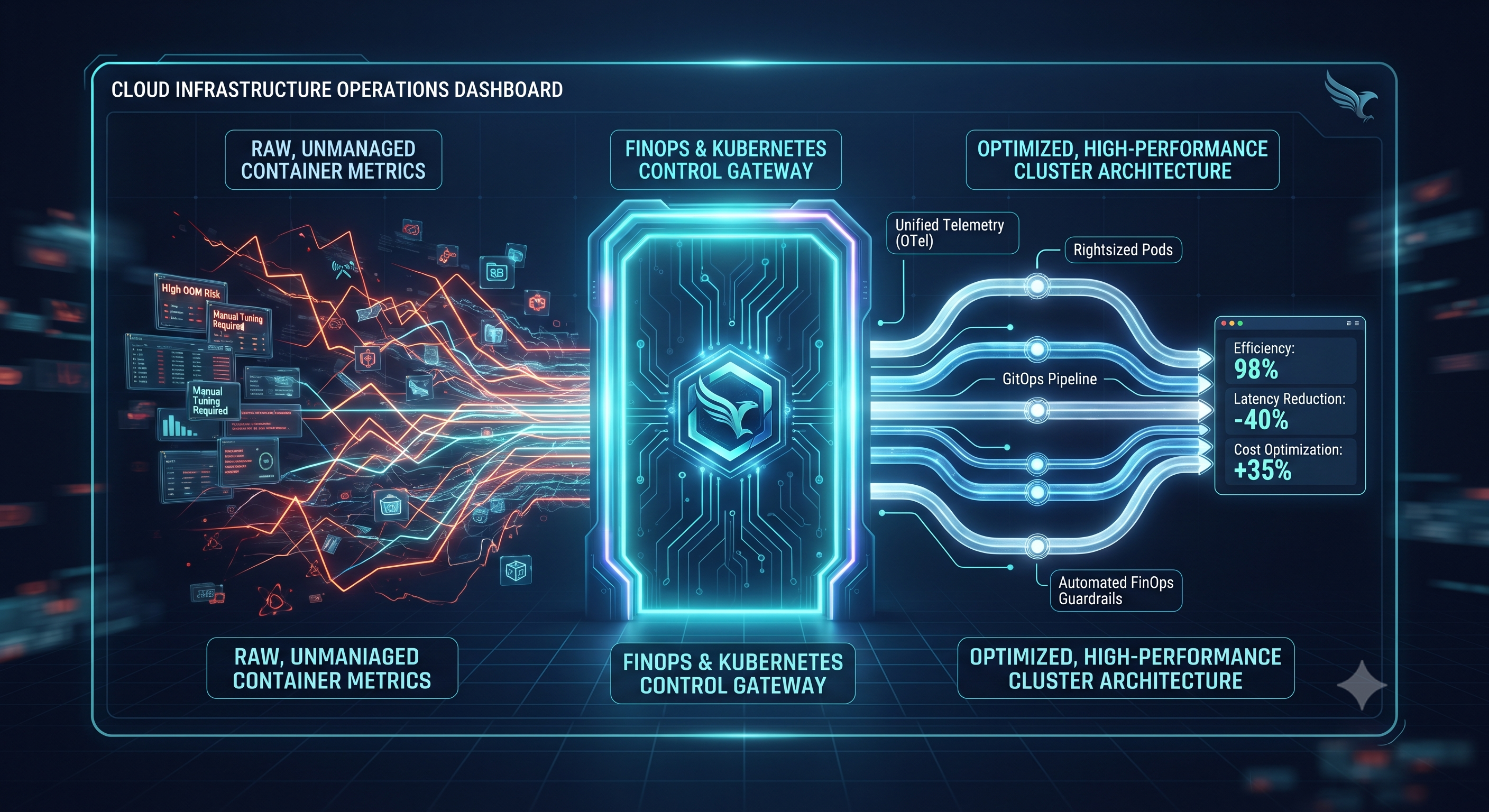
1. Enforce Unified Telemetry & OpenTelemetry (OTel): Collect unified, context-rich metrics across your entire application runtime and cloud nodes to track bottlenecks before they impact users.
2. Rightsize Container Limits and Runtimes: Avoid the bottom-up trap of only tweaking cluster nodes. Align pod resource limits with your actual application runtime needs (such as JVM memory allocation) to prevent Out-Of-Memory (OOM) crashes and resource waste.
3. Codify Infrastructure & GitOps Automation: Manage cluster configurations and deployments declaratively using version-controlled GitOps pipelines (like Argo CD or Flux) to eliminate "click-ops" drift.
4. Establish Automated FinOps Guardrails: Continuously monitor resource efficiency and cluster autoscaling policies to balance performance with predictable cloud unit economics.
Discussion Question
What has been your team’s biggest challenge when managing Day-2 operations and controlling cloud spend in large Kubernetes clusters? Let’s discuss below!
CTA (Join Cloud, DevOps & Open Source)
Ready to build resilient cloud architectures, master modern Kubernetes workflows, and connect with global infrastructure engineers? Join the Cloud, DevOps & Open Source community today to elevate your engineering capabilities.
Industry data shows that a vast majority of organizations still rely on manual Kubernetes tuning or guesswork when balancing performance and cost. When workloads scale and container runtimes interact with complex microservices, manual firefighting is no substitute for systematic architecture.
Use this practical 4-step checklist to master Day-2 cloud operations and optimize your Kubernetes infrastructure:
1. Enforce Unified Telemetry & OpenTelemetry (OTel): Collect unified, context-rich metrics across your entire application runtime and cloud nodes to track bottlenecks before they impact users.
2. Rightsize Container Limits and Runtimes: Avoid the bottom-up trap of only tweaking cluster nodes. Align pod resource limits with your actual application runtime needs (such as JVM memory allocation) to prevent Out-Of-Memory (OOM) crashes and resource waste.
3. Codify Infrastructure & GitOps Automation: Manage cluster configurations and deployments declaratively using version-controlled GitOps pipelines (like Argo CD or Flux) to eliminate "click-ops" drift.
4. Establish Automated FinOps Guardrails: Continuously monitor resource efficiency and cluster autoscaling policies to balance performance with predictable cloud unit economics.
Discussion Question
What has been your team’s biggest challenge when managing Day-2 operations and controlling cloud spend in large Kubernetes clusters? Let’s discuss below!
CTA (Join Cloud, DevOps & Open Source)
Ready to build resilient cloud architectures, master modern Kubernetes workflows, and connect with global infrastructure engineers? Join the Cloud, DevOps & Open Source community today to elevate your engineering capabilities.
Mastering Kubernetes Day-2 Operations: The 4-Step Checklist for Reliable Cloud Infrastructure
Industry data shows that a vast majority of organizations still rely on manual Kubernetes tuning or guesswork when balancing performance and cost. When workloads scale and container runtimes interact with complex microservices, manual firefighting is no substitute for systematic architecture.
Use this practical 4-step checklist to master Day-2 cloud operations and optimize your Kubernetes infrastructure:
1. Enforce Unified Telemetry & OpenTelemetry (OTel): Collect unified, context-rich metrics across your entire application runtime and cloud nodes to track bottlenecks before they impact users.
2. Rightsize Container Limits and Runtimes: Avoid the bottom-up trap of only tweaking cluster nodes. Align pod resource limits with your actual application runtime needs (such as JVM memory allocation) to prevent Out-Of-Memory (OOM) crashes and resource waste.
3. Codify Infrastructure & GitOps Automation: Manage cluster configurations and deployments declaratively using version-controlled GitOps pipelines (like Argo CD or Flux) to eliminate "click-ops" drift.
4. Establish Automated FinOps Guardrails: Continuously monitor resource efficiency and cluster autoscaling policies to balance performance with predictable cloud unit economics.
Discussion Question
What has been your team’s biggest challenge when managing Day-2 operations and controlling cloud spend in large Kubernetes clusters? Let’s discuss below!
CTA (Join Cloud, DevOps & Open Source)
Ready to build resilient cloud architectures, master modern Kubernetes workflows, and connect with global infrastructure engineers? Join the Cloud, DevOps & Open Source community today to elevate your engineering capabilities.

 Arabic
 French
 Spanish
 Portuguese
 Deutsch
 Turkish
 Dutch
Dutch
 Italiano
 Russian
 Romaian
 Portuguese (Brazil)
 Greek
Greek