


Stop Over-Provisioning Infrastructure: The 3-Step Cost & Reliability Optimization Framework for Cloud Engineers
We have all been there: spinning up larger instance types "just to be safe," leaving staging environments running 24/7, and assuming that cloud scalability means resource management doesn't matter. While speed and uptime are essential, treating cloud budgets as an afterthought leads to bloated infrastructure and wasted capital.
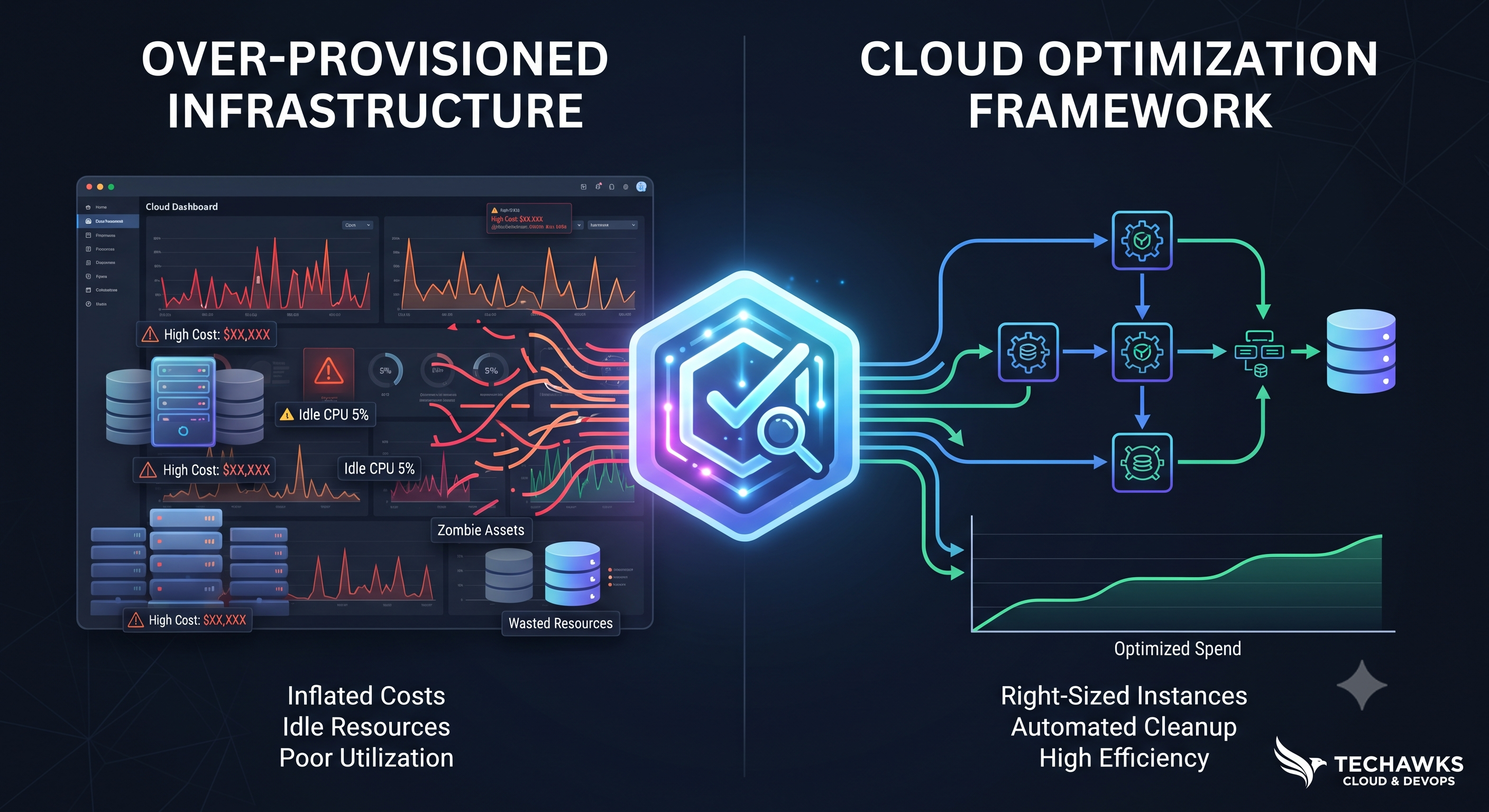
To transform naive cloud deployments into lean, highly reliable operations, put every architecture through this rigorous 3-step challenge framework:
Step 1: The Right-Sizing & Utilization Audit
Cloud providers love when you buy more capacity than you need. Before accepting default instance sizes, analyze your actual CPU and memory utilization metrics over a 30-day window. Ask yourself: Are these workloads ever exceeding 30% utilization outside of peak traffic? Downsize oversized instances and leverage burstable performance tiers where appropriate.
Step 2: The Idle Resource & Zombie Asset Cleanup
Orphaned EBS volumes, unattached elastic IPs, lingering snapshot backups, and non-production environments running over the weekend accumulate silent debt. Implement automated tagging policies and schedule automated shutdown scripts for non-production clusters to ensure resources are only active when humans or pipelines are actively using them.
Step 3: The Data Transfer & Egress Optimization Pass
Moving data across availability zones or out to the public internet without caching or proper VPC peering can quietly become your highest cloud expense. Strip out inefficient cross-region traffic patterns, configure proper CDN caching layers, and audit your NAT gateway data volumes to keep egress costs under control.
The Challenge for Today:
Open your cloud provider's cost management console, look at your top three spending services today, and identify at least one idle asset or oversized instance that can be right-sized or terminated immediately.
Key Takeaways
Right-Size Workloads: Never guess capacity; base instance sizing on real historical utilization metrics rather than safe defaults.
Kill Zombie Assets: Automate the cleanup of unattached volumes, snapshots, and non-production workloads running outside business hours.
Control Egress Costs: Audit data transfer patterns, leverage CDNs, and optimize VPC routing to eliminate hidden network bills.
CTA (Join Cloud, DevOps & Open Source)
Want to elevate your cloud architecture and DevOps practices alongside thousands of global engineers? Join the Cloud, DevOps & Open Source community today to share optimization patterns, tackle weekly infrastructure challenges, and build scalable systems together.
We have all been there: spinning up larger instance types "just to be safe," leaving staging environments running 24/7, and assuming that cloud scalability means resource management doesn't matter. While speed and uptime are essential, treating cloud budgets as an afterthought leads to bloated infrastructure and wasted capital.
To transform naive cloud deployments into lean, highly reliable operations, put every architecture through this rigorous 3-step challenge framework:
Step 1: The Right-Sizing & Utilization Audit
Cloud providers love when you buy more capacity than you need. Before accepting default instance sizes, analyze your actual CPU and memory utilization metrics over a 30-day window. Ask yourself: Are these workloads ever exceeding 30% utilization outside of peak traffic? Downsize oversized instances and leverage burstable performance tiers where appropriate.
Step 2: The Idle Resource & Zombie Asset Cleanup
Orphaned EBS volumes, unattached elastic IPs, lingering snapshot backups, and non-production environments running over the weekend accumulate silent debt. Implement automated tagging policies and schedule automated shutdown scripts for non-production clusters to ensure resources are only active when humans or pipelines are actively using them.
Step 3: The Data Transfer & Egress Optimization Pass
Moving data across availability zones or out to the public internet without caching or proper VPC peering can quietly become your highest cloud expense. Strip out inefficient cross-region traffic patterns, configure proper CDN caching layers, and audit your NAT gateway data volumes to keep egress costs under control.
The Challenge for Today:
Open your cloud provider's cost management console, look at your top three spending services today, and identify at least one idle asset or oversized instance that can be right-sized or terminated immediately.
Key Takeaways
Right-Size Workloads: Never guess capacity; base instance sizing on real historical utilization metrics rather than safe defaults.
Kill Zombie Assets: Automate the cleanup of unattached volumes, snapshots, and non-production workloads running outside business hours.
Control Egress Costs: Audit data transfer patterns, leverage CDNs, and optimize VPC routing to eliminate hidden network bills.
CTA (Join Cloud, DevOps & Open Source)
Want to elevate your cloud architecture and DevOps practices alongside thousands of global engineers? Join the Cloud, DevOps & Open Source community today to share optimization patterns, tackle weekly infrastructure challenges, and build scalable systems together.
Stop Over-Provisioning Infrastructure: The 3-Step Cost & Reliability Optimization Framework for Cloud Engineers
We have all been there: spinning up larger instance types "just to be safe," leaving staging environments running 24/7, and assuming that cloud scalability means resource management doesn't matter. While speed and uptime are essential, treating cloud budgets as an afterthought leads to bloated infrastructure and wasted capital.
To transform naive cloud deployments into lean, highly reliable operations, put every architecture through this rigorous 3-step challenge framework:
Step 1: The Right-Sizing & Utilization Audit
Cloud providers love when you buy more capacity than you need. Before accepting default instance sizes, analyze your actual CPU and memory utilization metrics over a 30-day window. Ask yourself: Are these workloads ever exceeding 30% utilization outside of peak traffic? Downsize oversized instances and leverage burstable performance tiers where appropriate.
Step 2: The Idle Resource & Zombie Asset Cleanup
Orphaned EBS volumes, unattached elastic IPs, lingering snapshot backups, and non-production environments running over the weekend accumulate silent debt. Implement automated tagging policies and schedule automated shutdown scripts for non-production clusters to ensure resources are only active when humans or pipelines are actively using them.
Step 3: The Data Transfer & Egress Optimization Pass
Moving data across availability zones or out to the public internet without caching or proper VPC peering can quietly become your highest cloud expense. Strip out inefficient cross-region traffic patterns, configure proper CDN caching layers, and audit your NAT gateway data volumes to keep egress costs under control.
The Challenge for Today:
Open your cloud provider's cost management console, look at your top three spending services today, and identify at least one idle asset or oversized instance that can be right-sized or terminated immediately.
Key Takeaways
Right-Size Workloads: Never guess capacity; base instance sizing on real historical utilization metrics rather than safe defaults.
Kill Zombie Assets: Automate the cleanup of unattached volumes, snapshots, and non-production workloads running outside business hours.
Control Egress Costs: Audit data transfer patterns, leverage CDNs, and optimize VPC routing to eliminate hidden network bills.
CTA (Join Cloud, DevOps & Open Source)
Want to elevate your cloud architecture and DevOps practices alongside thousands of global engineers? Join the Cloud, DevOps & Open Source community today to share optimization patterns, tackle weekly infrastructure challenges, and build scalable systems together.

 English
 Arabic
 French
 Spanish
 Deutsch
 Turkish
 Dutch
Dutch
 Italiano
 Russian
 Romaian
 Portuguese (Brazil)
 Greek
Greek