


Beyond Basic Coding: Why Learning Abstract Data Structures Unlocks Faster Problem Solving
When you're first learning to code, it’s easy to treat arrays and loops as the answer to every problem. But as your codebases grow and datasets expand, choosing the wrong data structure can turn an O(n) operation into a massive performance bottleneck.
Enter the Power of Abstract Data Types (ADTs):
Understanding how structures like Hash Maps, Graphs, and Heaps are structured in memory changes how you approach software engineering:
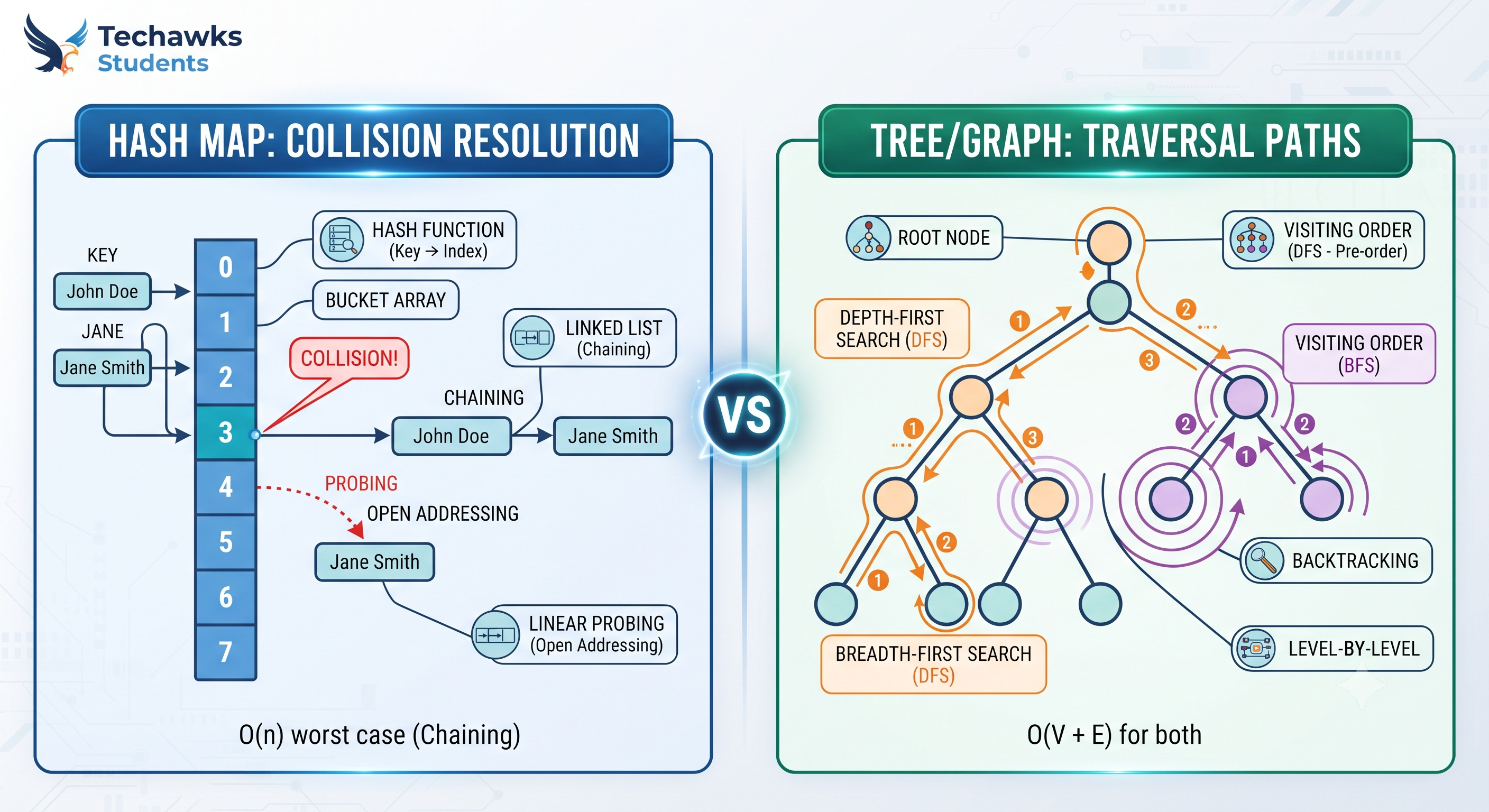
Master Hash Function Mechanics: Learn how keys map to memory addresses and how collision resolution (like chaining or open addressing) impacts lookup speeds.
Visualize Graph Traversals: Understand when to use Breadth-First Search (BFS) versus Depth-First Search (DFS) for pathfinding, dependency resolution, and network mapping.
Leverage Priority Queues: Use heaps when you need constant access to the largest or smallest elements without sorting an entire array every time new data arrives.
By shifting your focus from syntax memorization to structural efficiency, you build a mental framework that makes learning new languages and passing technical evaluations much easier.
Discussion Question: What data structure do you find the most challenging to implement from scratch? Let’s break it down together in the comments! 👇
CTA (Join Students in Tech): Ready to accelerate your computer science journey and build a rock-solid foundation? Join our community of students and learners at Techawks to master the concepts that matter.
When you're first learning to code, it’s easy to treat arrays and loops as the answer to every problem. But as your codebases grow and datasets expand, choosing the wrong data structure can turn an O(n) operation into a massive performance bottleneck.
Enter the Power of Abstract Data Types (ADTs):
Understanding how structures like Hash Maps, Graphs, and Heaps are structured in memory changes how you approach software engineering:
Master Hash Function Mechanics: Learn how keys map to memory addresses and how collision resolution (like chaining or open addressing) impacts lookup speeds.
Visualize Graph Traversals: Understand when to use Breadth-First Search (BFS) versus Depth-First Search (DFS) for pathfinding, dependency resolution, and network mapping.
Leverage Priority Queues: Use heaps when you need constant access to the largest or smallest elements without sorting an entire array every time new data arrives.
By shifting your focus from syntax memorization to structural efficiency, you build a mental framework that makes learning new languages and passing technical evaluations much easier.
Discussion Question: What data structure do you find the most challenging to implement from scratch? Let’s break it down together in the comments! 👇
CTA (Join Students in Tech): Ready to accelerate your computer science journey and build a rock-solid foundation? Join our community of students and learners at Techawks to master the concepts that matter.
Beyond Basic Coding: Why Learning Abstract Data Structures Unlocks Faster Problem Solving
When you're first learning to code, it’s easy to treat arrays and loops as the answer to every problem. But as your codebases grow and datasets expand, choosing the wrong data structure can turn an O(n) operation into a massive performance bottleneck.
Enter the Power of Abstract Data Types (ADTs):
Understanding how structures like Hash Maps, Graphs, and Heaps are structured in memory changes how you approach software engineering:
Master Hash Function Mechanics: Learn how keys map to memory addresses and how collision resolution (like chaining or open addressing) impacts lookup speeds.
Visualize Graph Traversals: Understand when to use Breadth-First Search (BFS) versus Depth-First Search (DFS) for pathfinding, dependency resolution, and network mapping.
Leverage Priority Queues: Use heaps when you need constant access to the largest or smallest elements without sorting an entire array every time new data arrives.
By shifting your focus from syntax memorization to structural efficiency, you build a mental framework that makes learning new languages and passing technical evaluations much easier.
Discussion Question: What data structure do you find the most challenging to implement from scratch? Let’s break it down together in the comments! 👇
CTA (Join Students in Tech): Ready to accelerate your computer science journey and build a rock-solid foundation? Join our community of students and learners at Techawks to master the concepts that matter.

 English
 Arabic
 French
 Spanish
 Portuguese
 Deutsch
 Turkish
 Dutch
Dutch
 Italiano
 Russian
 Romaian
 Portuguese (Brazil)