


The Internal Developer Platform (IDP) Checklist: 5 Core Layers to Build Frictionless Kubernetes Golden Paths
As cloud-native engineering matures into platform engineering, the goal is no longer forcing developers to become Kubernetes and Terraform experts. Instead, it’s about treating internal infrastructure as a product and building standardized "paved roads" (golden paths) that make the secure, compliant choice the easiest choice.
Audit and mature your Internal Developer Platform with this cloud-native checklist:
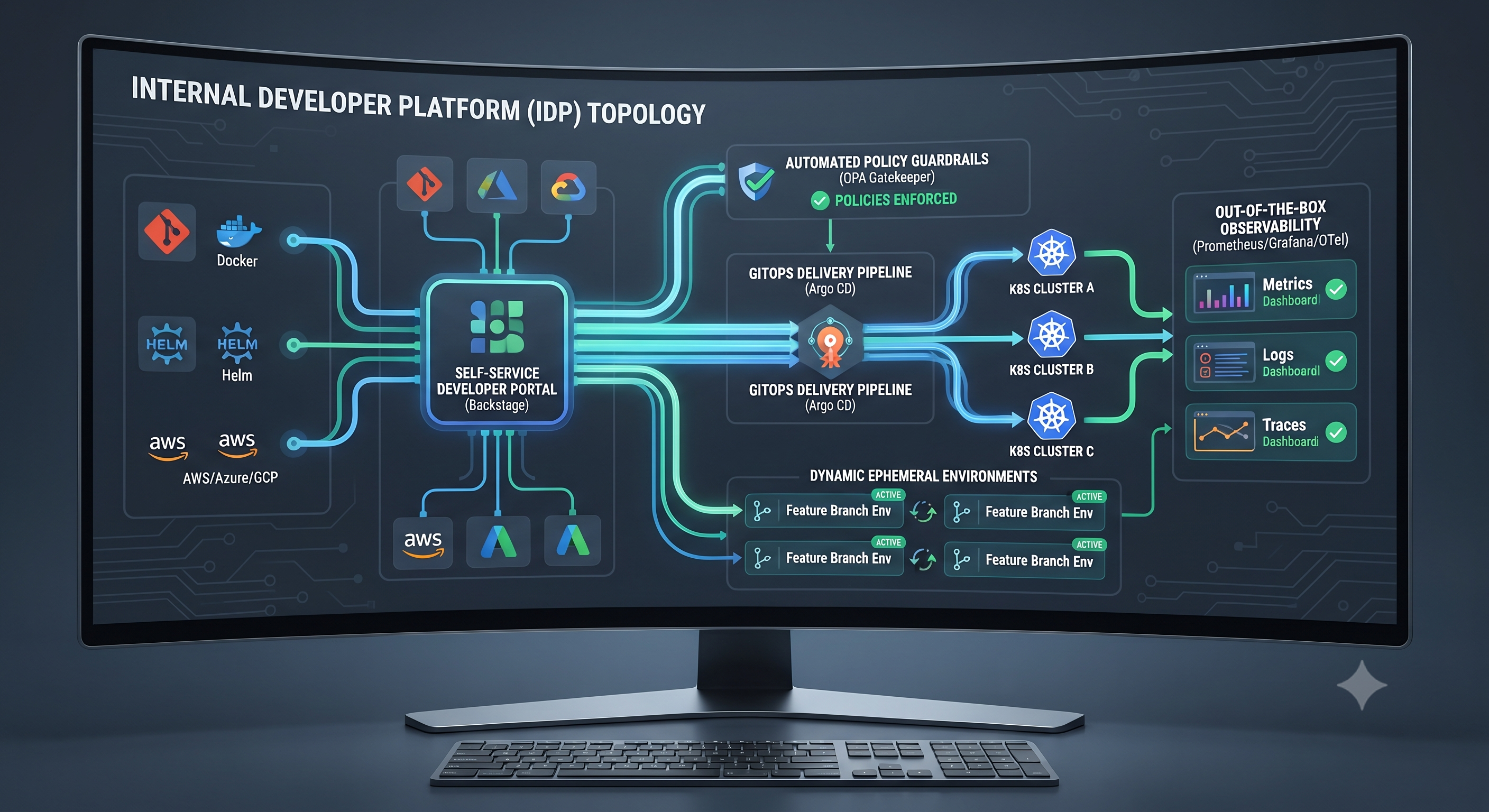
[ ] Self-Service Developer Portals: Implement an abstraction layer (such as Backstage) where developers can spin up standard workloads, databases, and environments with a single click.
[ ] Declarative GitOps Delivery: Use GitOps engines (like Argo CD) as the single source of truth, ensuring cluster states continuously reconcile directly from version-controlled repositories.
[ ] Automated Policy-as-Code Guardrails: Embed security and compliance checks (using OPA Gatekeeper or Kyverno) directly into admission controllers so misconfigurations never hit production.
[ ] Out-of-the-Box Observability Wiring: Ensure every newly provisioned service automatically injects metrics, structured logs, and OpenTelemetry traces the moment it is born.
[ ] Dynamic Ephemeral Environments: Enable automated, per-PR staging environments so feature testing happens in isolated replicas without clogging shared development clusters.
Why It Matters
A well-designed IDP absorbs cloud complexity so your engineering teams don't have to. By standardizing golden paths and embedding security by default, you accelerate time-to-market while keeping multi-cluster infrastructure stable, secure, and cost-efficient.
Discussion Question
What is the hardest part about getting development teams to adopt your internal platform templates instead of bypassing them with custom scripts? Let’s talk strategy below! 👇
CTA (Join Cloud, DevOps & Open Source)
Ready to master platform engineering and cloud-native infrastructure? Join the Cloud, DevOps & Open Source community to collaborate with engineers, share golden path patterns, and scale your systems.
As cloud-native engineering matures into platform engineering, the goal is no longer forcing developers to become Kubernetes and Terraform experts. Instead, it’s about treating internal infrastructure as a product and building standardized "paved roads" (golden paths) that make the secure, compliant choice the easiest choice.
Audit and mature your Internal Developer Platform with this cloud-native checklist:
[ ] Self-Service Developer Portals: Implement an abstraction layer (such as Backstage) where developers can spin up standard workloads, databases, and environments with a single click.
[ ] Declarative GitOps Delivery: Use GitOps engines (like Argo CD) as the single source of truth, ensuring cluster states continuously reconcile directly from version-controlled repositories.
[ ] Automated Policy-as-Code Guardrails: Embed security and compliance checks (using OPA Gatekeeper or Kyverno) directly into admission controllers so misconfigurations never hit production.
[ ] Out-of-the-Box Observability Wiring: Ensure every newly provisioned service automatically injects metrics, structured logs, and OpenTelemetry traces the moment it is born.
[ ] Dynamic Ephemeral Environments: Enable automated, per-PR staging environments so feature testing happens in isolated replicas without clogging shared development clusters.
Why It Matters
A well-designed IDP absorbs cloud complexity so your engineering teams don't have to. By standardizing golden paths and embedding security by default, you accelerate time-to-market while keeping multi-cluster infrastructure stable, secure, and cost-efficient.
Discussion Question
What is the hardest part about getting development teams to adopt your internal platform templates instead of bypassing them with custom scripts? Let’s talk strategy below! 👇
CTA (Join Cloud, DevOps & Open Source)
Ready to master platform engineering and cloud-native infrastructure? Join the Cloud, DevOps & Open Source community to collaborate with engineers, share golden path patterns, and scale your systems.
The Internal Developer Platform (IDP) Checklist: 5 Core Layers to Build Frictionless Kubernetes Golden Paths
As cloud-native engineering matures into platform engineering, the goal is no longer forcing developers to become Kubernetes and Terraform experts. Instead, it’s about treating internal infrastructure as a product and building standardized "paved roads" (golden paths) that make the secure, compliant choice the easiest choice.
Audit and mature your Internal Developer Platform with this cloud-native checklist:
[ ] Self-Service Developer Portals: Implement an abstraction layer (such as Backstage) where developers can spin up standard workloads, databases, and environments with a single click.
[ ] Declarative GitOps Delivery: Use GitOps engines (like Argo CD) as the single source of truth, ensuring cluster states continuously reconcile directly from version-controlled repositories.
[ ] Automated Policy-as-Code Guardrails: Embed security and compliance checks (using OPA Gatekeeper or Kyverno) directly into admission controllers so misconfigurations never hit production.
[ ] Out-of-the-Box Observability Wiring: Ensure every newly provisioned service automatically injects metrics, structured logs, and OpenTelemetry traces the moment it is born.
[ ] Dynamic Ephemeral Environments: Enable automated, per-PR staging environments so feature testing happens in isolated replicas without clogging shared development clusters.
Why It Matters
A well-designed IDP absorbs cloud complexity so your engineering teams don't have to. By standardizing golden paths and embedding security by default, you accelerate time-to-market while keeping multi-cluster infrastructure stable, secure, and cost-efficient.
Discussion Question
What is the hardest part about getting development teams to adopt your internal platform templates instead of bypassing them with custom scripts? Let’s talk strategy below! 👇
CTA (Join Cloud, DevOps & Open Source)
Ready to master platform engineering and cloud-native infrastructure? Join the Cloud, DevOps & Open Source community to collaborate with engineers, share golden path patterns, and scale your systems.

 English
 Arabic
 French
 Spanish
 Portuguese
 Deutsch
 Turkish
 Dutch
Dutch
 Russian
 Romaian
 Portuguese (Brazil)
 Greek
Greek