


Bootstrapping vs. Venture Capital: How Should You Finance Your MVP in 2026?
Choosing between Bootstrapping and raising Venture Capital (VC) isn't a badge of honor—it's a capital efficiency decision based on your market dynamics, product type, and growth expectations.
Before deciding which path to pursue, founders must evaluate three critical factors:
1. Market Speed and "Winner-Take-All" Dynamics
Venture Capital: Critical when operating in rapidly emerging markets with high network effects, where being first to market dictates survival and scale.
Bootstrapping: Ideal when building specialized B2B SaaS, niche marketplaces, or services where sustainable unit economics matter more than rapid land-grab market share.
2. Product Development Capital Requirements
Venture Capital: Necessary for deep tech, hardware, or complex enterprise software requiring significant R&D spending before reaching a commercial launch.
Bootstrapping: Highly effective for lean MVPs, developer tools, or micro-SaaS products that can be built quickly using modern frameworks and low-code infrastructure.
3. Exit Horizon & Strategic Autonomy
Venture Capital: Aligns your company with a strict 7–10 year exit timeline, requiring high valuation multiples to satisfy fund metrics.
Bootstrapping: Grants full operational control, allowing founders to prioritize long-term profitability, dividend payouts, or strategic acquisitions on their own timeline.
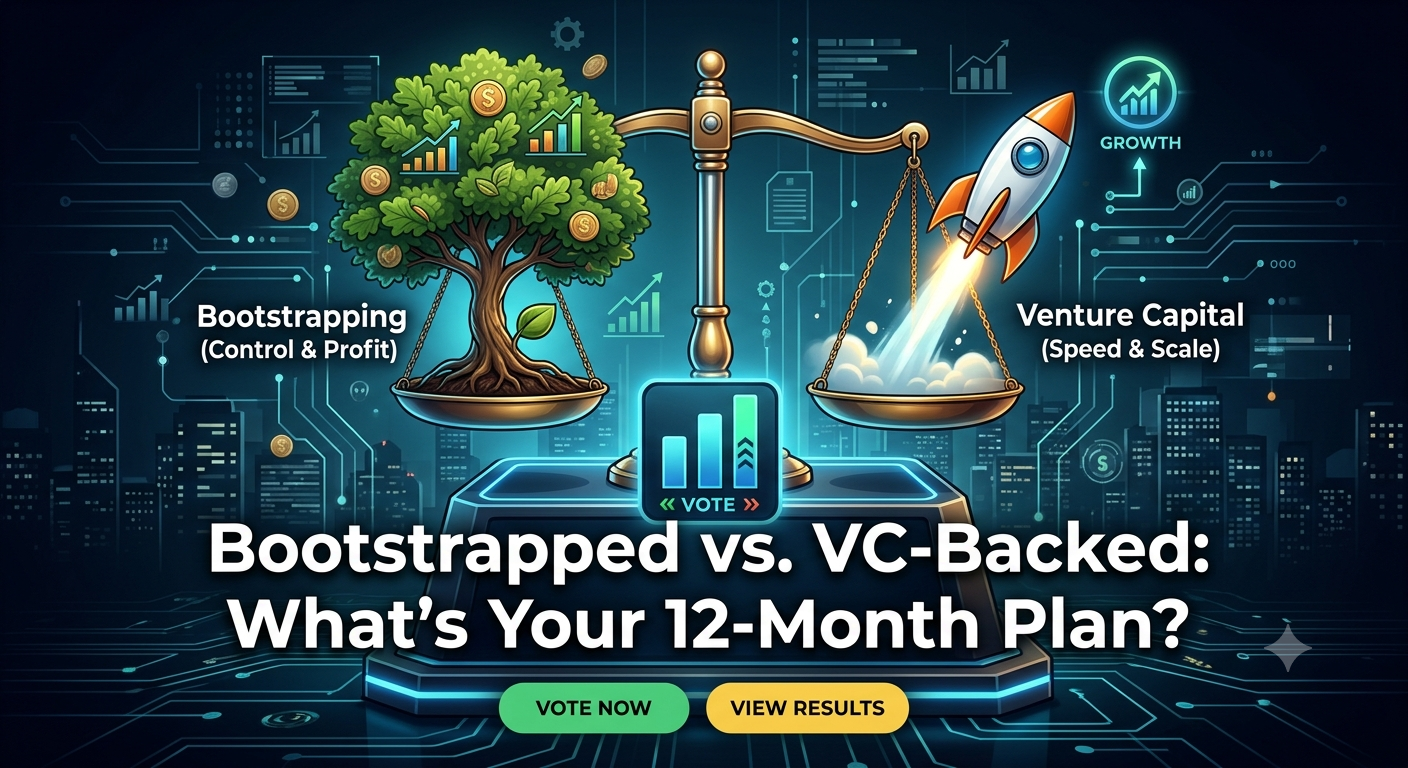
📊 Community Poll
If you were launching a new digital B2B software startup today, what would be your target funding strategy for the first 12 months?
🟢 100% Bootstrapped (Funded via revenue & personal savings to retain maximum equity)
🟡 Pre-Seed / Angel Round (Small raise to prove product-market fit quickly)
🔵 Institutional Seed VC (Substantial capital injection to aggressively scale team & distribution)
🟣 Hybrid Strategy (Bootstrap to initial MRR, then raise growth capital)
(Cast your vote in the poll above and drop your reasoning in the comments!)
Key Takeaways
Capital dictates strategy: VC money accelerates speed at the cost of dilution and strict exit expectations; bootstrapping maximizes control but limits burn rate.
Evaluate your domain: High upfront R&D or network-driven markets favor VC; lean software and high-margin B2B favor bootstrapping.
Bootstrap to leverage: Even if you plan to raise later, bootstrapping to early traction significantly increases your valuation and negotiating leverage with investors.
CTA
Building an early-stage company and navigating funding strategies, cap tables, or go-to-market execution? Join Startup Founders & Entrepreneurs on Techawks today to benchmark ideas, get peer advice, and connect with fellow founders.
Choosing between Bootstrapping and raising Venture Capital (VC) isn't a badge of honor—it's a capital efficiency decision based on your market dynamics, product type, and growth expectations.
Before deciding which path to pursue, founders must evaluate three critical factors:
1. Market Speed and "Winner-Take-All" Dynamics
Venture Capital: Critical when operating in rapidly emerging markets with high network effects, where being first to market dictates survival and scale.
Bootstrapping: Ideal when building specialized B2B SaaS, niche marketplaces, or services where sustainable unit economics matter more than rapid land-grab market share.
2. Product Development Capital Requirements
Venture Capital: Necessary for deep tech, hardware, or complex enterprise software requiring significant R&D spending before reaching a commercial launch.
Bootstrapping: Highly effective for lean MVPs, developer tools, or micro-SaaS products that can be built quickly using modern frameworks and low-code infrastructure.
3. Exit Horizon & Strategic Autonomy
Venture Capital: Aligns your company with a strict 7–10 year exit timeline, requiring high valuation multiples to satisfy fund metrics.
Bootstrapping: Grants full operational control, allowing founders to prioritize long-term profitability, dividend payouts, or strategic acquisitions on their own timeline.
📊 Community Poll
If you were launching a new digital B2B software startup today, what would be your target funding strategy for the first 12 months?
🟢 100% Bootstrapped (Funded via revenue & personal savings to retain maximum equity)
🟡 Pre-Seed / Angel Round (Small raise to prove product-market fit quickly)
🔵 Institutional Seed VC (Substantial capital injection to aggressively scale team & distribution)
🟣 Hybrid Strategy (Bootstrap to initial MRR, then raise growth capital)
(Cast your vote in the poll above and drop your reasoning in the comments!)
Key Takeaways
Capital dictates strategy: VC money accelerates speed at the cost of dilution and strict exit expectations; bootstrapping maximizes control but limits burn rate.
Evaluate your domain: High upfront R&D or network-driven markets favor VC; lean software and high-margin B2B favor bootstrapping.
Bootstrap to leverage: Even if you plan to raise later, bootstrapping to early traction significantly increases your valuation and negotiating leverage with investors.
CTA
Building an early-stage company and navigating funding strategies, cap tables, or go-to-market execution? Join Startup Founders & Entrepreneurs on Techawks today to benchmark ideas, get peer advice, and connect with fellow founders.
Bootstrapping vs. Venture Capital: How Should You Finance Your MVP in 2026?
Choosing between Bootstrapping and raising Venture Capital (VC) isn't a badge of honor—it's a capital efficiency decision based on your market dynamics, product type, and growth expectations.
Before deciding which path to pursue, founders must evaluate three critical factors:
1. Market Speed and "Winner-Take-All" Dynamics
Venture Capital: Critical when operating in rapidly emerging markets with high network effects, where being first to market dictates survival and scale.
Bootstrapping: Ideal when building specialized B2B SaaS, niche marketplaces, or services where sustainable unit economics matter more than rapid land-grab market share.
2. Product Development Capital Requirements
Venture Capital: Necessary for deep tech, hardware, or complex enterprise software requiring significant R&D spending before reaching a commercial launch.
Bootstrapping: Highly effective for lean MVPs, developer tools, or micro-SaaS products that can be built quickly using modern frameworks and low-code infrastructure.
3. Exit Horizon & Strategic Autonomy
Venture Capital: Aligns your company with a strict 7–10 year exit timeline, requiring high valuation multiples to satisfy fund metrics.
Bootstrapping: Grants full operational control, allowing founders to prioritize long-term profitability, dividend payouts, or strategic acquisitions on their own timeline.
📊 Community Poll
If you were launching a new digital B2B software startup today, what would be your target funding strategy for the first 12 months?
🟢 100% Bootstrapped (Funded via revenue & personal savings to retain maximum equity)
🟡 Pre-Seed / Angel Round (Small raise to prove product-market fit quickly)
🔵 Institutional Seed VC (Substantial capital injection to aggressively scale team & distribution)
🟣 Hybrid Strategy (Bootstrap to initial MRR, then raise growth capital)
(Cast your vote in the poll above and drop your reasoning in the comments!)
Key Takeaways
Capital dictates strategy: VC money accelerates speed at the cost of dilution and strict exit expectations; bootstrapping maximizes control but limits burn rate.
Evaluate your domain: High upfront R&D or network-driven markets favor VC; lean software and high-margin B2B favor bootstrapping.
Bootstrap to leverage: Even if you plan to raise later, bootstrapping to early traction significantly increases your valuation and negotiating leverage with investors.
CTA
Building an early-stage company and navigating funding strategies, cap tables, or go-to-market execution? Join Startup Founders & Entrepreneurs on Techawks today to benchmark ideas, get peer advice, and connect with fellow founders.

 English
 Arabic
 French
 Spanish
 Deutsch
 Turkish
 Dutch
Dutch
 Italiano
 Russian
 Romaian
 Portuguese (Brazil)
 Greek
Greek