


Beyond Syntax: Why Your Computer Science Curriculum is Missing the System Architecture Gap
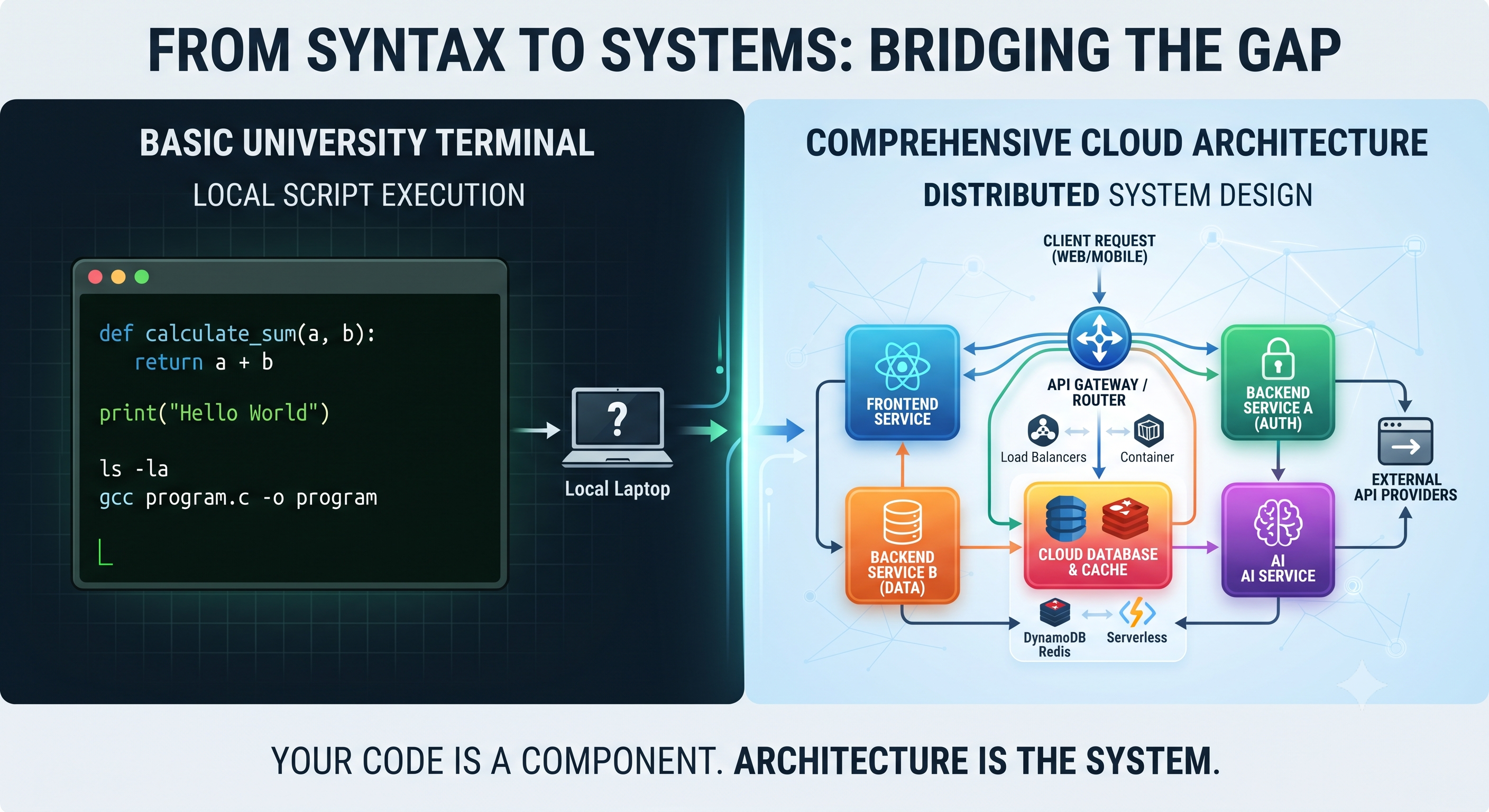
As a student stepping into the tech landscape, it is easy to fall into the trap of treating code syntax as the ultimate destination. But with AI coding assistants and automation handling routine boilerplate instantly, the real competitive edge for early-career developers is systems thinking.
Writing a working algorithm in isolation is completely different from designing an application that handles provider gateways, concurrent user loads, state management, and error resilience.
Why it matters:
Hiring managers aren't looking for human syntax compilers; they want problem solvers who understand how components interact across a distributed stack. If you don't know how data flows from a client application through a gateway proxy, or how to decouple business logic from third-party APIs, your portfolio projects will look identical to thousands of other tutorial apps.
How to bridge the gap (The Student Blueprint):
Build Beyond the Terminal: Stop building scripts that only run locally in your console. Deploy full-stack apps that include environment configuration, database management, and error fallbacks.
Master the API Gateway Concept: Learn how modern applications route traffic, handle rate limits, and abstract external dependencies instead of hardcoding API keys directly into your source files.
Document Your Architecture: Practice drawing system architecture diagrams for your student projects. Being able to explain why you chose a specific data flow or storage layer matters much more than memorizing syntax.
Discussion Question: How are you supplementing your university coursework or self-study with system design and architecture practices? What is the hardest part about moving from writing small scripts to building complete systems?
CTA (Join Students in Tech): Ready to accelerate your learning and build real-world engineering skills? Join the Students in Tech community to collaborate with peers, share project blueprints, and prepare for the future of software development.
As a student stepping into the tech landscape, it is easy to fall into the trap of treating code syntax as the ultimate destination. But with AI coding assistants and automation handling routine boilerplate instantly, the real competitive edge for early-career developers is systems thinking.
Writing a working algorithm in isolation is completely different from designing an application that handles provider gateways, concurrent user loads, state management, and error resilience.
Why it matters:
Hiring managers aren't looking for human syntax compilers; they want problem solvers who understand how components interact across a distributed stack. If you don't know how data flows from a client application through a gateway proxy, or how to decouple business logic from third-party APIs, your portfolio projects will look identical to thousands of other tutorial apps.
How to bridge the gap (The Student Blueprint):
Build Beyond the Terminal: Stop building scripts that only run locally in your console. Deploy full-stack apps that include environment configuration, database management, and error fallbacks.
Master the API Gateway Concept: Learn how modern applications route traffic, handle rate limits, and abstract external dependencies instead of hardcoding API keys directly into your source files.
Document Your Architecture: Practice drawing system architecture diagrams for your student projects. Being able to explain why you chose a specific data flow or storage layer matters much more than memorizing syntax.
Discussion Question: How are you supplementing your university coursework or self-study with system design and architecture practices? What is the hardest part about moving from writing small scripts to building complete systems?
CTA (Join Students in Tech): Ready to accelerate your learning and build real-world engineering skills? Join the Students in Tech community to collaborate with peers, share project blueprints, and prepare for the future of software development.
Beyond Syntax: Why Your Computer Science Curriculum is Missing the System Architecture Gap
As a student stepping into the tech landscape, it is easy to fall into the trap of treating code syntax as the ultimate destination. But with AI coding assistants and automation handling routine boilerplate instantly, the real competitive edge for early-career developers is systems thinking.
Writing a working algorithm in isolation is completely different from designing an application that handles provider gateways, concurrent user loads, state management, and error resilience.
Why it matters:
Hiring managers aren't looking for human syntax compilers; they want problem solvers who understand how components interact across a distributed stack. If you don't know how data flows from a client application through a gateway proxy, or how to decouple business logic from third-party APIs, your portfolio projects will look identical to thousands of other tutorial apps.
How to bridge the gap (The Student Blueprint):
Build Beyond the Terminal: Stop building scripts that only run locally in your console. Deploy full-stack apps that include environment configuration, database management, and error fallbacks.
Master the API Gateway Concept: Learn how modern applications route traffic, handle rate limits, and abstract external dependencies instead of hardcoding API keys directly into your source files.
Document Your Architecture: Practice drawing system architecture diagrams for your student projects. Being able to explain why you chose a specific data flow or storage layer matters much more than memorizing syntax.
Discussion Question: How are you supplementing your university coursework or self-study with system design and architecture practices? What is the hardest part about moving from writing small scripts to building complete systems?
CTA (Join Students in Tech): Ready to accelerate your learning and build real-world engineering skills? Join the Students in Tech community to collaborate with peers, share project blueprints, and prepare for the future of software development.

 English
 Arabic
 French
 Spanish
 Portuguese
 Deutsch
 Turkish
 Dutch
Dutch
 Italiano
 Russian
 Romaian
 Greek
Greek