


Beyond Traditional Perimeters: Securing Non-Human Identities in Agentic AI Architectures
As engineering teams transition from static chatbots to autonomous multi-agent systems, the security paradigm has fundamentally shifted. AI agents are no longer passive tools waiting for input; they actively query databases, invoke APIs, and execute workflows across distributed environments.
However, organizations frequently assign these non-human identities broad, standing privileges or shared API keys inherited from development environments.
Why it matters:
When an autonomous agent operates with excessive agency or unconstrained tool permissions, a single prompt injection or agent goal hijack can grant attackers system-wide lateral movement without ever triggering traditional identity alerts. Traditional perimeter defenses crumble when the threat originates from a compromised, trusted internal agent loop.
How to secure it (The Defensive Blueprint):
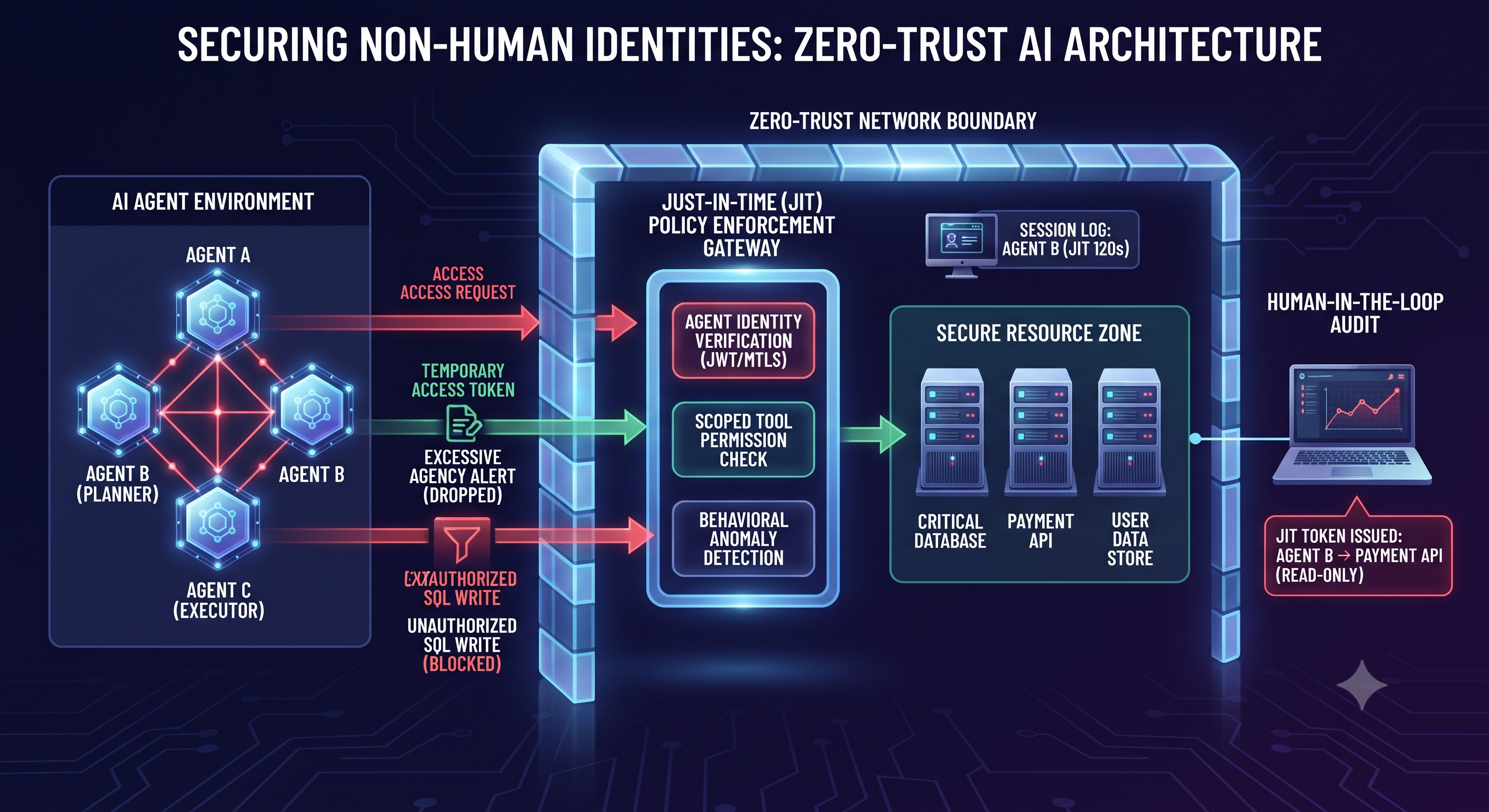
Enforce Least-Privilege Scoping: Never give an AI agent standing database write permissions or broad service keys. Scope credentials strictly to the specific tool execution required for the immediate task.
Implement Just-In-Time (JIT) Access: Replace long-lived API secrets with short-lived, dynamically generated tokens that expire immediately upon task completion.
Deterministic Inter-Agent Validation: Never allow agents to trust downstream or upstream communications blindly. Enforce cryptographic identity verification and schema validation at every single inter-agent handoff.
Discussion Question: How is your security team auditing non-human identities and tool permissions across your AI workflows? Are you relying on static API keys or implementing JIT access controls?
CTA (Join Cybersecurity & Ethical Hacking): Ready to master the cutting edge of threat defense and secure next-gen infrastructure? Join the Cybersecurity & Ethical Hacking community to connect with security professionals and ethical hackers shaping resilient systems.
As engineering teams transition from static chatbots to autonomous multi-agent systems, the security paradigm has fundamentally shifted. AI agents are no longer passive tools waiting for input; they actively query databases, invoke APIs, and execute workflows across distributed environments.
However, organizations frequently assign these non-human identities broad, standing privileges or shared API keys inherited from development environments.
Why it matters:
When an autonomous agent operates with excessive agency or unconstrained tool permissions, a single prompt injection or agent goal hijack can grant attackers system-wide lateral movement without ever triggering traditional identity alerts. Traditional perimeter defenses crumble when the threat originates from a compromised, trusted internal agent loop.
How to secure it (The Defensive Blueprint):
Enforce Least-Privilege Scoping: Never give an AI agent standing database write permissions or broad service keys. Scope credentials strictly to the specific tool execution required for the immediate task.
Implement Just-In-Time (JIT) Access: Replace long-lived API secrets with short-lived, dynamically generated tokens that expire immediately upon task completion.
Deterministic Inter-Agent Validation: Never allow agents to trust downstream or upstream communications blindly. Enforce cryptographic identity verification and schema validation at every single inter-agent handoff.
Discussion Question: How is your security team auditing non-human identities and tool permissions across your AI workflows? Are you relying on static API keys or implementing JIT access controls?
CTA (Join Cybersecurity & Ethical Hacking): Ready to master the cutting edge of threat defense and secure next-gen infrastructure? Join the Cybersecurity & Ethical Hacking community to connect with security professionals and ethical hackers shaping resilient systems.
Beyond Traditional Perimeters: Securing Non-Human Identities in Agentic AI Architectures
As engineering teams transition from static chatbots to autonomous multi-agent systems, the security paradigm has fundamentally shifted. AI agents are no longer passive tools waiting for input; they actively query databases, invoke APIs, and execute workflows across distributed environments.
However, organizations frequently assign these non-human identities broad, standing privileges or shared API keys inherited from development environments.
Why it matters:
When an autonomous agent operates with excessive agency or unconstrained tool permissions, a single prompt injection or agent goal hijack can grant attackers system-wide lateral movement without ever triggering traditional identity alerts. Traditional perimeter defenses crumble when the threat originates from a compromised, trusted internal agent loop.
How to secure it (The Defensive Blueprint):
Enforce Least-Privilege Scoping: Never give an AI agent standing database write permissions or broad service keys. Scope credentials strictly to the specific tool execution required for the immediate task.
Implement Just-In-Time (JIT) Access: Replace long-lived API secrets with short-lived, dynamically generated tokens that expire immediately upon task completion.
Deterministic Inter-Agent Validation: Never allow agents to trust downstream or upstream communications blindly. Enforce cryptographic identity verification and schema validation at every single inter-agent handoff.
Discussion Question: How is your security team auditing non-human identities and tool permissions across your AI workflows? Are you relying on static API keys or implementing JIT access controls?
CTA (Join Cybersecurity & Ethical Hacking): Ready to master the cutting edge of threat defense and secure next-gen infrastructure? Join the Cybersecurity & Ethical Hacking community to connect with security professionals and ethical hackers shaping resilient systems.

 English
 Arabic
 French
 Spanish
 Portuguese
 Deutsch
 Turkish
 Dutch
Dutch
 Italiano
 Russian
 Portuguese (Brazil)
 Greek
Greek