


Which Study Method Actually Helps You Retain 80%+ of What You Learn?
Not all study strategies are created equal. Cognitive science shows that passive review (like highlighting or re-reading) gives a false sense of mastery, while active techniques build long-term memory pathways.
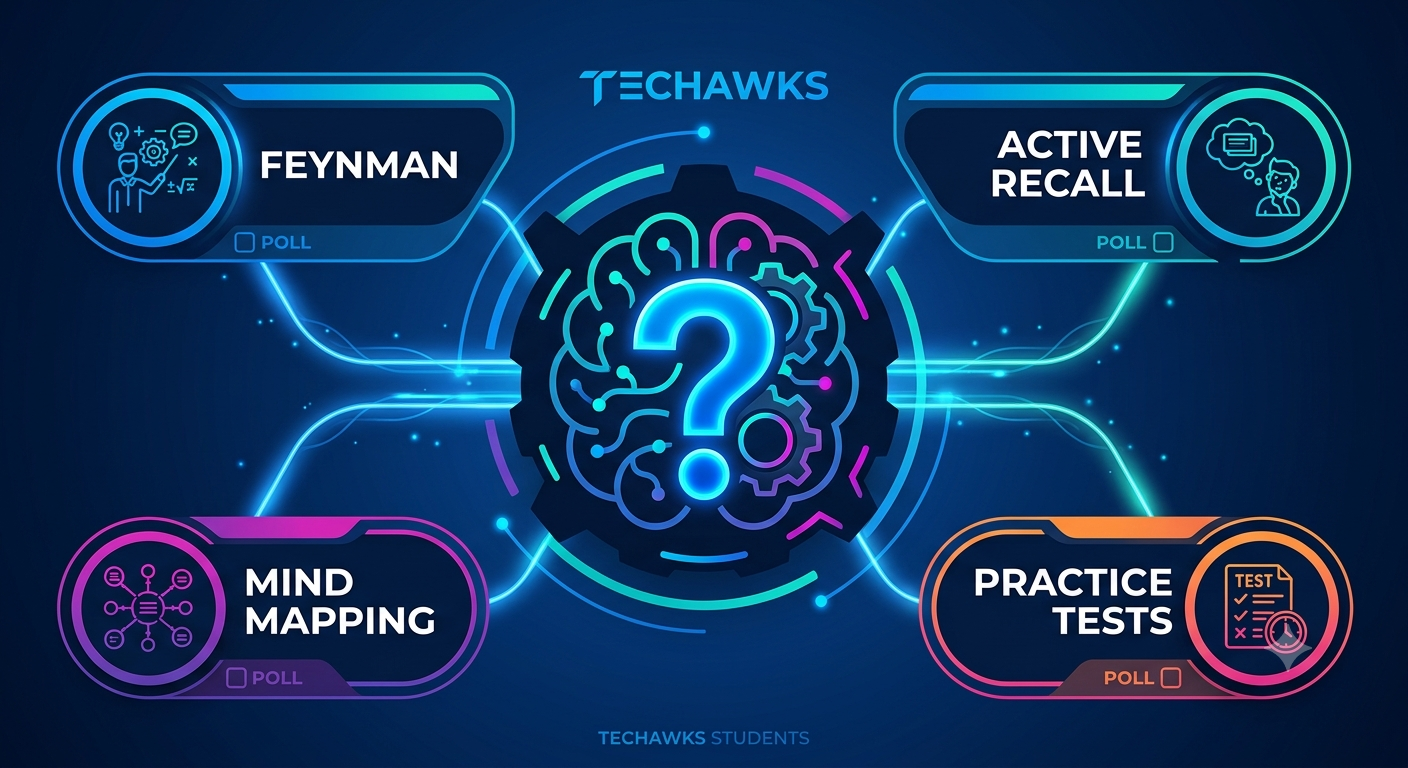
Quick Poll: Which active study technique is your go-to for tough subjects?
A) The Feynman Technique (Explaining complex concepts in plain language as if teaching a beginner)
B) Active Recall & Spaced Repetition (Testing yourself with flashcards/Anki over increasing intervals)
C) Practice Testing & Past Papers (Simulating real exam conditions under a time limit)
D) Mind Mapping & Concept Linking (Visually mapping how different topics connect to one another)
Why Strategy Beats Hours Spent
No matter which option you voted for, here is how to optimize it for maximum efficiency:
If you picked Feynman: Teach a classmate or write your notes without using jargon. If you get stuck explaining a step simply, that’s where your knowledge gap lives.
If you picked Active Recall: Stop reading notes line-by-line. Instead, write down key questions at the top of a page and try answering them from memory before checking your answer.
If you picked Practice Tests: Use errors as a diagnostic tool. Don't just check if an answer is right or wrong; write down why you got it wrong in an "Error Log."
If you picked Concept Mapping: Focus on relationships. Draw arrows between topics and write action verbs over the arrows explaining how Topic A causes or influences Topic B.
Key Takeaways
Ditch Passive Reading: Highlighting feels productive, but testing your memory is what builds lasting retention.
Identify Knowledge Gaps: The best study method is the one that forces you to confront what you don't know before test day.
Combine Methods: Use Feynman to understand, Concept Mapping to connect, and Spaced Repetition to remember long-term.
CTA
Want to master smarter study workflows?
[Join Students in Tech] to unlock high-yield study templates, connect with top-performing peer mentors, and swap learning strategies with fellow tech students!
Not all study strategies are created equal. Cognitive science shows that passive review (like highlighting or re-reading) gives a false sense of mastery, while active techniques build long-term memory pathways.
Quick Poll: Which active study technique is your go-to for tough subjects?
A) The Feynman Technique (Explaining complex concepts in plain language as if teaching a beginner)
B) Active Recall & Spaced Repetition (Testing yourself with flashcards/Anki over increasing intervals)
C) Practice Testing & Past Papers (Simulating real exam conditions under a time limit)
D) Mind Mapping & Concept Linking (Visually mapping how different topics connect to one another)
Why Strategy Beats Hours Spent
No matter which option you voted for, here is how to optimize it for maximum efficiency:
If you picked Feynman: Teach a classmate or write your notes without using jargon. If you get stuck explaining a step simply, that’s where your knowledge gap lives.
If you picked Active Recall: Stop reading notes line-by-line. Instead, write down key questions at the top of a page and try answering them from memory before checking your answer.
If you picked Practice Tests: Use errors as a diagnostic tool. Don't just check if an answer is right or wrong; write down why you got it wrong in an "Error Log."
If you picked Concept Mapping: Focus on relationships. Draw arrows between topics and write action verbs over the arrows explaining how Topic A causes or influences Topic B.
Key Takeaways
Ditch Passive Reading: Highlighting feels productive, but testing your memory is what builds lasting retention.
Identify Knowledge Gaps: The best study method is the one that forces you to confront what you don't know before test day.
Combine Methods: Use Feynman to understand, Concept Mapping to connect, and Spaced Repetition to remember long-term.
CTA
Want to master smarter study workflows?
[Join Students in Tech] to unlock high-yield study templates, connect with top-performing peer mentors, and swap learning strategies with fellow tech students!
Which Study Method Actually Helps You Retain 80%+ of What You Learn?
Not all study strategies are created equal. Cognitive science shows that passive review (like highlighting or re-reading) gives a false sense of mastery, while active techniques build long-term memory pathways.
Quick Poll: Which active study technique is your go-to for tough subjects?
A) The Feynman Technique (Explaining complex concepts in plain language as if teaching a beginner)
B) Active Recall & Spaced Repetition (Testing yourself with flashcards/Anki over increasing intervals)
C) Practice Testing & Past Papers (Simulating real exam conditions under a time limit)
D) Mind Mapping & Concept Linking (Visually mapping how different topics connect to one another)
Why Strategy Beats Hours Spent
No matter which option you voted for, here is how to optimize it for maximum efficiency:
If you picked Feynman: Teach a classmate or write your notes without using jargon. If you get stuck explaining a step simply, that’s where your knowledge gap lives.
If you picked Active Recall: Stop reading notes line-by-line. Instead, write down key questions at the top of a page and try answering them from memory before checking your answer.
If you picked Practice Tests: Use errors as a diagnostic tool. Don't just check if an answer is right or wrong; write down why you got it wrong in an "Error Log."
If you picked Concept Mapping: Focus on relationships. Draw arrows between topics and write action verbs over the arrows explaining how Topic A causes or influences Topic B.
Key Takeaways
Ditch Passive Reading: Highlighting feels productive, but testing your memory is what builds lasting retention.
Identify Knowledge Gaps: The best study method is the one that forces you to confront what you don't know before test day.
Combine Methods: Use Feynman to understand, Concept Mapping to connect, and Spaced Repetition to remember long-term.
CTA
Want to master smarter study workflows?
[Join Students in Tech] to unlock high-yield study templates, connect with top-performing peer mentors, and swap learning strategies with fellow tech students!

 English
 Arabic
 French
 Spanish
 Portuguese
 Deutsch
 Turkish
 Dutch
Dutch
 Italiano
 Russian
 Romaian
 Portuguese (Brazil)