


Which Security Practice Is Your Weakest Link? (Vote & Test Your Defense)
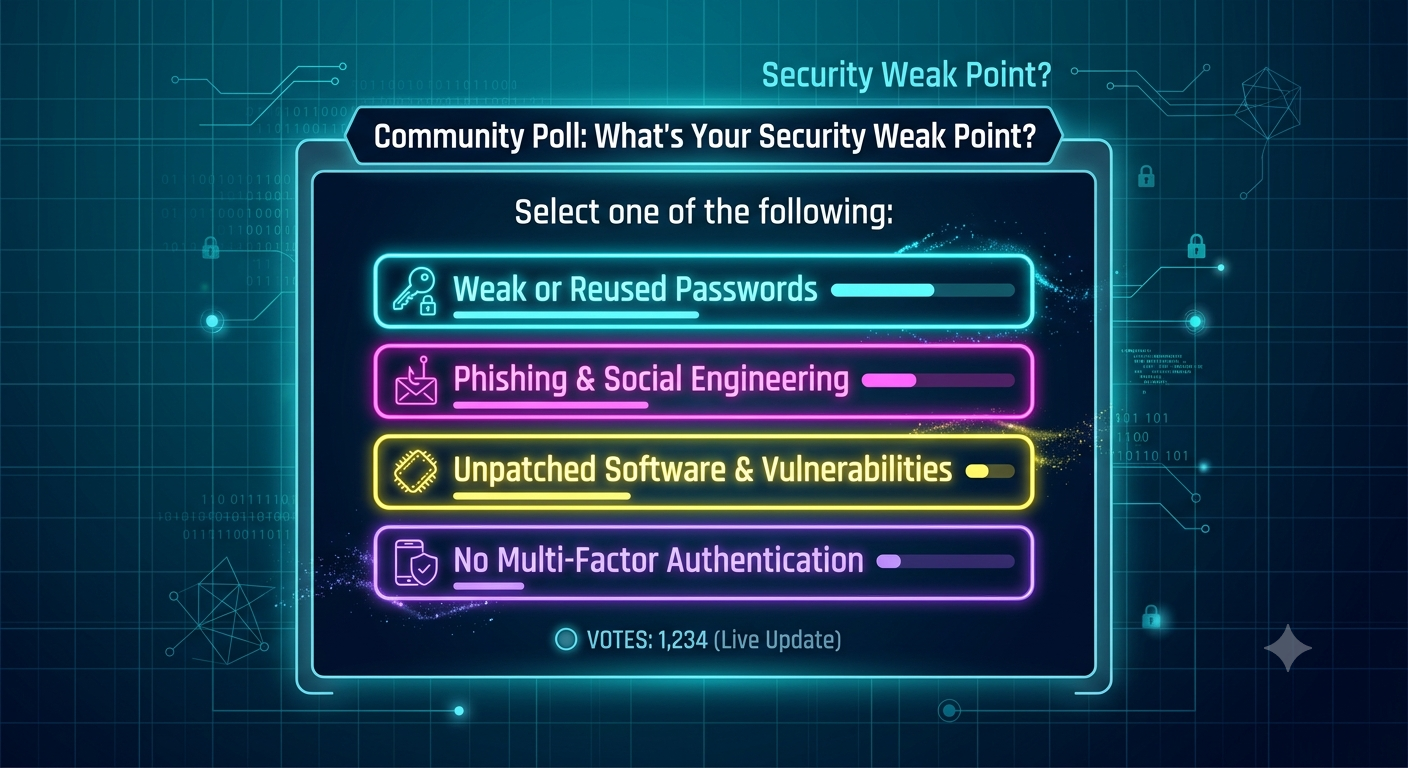
Good security hygiene isn't about complex hacks; it's about the daily habits that prevent 90% of opportunistic attacks. Cast your vote below, then check out the actionable tips to fix each vulnerability:
📊 Poll Question:
Which of these foundational security practices do you find hardest to keep up with?
Option A: Multi-Factor Authentication (MFA) on all accounts
Option B: Timely OS & Software Patching
Option C: Using a Password Manager for Unique Credentials
Option D: Regular, Isolated Data Backups
💡 How to Fix Your Weak Spot Right Now:
If you chose A (MFA): Switch from SMS-based MFA to an authenticator app (like Google Authenticator or Authy) or a hardware key (YubiKey). SMS interception is a common vector; app-based TOTP is vastly more secure.
If you chose B (Patching): Enable automatic updates for operating systems and key software. Most exploit kits target known vulnerabilities that already have patches available.
If you chose C (Password Management): Audit your accounts. Never reuse passwords across services. A password manager lets you generate 16+ character complex strings without the headache of memorization.
If you chose D (Backups): Follow the 3-2-1 Rule: 3 total copies of your data, 2 different storage media types, and 1 off-site or offline copy (to protect against ransomware).
Key Takeaways
Basics win games: The vast majority of breaches exploit basic lapses like reused passwords or delayed patches.
MFA is essential: Adding a second factor stops automated brute-force attacks in their tracks.
Air-gap your backups: Backups connected to your primary network can be encrypted by ransomware along with your live files.
CTA
Want to benchmark your security knowledge and learn how to audit defenses like a pro?
👉 Join our Cybersecurity & Ethical Hacking community today to participate in daily quizzes, discussion polls, and hands-on labs!
Good security hygiene isn't about complex hacks; it's about the daily habits that prevent 90% of opportunistic attacks. Cast your vote below, then check out the actionable tips to fix each vulnerability:
📊 Poll Question:
Which of these foundational security practices do you find hardest to keep up with?
Option A: Multi-Factor Authentication (MFA) on all accounts
Option B: Timely OS & Software Patching
Option C: Using a Password Manager for Unique Credentials
Option D: Regular, Isolated Data Backups
💡 How to Fix Your Weak Spot Right Now:
If you chose A (MFA): Switch from SMS-based MFA to an authenticator app (like Google Authenticator or Authy) or a hardware key (YubiKey). SMS interception is a common vector; app-based TOTP is vastly more secure.
If you chose B (Patching): Enable automatic updates for operating systems and key software. Most exploit kits target known vulnerabilities that already have patches available.
If you chose C (Password Management): Audit your accounts. Never reuse passwords across services. A password manager lets you generate 16+ character complex strings without the headache of memorization.
If you chose D (Backups): Follow the 3-2-1 Rule: 3 total copies of your data, 2 different storage media types, and 1 off-site or offline copy (to protect against ransomware).
Key Takeaways
Basics win games: The vast majority of breaches exploit basic lapses like reused passwords or delayed patches.
MFA is essential: Adding a second factor stops automated brute-force attacks in their tracks.
Air-gap your backups: Backups connected to your primary network can be encrypted by ransomware along with your live files.
CTA
Want to benchmark your security knowledge and learn how to audit defenses like a pro?
👉 Join our Cybersecurity & Ethical Hacking community today to participate in daily quizzes, discussion polls, and hands-on labs!
Which Security Practice Is Your Weakest Link? (Vote & Test Your Defense)
Good security hygiene isn't about complex hacks; it's about the daily habits that prevent 90% of opportunistic attacks. Cast your vote below, then check out the actionable tips to fix each vulnerability:
📊 Poll Question:
Which of these foundational security practices do you find hardest to keep up with?
Option A: Multi-Factor Authentication (MFA) on all accounts
Option B: Timely OS & Software Patching
Option C: Using a Password Manager for Unique Credentials
Option D: Regular, Isolated Data Backups
💡 How to Fix Your Weak Spot Right Now:
If you chose A (MFA): Switch from SMS-based MFA to an authenticator app (like Google Authenticator or Authy) or a hardware key (YubiKey). SMS interception is a common vector; app-based TOTP is vastly more secure.
If you chose B (Patching): Enable automatic updates for operating systems and key software. Most exploit kits target known vulnerabilities that already have patches available.
If you chose C (Password Management): Audit your accounts. Never reuse passwords across services. A password manager lets you generate 16+ character complex strings without the headache of memorization.
If you chose D (Backups): Follow the 3-2-1 Rule: 3 total copies of your data, 2 different storage media types, and 1 off-site or offline copy (to protect against ransomware).
Key Takeaways
Basics win games: The vast majority of breaches exploit basic lapses like reused passwords or delayed patches.
MFA is essential: Adding a second factor stops automated brute-force attacks in their tracks.
Air-gap your backups: Backups connected to your primary network can be encrypted by ransomware along with your live files.
CTA
Want to benchmark your security knowledge and learn how to audit defenses like a pro?
👉 Join our Cybersecurity & Ethical Hacking community today to participate in daily quizzes, discussion polls, and hands-on labs!

 English
 Arabic
 French
 Spanish
 Portuguese
 Deutsch
 Turkish
 Italiano
 Russian
 Romaian
 Portuguese (Brazil)
 Greek
Greek