


Which Data Modeling Approach Powers Your Analytics Stack? (Vote & Compare)
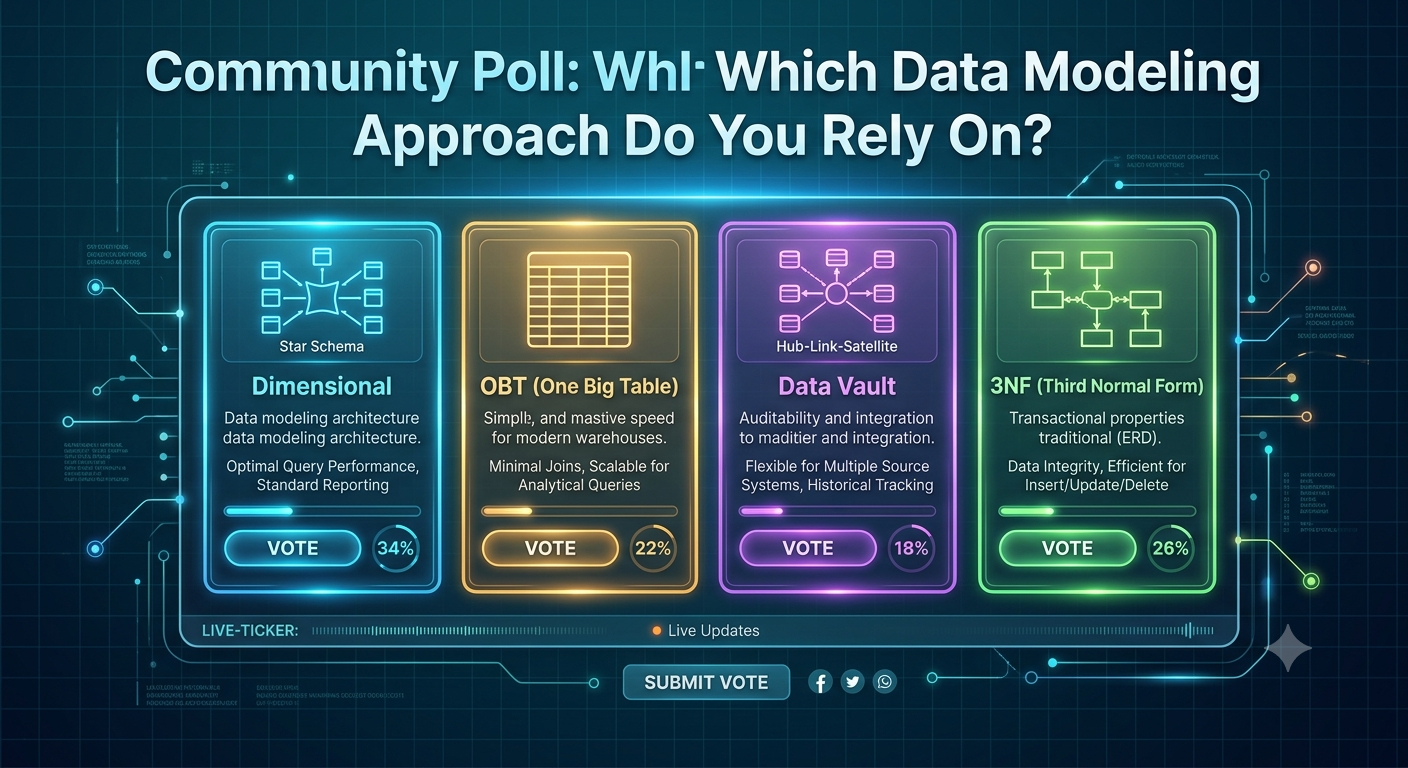
Data architectures evolve, but foundational modeling patterns remain critical for organizing analytical data efficiently. Cast your vote below, then check out the practical breakdown for when to leverage each strategy:
📊 Poll Question:
What is your team's primary approach for structuring analytical data models?
Option A: Dimensional Modeling (Star / Snowflake Schema)
Option B: One Big Table (OBT / Wide Tables)
Option C: Data Vault (Hubs, Links, and Satellites)
Option D: Normalized / Relational (3NF)
💡 When to Use Each Approach:
If you chose A (Dimensional Modeling): The gold standard for business intelligence. By separating facts (quantitative measurements) from dimensions (contextual attributes), you ensure intuitive querying for tools like Tableau or PowerBI while keeping query joins fast and readable.
If you chose B (OBT): Gaining massive popularity with modern cloud data warehouses (Snowflake, BigQuery, ClickHouse). Denormalizing data into a single wide table eliminates join overhead, making nested analytical queries lightning-fast at scale.
If you chose C (Data Vault): Best for enterprise-scale environments with constantly shifting source systems. Data Vault isolates changes by decoupling business keys (Hubs), relationships (Links), and descriptive context (Satellites), offering auditability and long-term scalability.
If you chose D (3NF): Great for transactional systems (OLTP), but usually a bottleneck for analytics (OLAP). If your reporting tables are heavily normalized, consider transforming them into Star Schema or OBT layers to avoid expensive multi-table joins.
Key Takeaways
No one-size-fits-all: Choose OBT for raw query speed, Dimensional for self-serve BI usability, and Data Vault for complex enterprise auditability.
Decouple OLTP and OLAP: Never expose raw 3NF operational schemas directly to reporting tools; transform them into analytical structures first.
Prioritize stakeholder clarity: A model is only effective if business analysts can easily query and understand the underlying data relationships.
CTA
Want to dive deeper into data modeling frameworks and modern warehouse architectures?
👉 Join our Data Science & Analytics community today to participate in architectural discussions, vote in weekly polls, and level up your data engineering skills!
Data architectures evolve, but foundational modeling patterns remain critical for organizing analytical data efficiently. Cast your vote below, then check out the practical breakdown for when to leverage each strategy:
📊 Poll Question:
What is your team's primary approach for structuring analytical data models?
Option A: Dimensional Modeling (Star / Snowflake Schema)
Option B: One Big Table (OBT / Wide Tables)
Option C: Data Vault (Hubs, Links, and Satellites)
Option D: Normalized / Relational (3NF)
💡 When to Use Each Approach:
If you chose A (Dimensional Modeling): The gold standard for business intelligence. By separating facts (quantitative measurements) from dimensions (contextual attributes), you ensure intuitive querying for tools like Tableau or PowerBI while keeping query joins fast and readable.
If you chose B (OBT): Gaining massive popularity with modern cloud data warehouses (Snowflake, BigQuery, ClickHouse). Denormalizing data into a single wide table eliminates join overhead, making nested analytical queries lightning-fast at scale.
If you chose C (Data Vault): Best for enterprise-scale environments with constantly shifting source systems. Data Vault isolates changes by decoupling business keys (Hubs), relationships (Links), and descriptive context (Satellites), offering auditability and long-term scalability.
If you chose D (3NF): Great for transactional systems (OLTP), but usually a bottleneck for analytics (OLAP). If your reporting tables are heavily normalized, consider transforming them into Star Schema or OBT layers to avoid expensive multi-table joins.
Key Takeaways
No one-size-fits-all: Choose OBT for raw query speed, Dimensional for self-serve BI usability, and Data Vault for complex enterprise auditability.
Decouple OLTP and OLAP: Never expose raw 3NF operational schemas directly to reporting tools; transform them into analytical structures first.
Prioritize stakeholder clarity: A model is only effective if business analysts can easily query and understand the underlying data relationships.
CTA
Want to dive deeper into data modeling frameworks and modern warehouse architectures?
👉 Join our Data Science & Analytics community today to participate in architectural discussions, vote in weekly polls, and level up your data engineering skills!
Which Data Modeling Approach Powers Your Analytics Stack? (Vote & Compare)
Data architectures evolve, but foundational modeling patterns remain critical for organizing analytical data efficiently. Cast your vote below, then check out the practical breakdown for when to leverage each strategy:
📊 Poll Question:
What is your team's primary approach for structuring analytical data models?
Option A: Dimensional Modeling (Star / Snowflake Schema)
Option B: One Big Table (OBT / Wide Tables)
Option C: Data Vault (Hubs, Links, and Satellites)
Option D: Normalized / Relational (3NF)
💡 When to Use Each Approach:
If you chose A (Dimensional Modeling): The gold standard for business intelligence. By separating facts (quantitative measurements) from dimensions (contextual attributes), you ensure intuitive querying for tools like Tableau or PowerBI while keeping query joins fast and readable.
If you chose B (OBT): Gaining massive popularity with modern cloud data warehouses (Snowflake, BigQuery, ClickHouse). Denormalizing data into a single wide table eliminates join overhead, making nested analytical queries lightning-fast at scale.
If you chose C (Data Vault): Best for enterprise-scale environments with constantly shifting source systems. Data Vault isolates changes by decoupling business keys (Hubs), relationships (Links), and descriptive context (Satellites), offering auditability and long-term scalability.
If you chose D (3NF): Great for transactional systems (OLTP), but usually a bottleneck for analytics (OLAP). If your reporting tables are heavily normalized, consider transforming them into Star Schema or OBT layers to avoid expensive multi-table joins.
Key Takeaways
No one-size-fits-all: Choose OBT for raw query speed, Dimensional for self-serve BI usability, and Data Vault for complex enterprise auditability.
Decouple OLTP and OLAP: Never expose raw 3NF operational schemas directly to reporting tools; transform them into analytical structures first.
Prioritize stakeholder clarity: A model is only effective if business analysts can easily query and understand the underlying data relationships.
CTA
Want to dive deeper into data modeling frameworks and modern warehouse architectures?
👉 Join our Data Science & Analytics community today to participate in architectural discussions, vote in weekly polls, and level up your data engineering skills!

 English
 Arabic
 French
 Spanish
 Portuguese
 Deutsch
 Turkish
 Dutch
Dutch
 Italiano
 Russian
 Romaian
 Greek
Greek