


Kubernetes Deployment vs. StatefulSet: Which Do You Use for Databases?
The Big Question:
When running a stateful application—like PostgreSQL, MySQL, or MongoDB—on Kubernetes, which controller should you use to manage your pods?
🗳️ POLL:
How do you deploy databases in your Kubernetes cluster?
🔴 A) StatefulSet (Proper identity & persistent storage mapping)
🔵 B) Deployment with PVC attached (Quick & risky)
🟡 C) Managed Database Service outside K8s (RDS, Cloud SQL, etc.)
🟢 D) Custom Operator (e.g., CloudNativePG, Zalando)
💡 The Practical Breakdown
Why Deployment Fails for Databases:
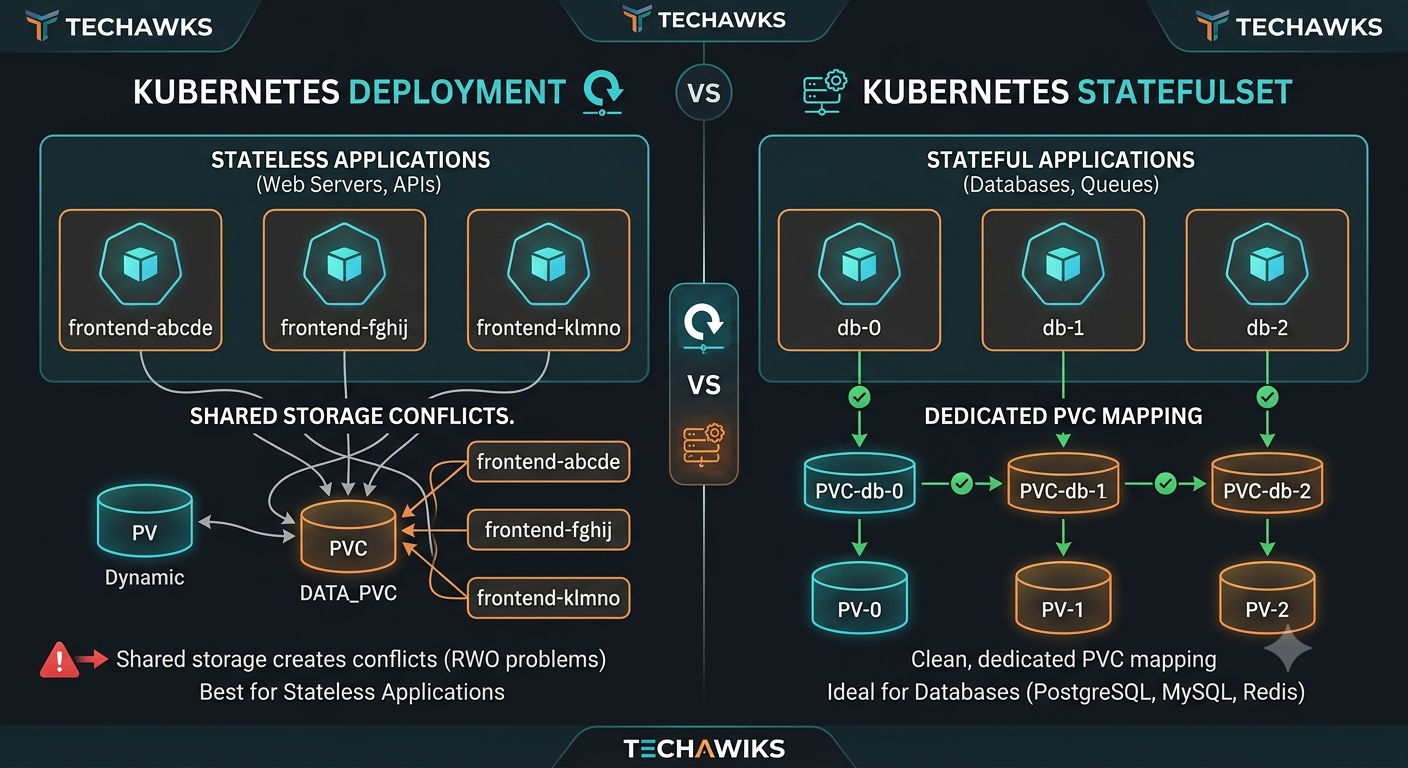
Pods are stateless and interchangeable: A Deployment treats pods like cattle. If a pod crashes, K8s replaces it with a completely random host name and dynamic identity.
Storage conflicts: Attaching a ReadWriteOnce Persistent Volume (PV) to a standard Deployment can lead to locking issues during rolling updates, as two pods attempt to mount the same volume simultaneously.
Why StatefulSet is Built for State:
Stable Network IDs: Pods get deterministic names (e.g., db-0, db-1), which is crucial for master-replica clustering.
Ordered Deployment & Scaling: Pods are created, updated, and deleted sequentially ($0 \to 1 \to 2$).
Dedicated Persistent Volume Claim (PVC) per Pod: Each replica maintains its own persistent storage binding, preserving data even if the pod restarts
Key Takeaways
Stateless = Deployments: Web servers, APIs, microservices.
Stateful = StatefulSets or Operators: Databases, Redis clusters, Kafka nodes.
Best Practice: For production databases, leverage a dedicated Kubernetes Operator (Option D) on top of StatefulSets to handle automated failover, backups, and point-in-time recovery seamlessly.
CTA
🚀 Want to master production-grade Kubernetes architecture, CI/CD pipelines, and cloud-native practices?
👉 Join Cloud, DevOps & Open Source to level up your engineering skills with hands-on labs and expert-led discussions!.
The Big Question:
When running a stateful application—like PostgreSQL, MySQL, or MongoDB—on Kubernetes, which controller should you use to manage your pods?
🗳️ POLL:
How do you deploy databases in your Kubernetes cluster?
🔴 A) StatefulSet (Proper identity & persistent storage mapping)
🔵 B) Deployment with PVC attached (Quick & risky)
🟡 C) Managed Database Service outside K8s (RDS, Cloud SQL, etc.)
🟢 D) Custom Operator (e.g., CloudNativePG, Zalando)
💡 The Practical Breakdown
Why Deployment Fails for Databases:
Pods are stateless and interchangeable: A Deployment treats pods like cattle. If a pod crashes, K8s replaces it with a completely random host name and dynamic identity.
Storage conflicts: Attaching a ReadWriteOnce Persistent Volume (PV) to a standard Deployment can lead to locking issues during rolling updates, as two pods attempt to mount the same volume simultaneously.
Why StatefulSet is Built for State:
Stable Network IDs: Pods get deterministic names (e.g., db-0, db-1), which is crucial for master-replica clustering.
Ordered Deployment & Scaling: Pods are created, updated, and deleted sequentially ($0 \to 1 \to 2$).
Dedicated Persistent Volume Claim (PVC) per Pod: Each replica maintains its own persistent storage binding, preserving data even if the pod restarts
Key Takeaways
Stateless = Deployments: Web servers, APIs, microservices.
Stateful = StatefulSets or Operators: Databases, Redis clusters, Kafka nodes.
Best Practice: For production databases, leverage a dedicated Kubernetes Operator (Option D) on top of StatefulSets to handle automated failover, backups, and point-in-time recovery seamlessly.
CTA
🚀 Want to master production-grade Kubernetes architecture, CI/CD pipelines, and cloud-native practices?
👉 Join Cloud, DevOps & Open Source to level up your engineering skills with hands-on labs and expert-led discussions!.
Kubernetes Deployment vs. StatefulSet: Which Do You Use for Databases?
The Big Question:
When running a stateful application—like PostgreSQL, MySQL, or MongoDB—on Kubernetes, which controller should you use to manage your pods?
🗳️ POLL:
How do you deploy databases in your Kubernetes cluster?
🔴 A) StatefulSet (Proper identity & persistent storage mapping)
🔵 B) Deployment with PVC attached (Quick & risky)
🟡 C) Managed Database Service outside K8s (RDS, Cloud SQL, etc.)
🟢 D) Custom Operator (e.g., CloudNativePG, Zalando)
💡 The Practical Breakdown
Why Deployment Fails for Databases:
Pods are stateless and interchangeable: A Deployment treats pods like cattle. If a pod crashes, K8s replaces it with a completely random host name and dynamic identity.
Storage conflicts: Attaching a ReadWriteOnce Persistent Volume (PV) to a standard Deployment can lead to locking issues during rolling updates, as two pods attempt to mount the same volume simultaneously.
Why StatefulSet is Built for State:
Stable Network IDs: Pods get deterministic names (e.g., db-0, db-1), which is crucial for master-replica clustering.
Ordered Deployment & Scaling: Pods are created, updated, and deleted sequentially ($0 \to 1 \to 2$).
Dedicated Persistent Volume Claim (PVC) per Pod: Each replica maintains its own persistent storage binding, preserving data even if the pod restarts
Key Takeaways
Stateless = Deployments: Web servers, APIs, microservices.
Stateful = StatefulSets or Operators: Databases, Redis clusters, Kafka nodes.
Best Practice: For production databases, leverage a dedicated Kubernetes Operator (Option D) on top of StatefulSets to handle automated failover, backups, and point-in-time recovery seamlessly.
CTA
🚀 Want to master production-grade Kubernetes architecture, CI/CD pipelines, and cloud-native practices?
👉 Join Cloud, DevOps & Open Source to level up your engineering skills with hands-on labs and expert-led discussions!.

 English
 Arabic
 French
 Spanish
 Portuguese
 Turkish
 Dutch
Dutch
 Italiano
 Russian
 Romaian
 Portuguese (Brazil)
 Greek
Greek