


From Autocomplete to Agency: Navigating the Shift to Multiagent Systems in Modern Software Architecture
As engineering teams scale their adoption of AI-native development platforms, the primary bottleneck is no longer generating code—it is managing control, context, and accountability.
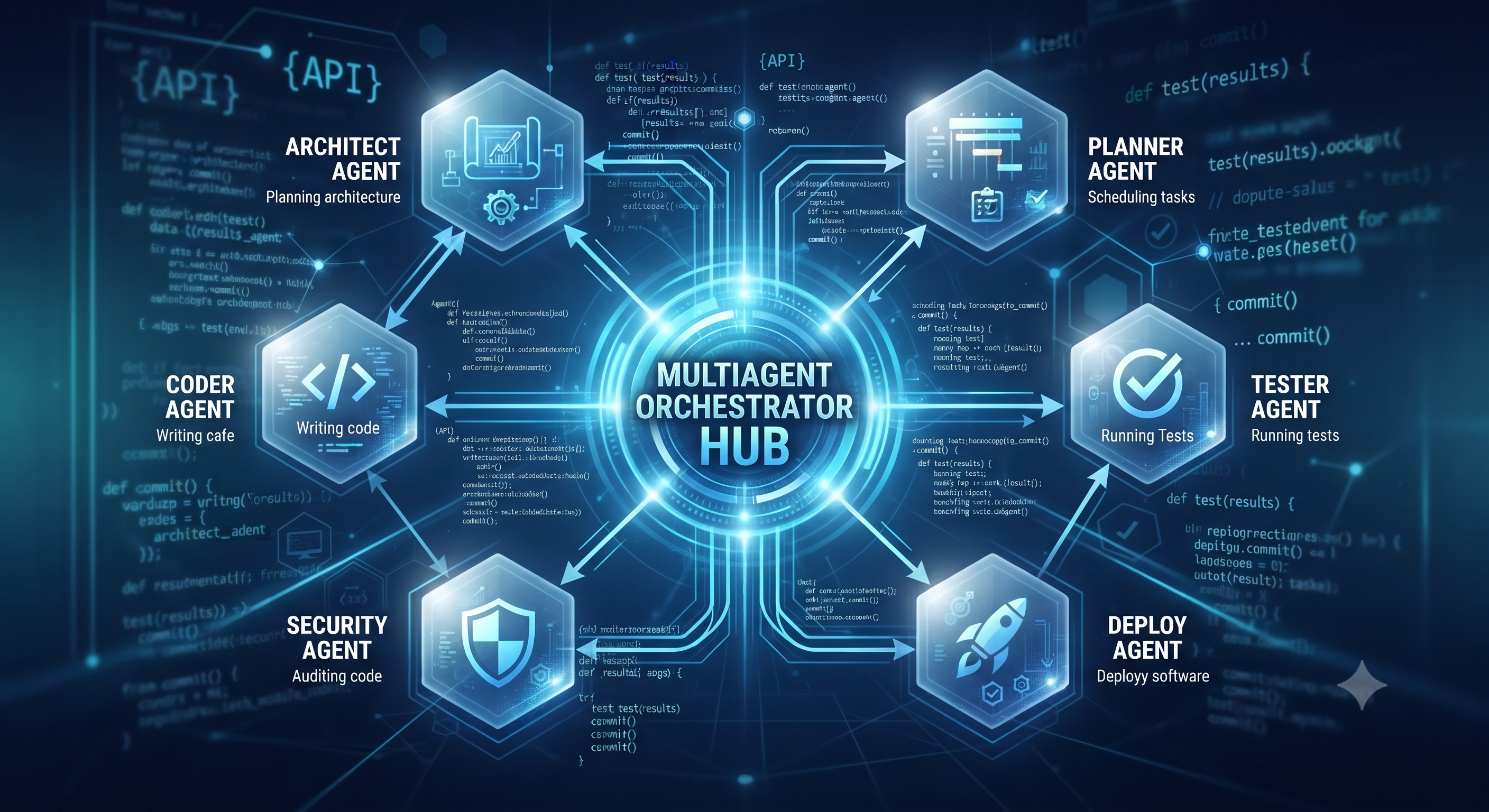
Traditional coding assistants operate in a single-turn loop: you prompt, they output, and you review. In contrast, multiagent architectures break down software engineering lifecycle tasks into specialized roles (e.g., architect, coder, tester, security reviewer) that communicate asynchronously, run unit tests, and resolve integration discrepancies autonomously.
Why This Shift Matters
End-to-End Task Ownership: Agents don't just write snippets; they plan migrations, refactor microservices across directories, and handle debugging loops across multiple files.
The Governance Challenge: With output velocity multiplying exponentially, engineering leaders face an accumulation of unowned or untested code.
Architectural Guardrails: Moving to agentic workflows requires strict policy definitions—establishing clear gates on what an autonomous agent can merge to production and where human-in-the-loop oversight remains mandatory.
What You Can Do Today (A Useful Blueprint)
Define Strict Boundaries: Restrict agentic toolsets to specific sandboxed environments or feature branches with mandatory CI/CD pipeline triggers.
Implement Ontological Grounding: Ensure your AI tooling references clean, up-to-date internal documentation and architectural decision records (ADRs) to minimize hallucinations.
Track Accountability: Treat autonomous agents like junior engineering contributors—they require code reviews, clear specifications, and rigorous observability metrics.
Discussion Question
How is your team drawing the line between automation and oversight? Are you implementing autonomous multiagent workflows yet, or sticking to single-assistant tools? Let us know in the comments below!
CTA
Join the conversation and connect with thousands of cloud architects, developers, and tech leaders in the Techawks General Community today.
As engineering teams scale their adoption of AI-native development platforms, the primary bottleneck is no longer generating code—it is managing control, context, and accountability.
Traditional coding assistants operate in a single-turn loop: you prompt, they output, and you review. In contrast, multiagent architectures break down software engineering lifecycle tasks into specialized roles (e.g., architect, coder, tester, security reviewer) that communicate asynchronously, run unit tests, and resolve integration discrepancies autonomously.
Why This Shift Matters
End-to-End Task Ownership: Agents don't just write snippets; they plan migrations, refactor microservices across directories, and handle debugging loops across multiple files.
The Governance Challenge: With output velocity multiplying exponentially, engineering leaders face an accumulation of unowned or untested code.
Architectural Guardrails: Moving to agentic workflows requires strict policy definitions—establishing clear gates on what an autonomous agent can merge to production and where human-in-the-loop oversight remains mandatory.
What You Can Do Today (A Useful Blueprint)
Define Strict Boundaries: Restrict agentic toolsets to specific sandboxed environments or feature branches with mandatory CI/CD pipeline triggers.
Implement Ontological Grounding: Ensure your AI tooling references clean, up-to-date internal documentation and architectural decision records (ADRs) to minimize hallucinations.
Track Accountability: Treat autonomous agents like junior engineering contributors—they require code reviews, clear specifications, and rigorous observability metrics.
Discussion Question
How is your team drawing the line between automation and oversight? Are you implementing autonomous multiagent workflows yet, or sticking to single-assistant tools? Let us know in the comments below!
CTA
Join the conversation and connect with thousands of cloud architects, developers, and tech leaders in the Techawks General Community today.
From Autocomplete to Agency: Navigating the Shift to Multiagent Systems in Modern Software Architecture
As engineering teams scale their adoption of AI-native development platforms, the primary bottleneck is no longer generating code—it is managing control, context, and accountability.
Traditional coding assistants operate in a single-turn loop: you prompt, they output, and you review. In contrast, multiagent architectures break down software engineering lifecycle tasks into specialized roles (e.g., architect, coder, tester, security reviewer) that communicate asynchronously, run unit tests, and resolve integration discrepancies autonomously.
Why This Shift Matters
End-to-End Task Ownership: Agents don't just write snippets; they plan migrations, refactor microservices across directories, and handle debugging loops across multiple files.
The Governance Challenge: With output velocity multiplying exponentially, engineering leaders face an accumulation of unowned or untested code.
Architectural Guardrails: Moving to agentic workflows requires strict policy definitions—establishing clear gates on what an autonomous agent can merge to production and where human-in-the-loop oversight remains mandatory.
What You Can Do Today (A Useful Blueprint)
Define Strict Boundaries: Restrict agentic toolsets to specific sandboxed environments or feature branches with mandatory CI/CD pipeline triggers.
Implement Ontological Grounding: Ensure your AI tooling references clean, up-to-date internal documentation and architectural decision records (ADRs) to minimize hallucinations.
Track Accountability: Treat autonomous agents like junior engineering contributors—they require code reviews, clear specifications, and rigorous observability metrics.
Discussion Question
How is your team drawing the line between automation and oversight? Are you implementing autonomous multiagent workflows yet, or sticking to single-assistant tools? Let us know in the comments below!
CTA
Join the conversation and connect with thousands of cloud architects, developers, and tech leaders in the Techawks General Community today.

 Arabic
 French
 Spanish
 Portuguese
 Deutsch
 Turkish
 Dutch
Dutch
 Italiano
 Russian
 Romaian
 Portuguese (Brazil)
 Greek
Greek