


From Dashboards to Decisions: Why Agentic AI Needs a Unified Semantic Layer
As enterprises pivot from standalone AI chat interfaces to fully autonomous Agentic AI workflows, the bottleneck has quietly shifted. It’s no longer about model size or parameter count—it’s about data fragmentation.
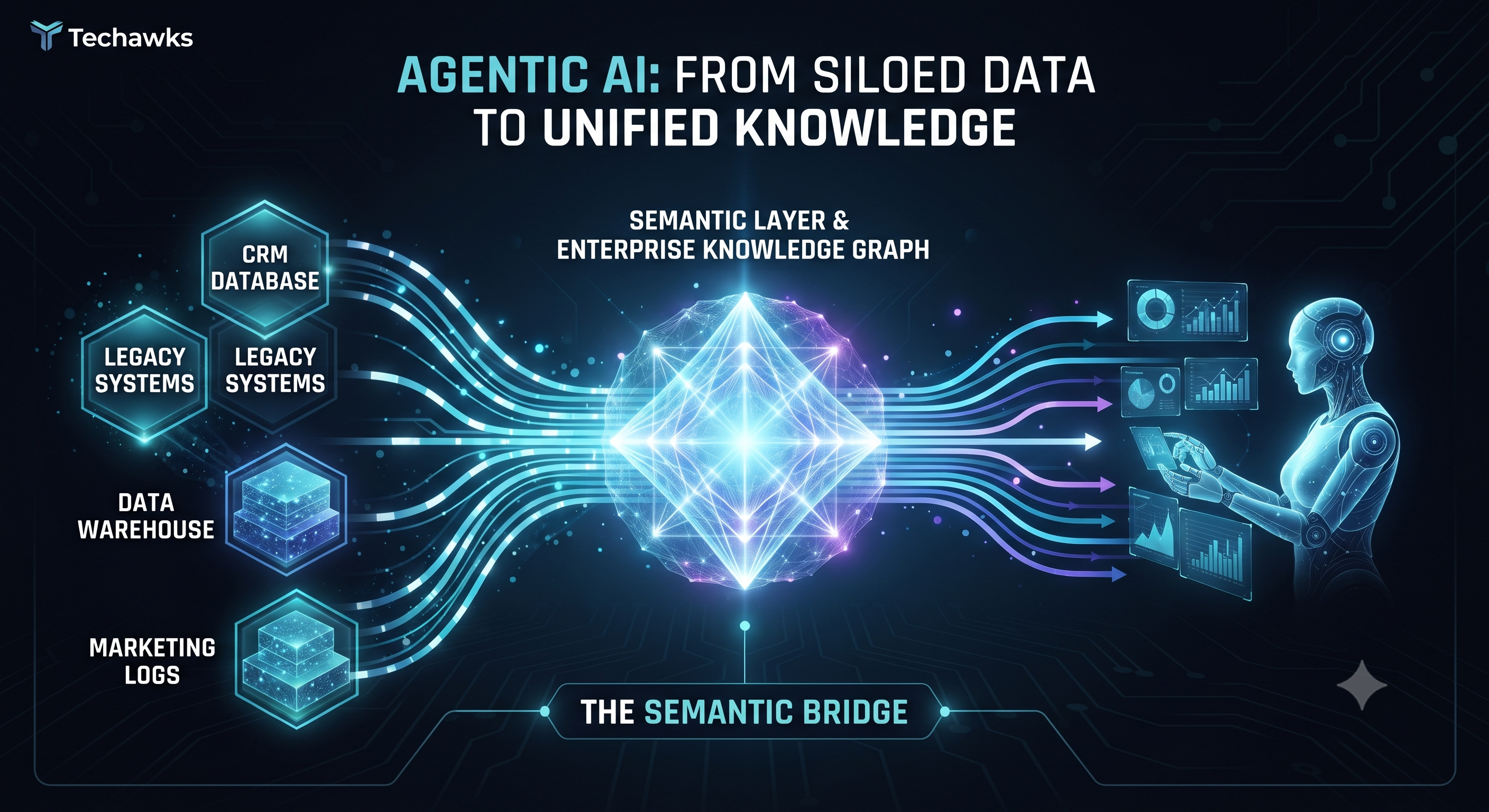
If Database A defines a "client" and Database B defines an "account", an autonomous agent will stumble, hallucinate, or fracture its execution chain trying to connect the dots. Recent enterprise infrastructure shifts—such as the introduction of unified semantic layers and enterprise knowledge graphs—highlight a critical truth: AI agents are only as intelligent as the context architecture beneath them.
What you need to know to stay ahead:
The Semantic Gap: Autonomous tools cannot reliably execute multi-system workflows without a standardized vocabulary layer that maps disparate schemas into a single business reality.
Inference Economics vs. Data Preparation: While hardware acceleration (like specialized server GPUs) speeds up raw compute, poorly structured data pipelines will bottleneck your token ROI.
The Shift to Knowledge Agents: Future engineering isn't just about prompt tuning; it’s about architecting governance rules, access controls, and relationship maps so agents can safely reason across institutional data.
Discussion Question
Is your engineering team focusing more on model selection or data infrastructure right now? How are you solving cross-system data consistency for your AI workflows?
CTA (Join Techawks General Community)
Want to stay at the intersection of enterprise architecture and cutting-edge AI development? Join the Techawks General Community today and connect with global technologists building the future.
As enterprises pivot from standalone AI chat interfaces to fully autonomous Agentic AI workflows, the bottleneck has quietly shifted. It’s no longer about model size or parameter count—it’s about data fragmentation.
If Database A defines a "client" and Database B defines an "account", an autonomous agent will stumble, hallucinate, or fracture its execution chain trying to connect the dots. Recent enterprise infrastructure shifts—such as the introduction of unified semantic layers and enterprise knowledge graphs—highlight a critical truth: AI agents are only as intelligent as the context architecture beneath them.
What you need to know to stay ahead:
The Semantic Gap: Autonomous tools cannot reliably execute multi-system workflows without a standardized vocabulary layer that maps disparate schemas into a single business reality.
Inference Economics vs. Data Preparation: While hardware acceleration (like specialized server GPUs) speeds up raw compute, poorly structured data pipelines will bottleneck your token ROI.
The Shift to Knowledge Agents: Future engineering isn't just about prompt tuning; it’s about architecting governance rules, access controls, and relationship maps so agents can safely reason across institutional data.
Discussion Question
Is your engineering team focusing more on model selection or data infrastructure right now? How are you solving cross-system data consistency for your AI workflows?
CTA (Join Techawks General Community)
Want to stay at the intersection of enterprise architecture and cutting-edge AI development? Join the Techawks General Community today and connect with global technologists building the future.
From Dashboards to Decisions: Why Agentic AI Needs a Unified Semantic Layer
As enterprises pivot from standalone AI chat interfaces to fully autonomous Agentic AI workflows, the bottleneck has quietly shifted. It’s no longer about model size or parameter count—it’s about data fragmentation.
If Database A defines a "client" and Database B defines an "account", an autonomous agent will stumble, hallucinate, or fracture its execution chain trying to connect the dots. Recent enterprise infrastructure shifts—such as the introduction of unified semantic layers and enterprise knowledge graphs—highlight a critical truth: AI agents are only as intelligent as the context architecture beneath them.
What you need to know to stay ahead:
The Semantic Gap: Autonomous tools cannot reliably execute multi-system workflows without a standardized vocabulary layer that maps disparate schemas into a single business reality.
Inference Economics vs. Data Preparation: While hardware acceleration (like specialized server GPUs) speeds up raw compute, poorly structured data pipelines will bottleneck your token ROI.
The Shift to Knowledge Agents: Future engineering isn't just about prompt tuning; it’s about architecting governance rules, access controls, and relationship maps so agents can safely reason across institutional data.
Discussion Question
Is your engineering team focusing more on model selection or data infrastructure right now? How are you solving cross-system data consistency for your AI workflows?
CTA (Join Techawks General Community)
Want to stay at the intersection of enterprise architecture and cutting-edge AI development? Join the Techawks General Community today and connect with global technologists building the future.

 English
 Arabic
 French
 Spanish
 Portuguese
 Deutsch
 Turkish
 Italiano
 Russian
 Romaian
 Portuguese (Brazil)
 Greek
Greek