


Immutable Infrastructure: The 4-Step Checklist to Eliminate Configuration Drift in Production
As cloud environments scale across multi-region clusters and automated microservices, configuration drift remains one of the most insidious threats to system stability. When servers or containers are modified over time through manual patches or hotfixes, staging and production environments diverge—making troubleshooting a nightmare and disaster recovery unpredictable.
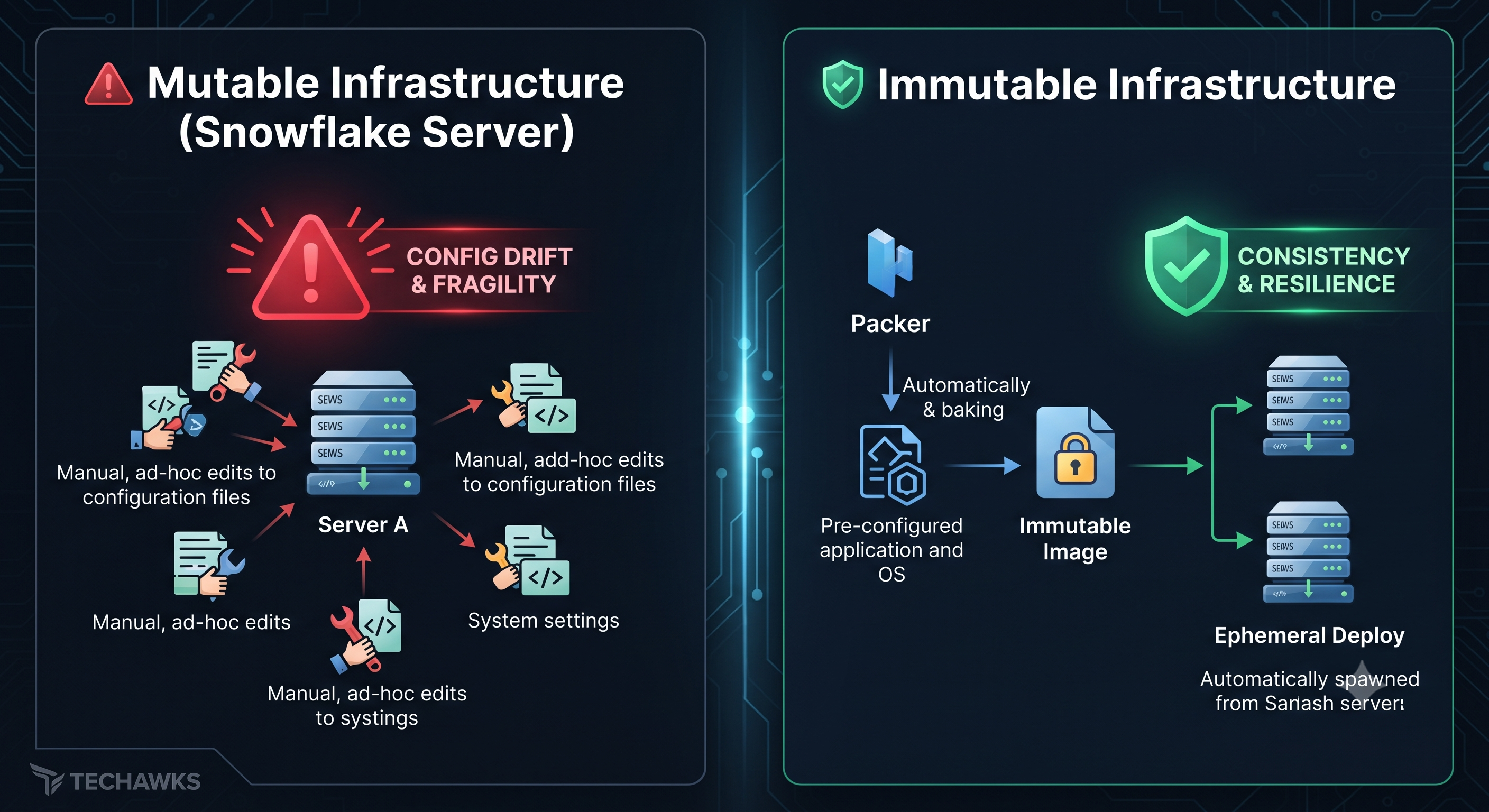
True cloud-native resilience relies on immutable infrastructure: the principle that servers are never modified after creation. If a change is needed, you destroy the instance and deploy a fresh, pre-configured image or container built from version-controlled code.
Use this 4-step checklist to enforce immutability across your cloud pipeline:
Bake Images Instead of Configuring In-Place: Use tools like Packer or Docker to pre-install all dependencies, runtime environments, and application binaries into a locked immutable image before deployment.
Lock Down Runtime Storage: Mount production container filesystems as read-only. Prevent runtime processes or applications from writing to local disk storage, forcing all persistent data into managed external databases or object stores.
Automate Infrastructure as Code (IaC): Manage all cloud networking, security groups, and compute resources through declarative code (Terraform, OpenTofu, or Pulumi) with automated drift detection enabled in your pipelines.
Enforce Ephemeral Compute Policies: Configure auto-scaling groups and container orchestrators (like Kubernetes) to regularly cycle and replace worker nodes, ensuring infrastructure stays fresh and resilient against lingering state corruption.
Discussion Question: How does your engineering team handle configuration updates in production? Are you strictly enforcing image rebuilding or relying on automated configuration management tools? Let’s discuss below!
CTA (Join Cloud, DevOps & Open Source): Want to master modern cloud architecture, infrastructure as code, and robust DevOps patterns? Join the Cloud, DevOps & Open Source community:
Immutable Infrastructure: The 4-Step Checklist to Eliminate Configuration Drift in Production
As cloud environments scale across multi-region clusters and automated microservices, configuration drift remains one of the most insidious threats to system stability. When servers or containers are modified over time through manual patches or hotfixes, staging and production environments diverge—making troubleshooting a nightmare and disaster recovery unpredictable.
True cloud-native resilience relies on immutable infrastructure: the principle that servers are never modified after creation. If a change is needed, you destroy the instance and deploy a fresh, pre-configured image or container built from version-controlled code.
Use this 4-step checklist to enforce immutability across your cloud pipeline:
Bake Images Instead of Configuring In-Place: Use tools like Packer or Docker to pre-install all dependencies, runtime environments, and application binaries into a locked immutable image before deployment.
Lock Down Runtime Storage: Mount production container filesystems as read-only. Prevent runtime processes or applications from writing to local disk storage, forcing all persistent data into managed external databases or object stores.
Automate Infrastructure as Code (IaC): Manage all cloud networking, security groups, and compute resources through declarative code (Terraform, OpenTofu, or Pulumi) with automated drift detection enabled in your pipelines.
Enforce Ephemeral Compute Policies: Configure auto-scaling groups and container orchestrators (like Kubernetes) to regularly cycle and replace worker nodes, ensuring infrastructure stays fresh and resilient against lingering state corruption.
Discussion Question: How does your engineering team handle configuration updates in production? Are you strictly enforcing image rebuilding or relying on automated configuration management tools? Let’s discuss below!
CTA (Join Cloud, DevOps & Open Source): Want to master modern cloud architecture, infrastructure as code, and robust DevOps patterns? Join the Cloud, DevOps & Open Source community:

 Arabic
 French
 Spanish
 Portuguese
 Deutsch
 Turkish
 Dutch
 Italiano
 Russian
 Romaian
 Portuguese (Brazil)
 Greek