


The Syntax Trap: Why Memorizing Code Is Ruining Your Engineering Career
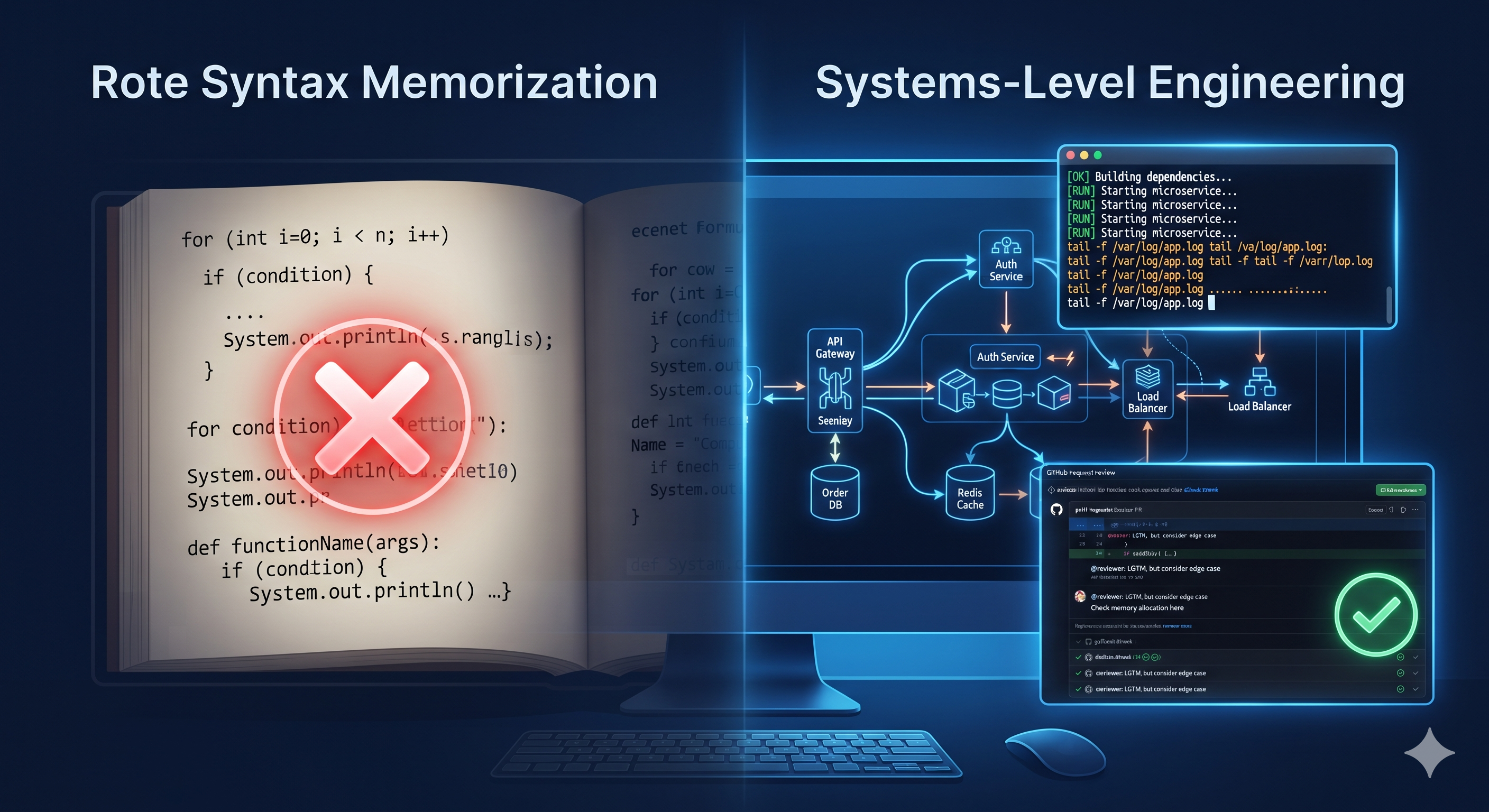
With modern software engineering ecosystems dominated by automated code generation, cloud infrastructure, and complex microservices, tech companies are no longer looking for human syntax compilers. AI can write a boilerplate function or a sorting algorithm in seconds. What AI cannot do is debug why a distributed transaction timed out across three cloud regions, or trace a memory leak hidden deep inside an unoptimized database query.
Why It Matters
When students focus entirely on language syntax and isolated algorithmic puzzles, they miss the invisible mechanics that keep real production software alive. If you don't understand how HTTP protocols work under the hood, how version control branching handles merge conflicts, or how operating systems manage memory allocation, you will struggle to move past junior-level roles. Building a lasting engineering career requires shifting your focus from writing isolated code blocks to understanding data flow, architecture, and system constraints.
What You Need to Know: The Student’s Blueprint for Real-World Competence
To bridge the gap between classroom theory and industry-grade engineering, master these core fundamentals:
Master the Command Line & Linux: Stop relying exclusively on graphical user interfaces. Most servers, containers, and cloud environments run on Linux. Learn how to navigate terminals, inspect process logs, and manage environment variables natively.
Read Code Before You Write It: Spend time exploring open-source repositories on GitHub. Read how seasoned engineers structure folder hierarchies, handle error exceptions, and write modular unit tests. Reading code is the fastest way to accelerate your own design intuition.
Trace Data from Frontend to Database: Build end-to-end applications where you manually handle API requests, validate schemas, and write raw SQL queries. Knowing how data moves across a network boundary separates average coders from true software engineers.
Discussion Question
What is the biggest gap you've noticed between what they teach you in school and what you actually need to build real-world software?
CTA (Join Students in Tech)
Want to skip the fluff, build a standout portfolio, and master the practical skills tech companies actually hire for? Join Students in Tech to connect with peers and mentors building the future of software.
With modern software engineering ecosystems dominated by automated code generation, cloud infrastructure, and complex microservices, tech companies are no longer looking for human syntax compilers. AI can write a boilerplate function or a sorting algorithm in seconds. What AI cannot do is debug why a distributed transaction timed out across three cloud regions, or trace a memory leak hidden deep inside an unoptimized database query.
Why It Matters
When students focus entirely on language syntax and isolated algorithmic puzzles, they miss the invisible mechanics that keep real production software alive. If you don't understand how HTTP protocols work under the hood, how version control branching handles merge conflicts, or how operating systems manage memory allocation, you will struggle to move past junior-level roles. Building a lasting engineering career requires shifting your focus from writing isolated code blocks to understanding data flow, architecture, and system constraints.
What You Need to Know: The Student’s Blueprint for Real-World Competence
To bridge the gap between classroom theory and industry-grade engineering, master these core fundamentals:
Master the Command Line & Linux: Stop relying exclusively on graphical user interfaces. Most servers, containers, and cloud environments run on Linux. Learn how to navigate terminals, inspect process logs, and manage environment variables natively.
Read Code Before You Write It: Spend time exploring open-source repositories on GitHub. Read how seasoned engineers structure folder hierarchies, handle error exceptions, and write modular unit tests. Reading code is the fastest way to accelerate your own design intuition.
Trace Data from Frontend to Database: Build end-to-end applications where you manually handle API requests, validate schemas, and write raw SQL queries. Knowing how data moves across a network boundary separates average coders from true software engineers.
Discussion Question
What is the biggest gap you've noticed between what they teach you in school and what you actually need to build real-world software?
CTA (Join Students in Tech)
Want to skip the fluff, build a standout portfolio, and master the practical skills tech companies actually hire for? Join Students in Tech to connect with peers and mentors building the future of software.
The Syntax Trap: Why Memorizing Code Is Ruining Your Engineering Career
With modern software engineering ecosystems dominated by automated code generation, cloud infrastructure, and complex microservices, tech companies are no longer looking for human syntax compilers. AI can write a boilerplate function or a sorting algorithm in seconds. What AI cannot do is debug why a distributed transaction timed out across three cloud regions, or trace a memory leak hidden deep inside an unoptimized database query.
Why It Matters
When students focus entirely on language syntax and isolated algorithmic puzzles, they miss the invisible mechanics that keep real production software alive. If you don't understand how HTTP protocols work under the hood, how version control branching handles merge conflicts, or how operating systems manage memory allocation, you will struggle to move past junior-level roles. Building a lasting engineering career requires shifting your focus from writing isolated code blocks to understanding data flow, architecture, and system constraints.
What You Need to Know: The Student’s Blueprint for Real-World Competence
To bridge the gap between classroom theory and industry-grade engineering, master these core fundamentals:
Master the Command Line & Linux: Stop relying exclusively on graphical user interfaces. Most servers, containers, and cloud environments run on Linux. Learn how to navigate terminals, inspect process logs, and manage environment variables natively.
Read Code Before You Write It: Spend time exploring open-source repositories on GitHub. Read how seasoned engineers structure folder hierarchies, handle error exceptions, and write modular unit tests. Reading code is the fastest way to accelerate your own design intuition.
Trace Data from Frontend to Database: Build end-to-end applications where you manually handle API requests, validate schemas, and write raw SQL queries. Knowing how data moves across a network boundary separates average coders from true software engineers.
Discussion Question
What is the biggest gap you've noticed between what they teach you in school and what you actually need to build real-world software?
CTA (Join Students in Tech)
Want to skip the fluff, build a standout portfolio, and master the practical skills tech companies actually hire for? Join Students in Tech to connect with peers and mentors building the future of software.

 English
 Arabic
 French
 Spanish
 Portuguese
 Deutsch
 Dutch
Dutch
 Italiano
 Russian
 Romaian
 Portuguese (Brazil)
 Greek
Greek