


The Configuration Drift Trap: Why Manual Hotfixes Are Silently Killing Your Multi-Cluster Uptime
With modern cloud engineering heavily dependent on declarative automation, GitOps, and complex platform architectures, operational strain is shifting away from simple resource provisioning toward fleet-wide lifecycle consistency. Enterprise data highlights that configuration drift and manual hotfixes account for the vast majority of production outages in distributed cloud environments.
Why It Matters
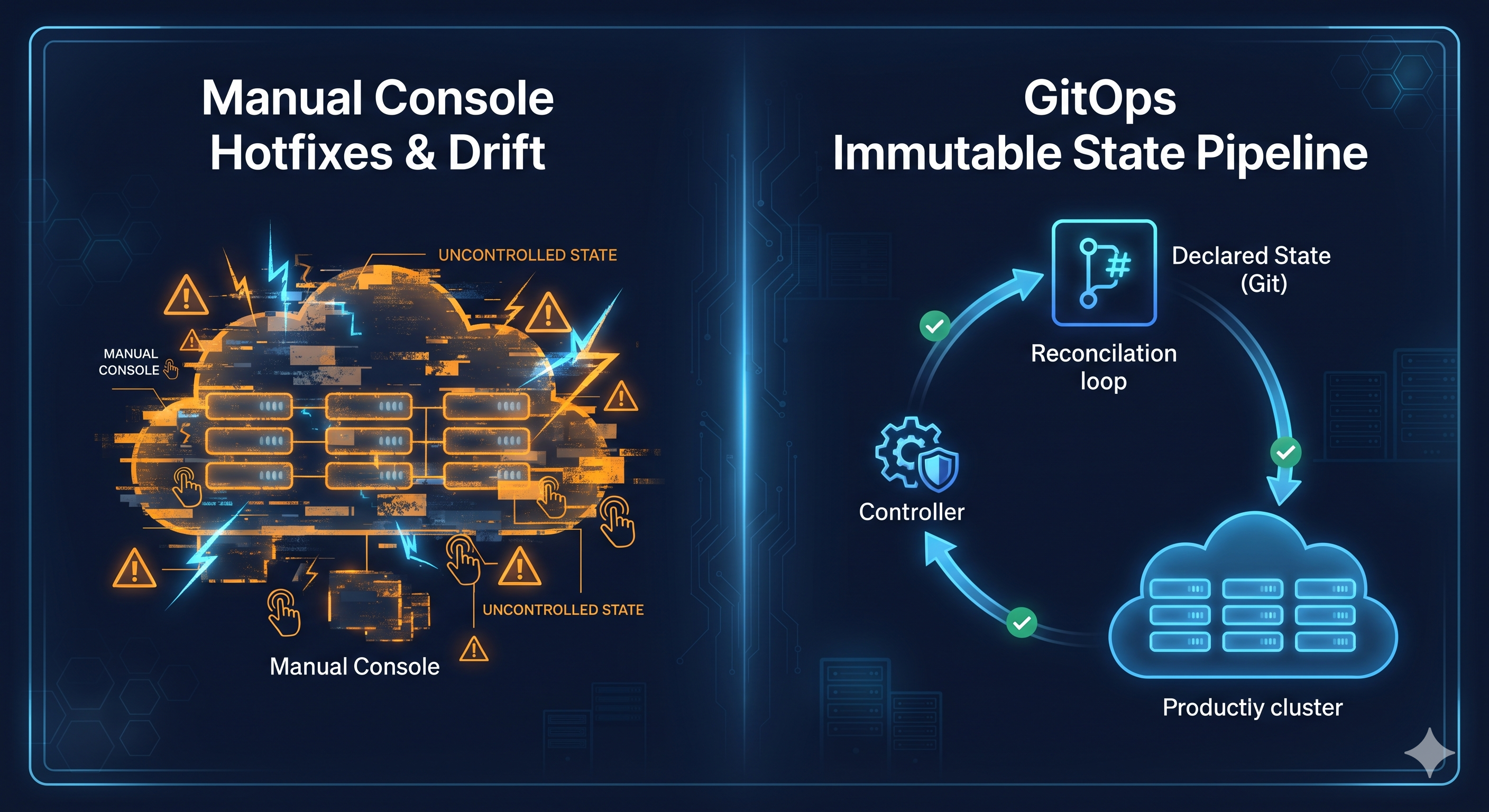
When engineers bypass declarative pipelines to make manual adjustments directly in cloud consoles or cluster nodes, they break the single source of truth. Automated CI/CD tools (like Argo CD) and Infrastructure as Code engines (like Terraform or OpenTofu) cannot protect your infrastructure if reality diverges from code. Without strict reconciliation loops and automated drift detection, your teams spend more time fighting accidental state drift than building reliable features.
What You Need to Know: Enforcing True Infrastructure Immutability
To protect your cloud environments from drift and ensure reliable scale, platform and DevOps teams must implement strict discipline:
Lock Down Direct Access: Strip away manual console write permissions for production environments. Force all changes—infrastructure adjustments, scaling patches, and security updates—through pull requests and version-controlled Git repositories.
Automate Continuous Reconciliation: Set up scheduled plan evaluations and reconciliation loops (using GitOps controllers or IaC drift alerts) that actively compare live cluster state against your declared repository state and trigger automated alerts on mismatch.
Embrace Immutable Infrastructure Patterns: Treat servers and container nodes as disposable assets. Instead of SSH-ing into a live instance to patch a bug, destroy and recreate the node from a hardened, version-controlled golden image or container registry.
Discussion Question
How do you currently handle configuration drift in your multi-cluster environments? Are you catching manual hotfixes through automated reconciliation, or only discovering them during the next deployment failure?
CTA (Join Cloud, DevOps & Open Source)
Want to master advanced Kubernetes orchestration, GitOps workflows, and production-grade infrastructure automation? Join Cloud, DevOps & Open Source to connect with global cloud engineers building resilient systems.
With modern cloud engineering heavily dependent on declarative automation, GitOps, and complex platform architectures, operational strain is shifting away from simple resource provisioning toward fleet-wide lifecycle consistency. Enterprise data highlights that configuration drift and manual hotfixes account for the vast majority of production outages in distributed cloud environments.
Why It Matters
When engineers bypass declarative pipelines to make manual adjustments directly in cloud consoles or cluster nodes, they break the single source of truth. Automated CI/CD tools (like Argo CD) and Infrastructure as Code engines (like Terraform or OpenTofu) cannot protect your infrastructure if reality diverges from code. Without strict reconciliation loops and automated drift detection, your teams spend more time fighting accidental state drift than building reliable features.
What You Need to Know: Enforcing True Infrastructure Immutability
To protect your cloud environments from drift and ensure reliable scale, platform and DevOps teams must implement strict discipline:
Lock Down Direct Access: Strip away manual console write permissions for production environments. Force all changes—infrastructure adjustments, scaling patches, and security updates—through pull requests and version-controlled Git repositories.
Automate Continuous Reconciliation: Set up scheduled plan evaluations and reconciliation loops (using GitOps controllers or IaC drift alerts) that actively compare live cluster state against your declared repository state and trigger automated alerts on mismatch.
Embrace Immutable Infrastructure Patterns: Treat servers and container nodes as disposable assets. Instead of SSH-ing into a live instance to patch a bug, destroy and recreate the node from a hardened, version-controlled golden image or container registry.
Discussion Question
How do you currently handle configuration drift in your multi-cluster environments? Are you catching manual hotfixes through automated reconciliation, or only discovering them during the next deployment failure?
CTA (Join Cloud, DevOps & Open Source)
Want to master advanced Kubernetes orchestration, GitOps workflows, and production-grade infrastructure automation? Join Cloud, DevOps & Open Source to connect with global cloud engineers building resilient systems.
The Configuration Drift Trap: Why Manual Hotfixes Are Silently Killing Your Multi-Cluster Uptime
With modern cloud engineering heavily dependent on declarative automation, GitOps, and complex platform architectures, operational strain is shifting away from simple resource provisioning toward fleet-wide lifecycle consistency. Enterprise data highlights that configuration drift and manual hotfixes account for the vast majority of production outages in distributed cloud environments.
Why It Matters
When engineers bypass declarative pipelines to make manual adjustments directly in cloud consoles or cluster nodes, they break the single source of truth. Automated CI/CD tools (like Argo CD) and Infrastructure as Code engines (like Terraform or OpenTofu) cannot protect your infrastructure if reality diverges from code. Without strict reconciliation loops and automated drift detection, your teams spend more time fighting accidental state drift than building reliable features.
What You Need to Know: Enforcing True Infrastructure Immutability
To protect your cloud environments from drift and ensure reliable scale, platform and DevOps teams must implement strict discipline:
Lock Down Direct Access: Strip away manual console write permissions for production environments. Force all changes—infrastructure adjustments, scaling patches, and security updates—through pull requests and version-controlled Git repositories.
Automate Continuous Reconciliation: Set up scheduled plan evaluations and reconciliation loops (using GitOps controllers or IaC drift alerts) that actively compare live cluster state against your declared repository state and trigger automated alerts on mismatch.
Embrace Immutable Infrastructure Patterns: Treat servers and container nodes as disposable assets. Instead of SSH-ing into a live instance to patch a bug, destroy and recreate the node from a hardened, version-controlled golden image or container registry.
Discussion Question
How do you currently handle configuration drift in your multi-cluster environments? Are you catching manual hotfixes through automated reconciliation, or only discovering them during the next deployment failure?
CTA (Join Cloud, DevOps & Open Source)
Want to master advanced Kubernetes orchestration, GitOps workflows, and production-grade infrastructure automation? Join Cloud, DevOps & Open Source to connect with global cloud engineers building resilient systems.

 English
 Arabic
 French
 Spanish
 Portuguese
 Deutsch
 Dutch
Dutch
 Italiano
 Russian
 Romaian
 Portuguese (Brazil)
 Greek
Greek