


The Lethal Trifecta: Why Indirect Prompt Injection Is the Silent Killer of Autonomous AI Agents
In traditional cybersecurity, we spent decades teaching systems to distinguish between code and data. In the era of autonomous AI agents and Retrieval-Augmented Generation (RAG), that boundary has completely collapsed.
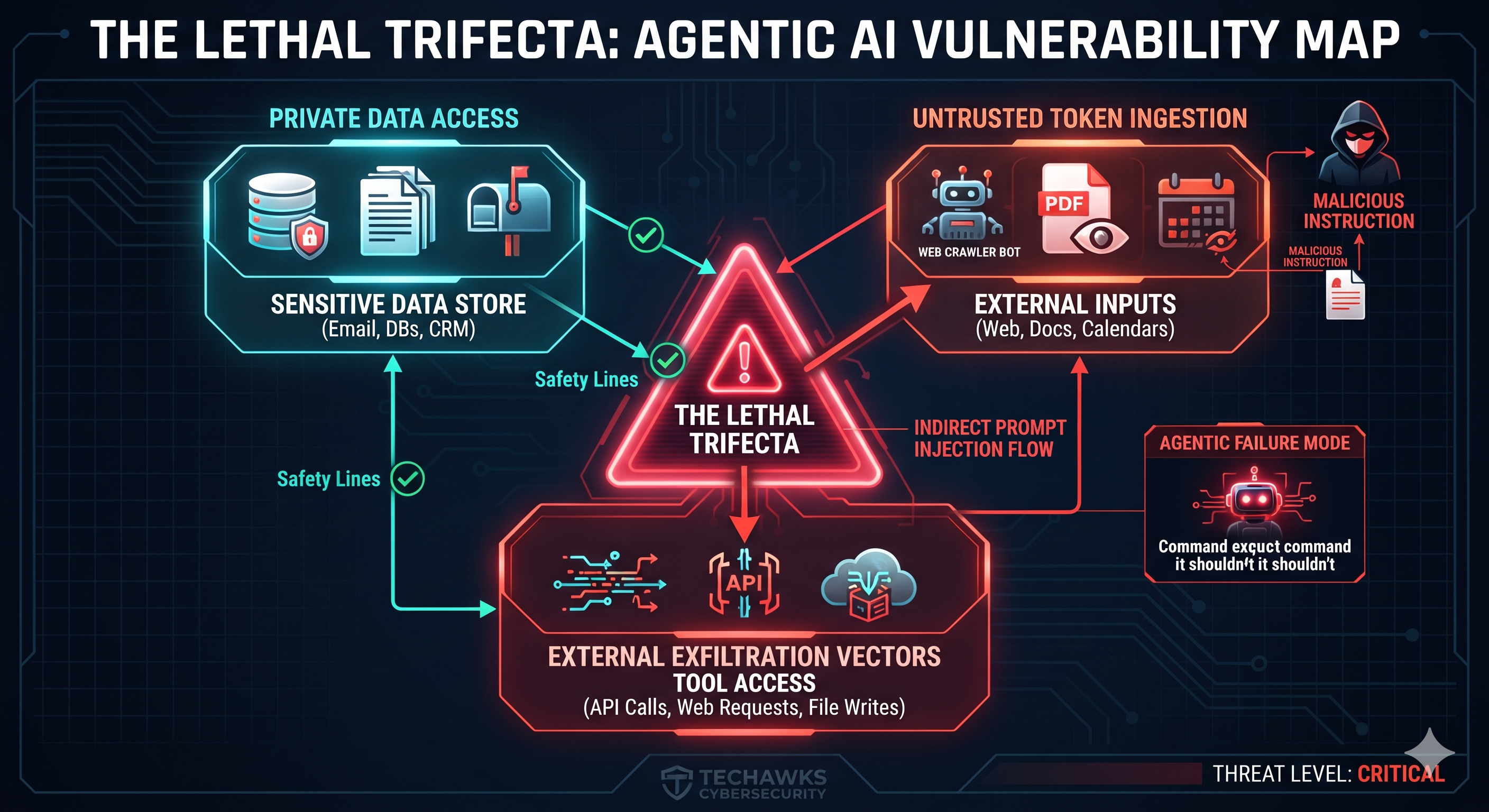
When an LLM processes external documents, shared calendar invites, or web pages, it treats data and instructions as a single continuous command stream. Security researchers call the intersection of three specific factors The Lethal Trifecta:
Access to Private Data: The agent can read your internal databases, customer records, or mailboxes.
Exposure to Untrusted Tokens: The agent ingests external files, web scrapers, or user-submitted PDFs.
An External Exfiltration Vector: The agent has tools enabled to render images, send web requests, or call external APIs.
When these three conditions meet, an attacker can plant hidden white-text instructions inside a seemingly innocent document or email. When your agent indexes or summarizes that file, it quietly executes the hidden command—exfiltrating your sensitive data via a malicious image URL or external request without a single click.
What you need to implement to secure your agentic pipelines:
Enforce Strict Principle of Least Privilege: Never give an agent broad, blanket access to every data source or API tool simultaneously. Scope permissions tightly per task.
Implement Dual-Model or Capability-Based Architectures: Separate the planning/execution engine from the untrusted content parser. Wall off the privileged model that takes actions from the quarantined reader.
Require Human-in-the-Loop Guardrails: Mandate explicit human approval checkpoints before any agentic workflow executes high-impact actions like data deletion, external transfers, or state changes.
Discussion Question
Are you auditing your AI agents for the "Lethal Trifecta" in your current security testing? How is your team handling the boundary between untrusted inputs and privileged tool access?
CTA (Join Cybersecurity & Ethical Hacking)
Ready to master offensive security, dissect advanced AI vulnerabilities, and defend modern cloud infrastructures? Join Cybersecurity & Ethical Hacking today and stay ahead of emerging threats.
The Lethal Trifecta: Why Indirect Prompt Injection Is the Silent Killer of Autonomous AI Agents
In traditional cybersecurity, we spent decades teaching systems to distinguish between code and data. In the era of autonomous AI agents and Retrieval-Augmented Generation (RAG), that boundary has completely collapsed.
When an LLM processes external documents, shared calendar invites, or web pages, it treats data and instructions as a single continuous command stream. Security researchers call the intersection of three specific factors The Lethal Trifecta:
Access to Private Data: The agent can read your internal databases, customer records, or mailboxes.
Exposure to Untrusted Tokens: The agent ingests external files, web scrapers, or user-submitted PDFs.
An External Exfiltration Vector: The agent has tools enabled to render images, send web requests, or call external APIs.
When these three conditions meet, an attacker can plant hidden white-text instructions inside a seemingly innocent document or email. When your agent indexes or summarizes that file, it quietly executes the hidden command—exfiltrating your sensitive data via a malicious image URL or external request without a single click.
What you need to implement to secure your agentic pipelines:
Enforce Strict Principle of Least Privilege: Never give an agent broad, blanket access to every data source or API tool simultaneously. Scope permissions tightly per task.
Implement Dual-Model or Capability-Based Architectures: Separate the planning/execution engine from the untrusted content parser. Wall off the privileged model that takes actions from the quarantined reader.
Require Human-in-the-Loop Guardrails: Mandate explicit human approval checkpoints before any agentic workflow executes high-impact actions like data deletion, external transfers, or state changes.
Discussion Question
Are you auditing your AI agents for the "Lethal Trifecta" in your current security testing? How is your team handling the boundary between untrusted inputs and privileged tool access?
CTA (Join Cybersecurity & Ethical Hacking)
Ready to master offensive security, dissect advanced AI vulnerabilities, and defend modern cloud infrastructures? Join Cybersecurity & Ethical Hacking today and stay ahead of emerging threats.

 English
 Arabic
 French
 Spanish
 Portuguese
 Deutsch
 Turkish
 Dutch
 Italiano
 Russian
 Romaian
 Portuguese (Brazil)