


The Death of the Wild-West CI/CD Pipeline: Why Platform Engineering Is Replacing Traditional DevOps
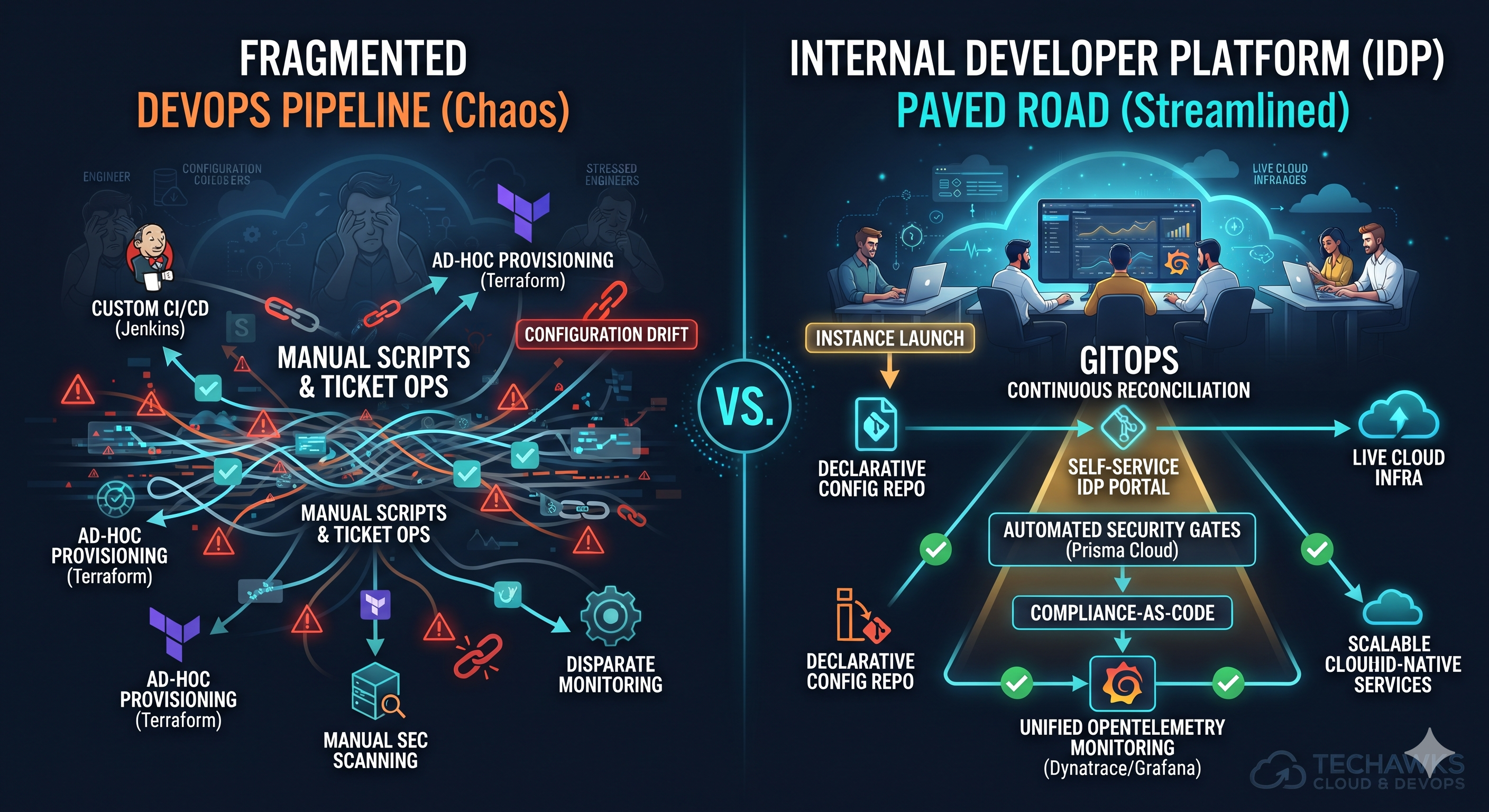
For years, "DevOps" became a catch-all term where software engineers were expected to manage everything from application logic to Kubernetes cluster tuning, security scanning, and cloud cost optimization. The result? Burnout, severe configuration drift, and pipelines that break every time an upstream dependency updates.
That is why leading engineering organizations are rapidly shifting toward Platform Engineering and Internal Developer Platforms (IDPs). Instead of treating developers as infrastructure cowboys, platform teams build "paved roads"—standardized, self-service operational workflows that abstract away cloud complexity.
What you need to implement in your cloud architecture right now:
Treat Your Platform as a Product: Build an internal developer portal (using tools like Backstage or custom IDPs) where developers can spin up production-ready, compliant microservices with a single click.
Enforce GitOps as the Single Source of Truth: Move away from manual kubectl commands or disparate CI/CD server scripts. Use GitOps engines (like Argo CD or Flux) to continuously reconcile your live cloud state with declarative code.
Embed Policy and Security as Code: Stop using manual security review boards that slow down releases. Build automated compliance, vulnerability scanning, and OpenTelemetry observability directly into the deployment pipeline from day one.
Discussion Question
Is your engineering organization moving toward internal developer platforms and paved roads, or are your teams still building custom pipelines from scratch for every new service?
CTA (Join Cloud, DevOps & Open Source)
Ready to master cloud-native architecture, scale resilient infrastructure, and build the future of platform engineering with global experts? Join Cloud, DevOps & Open Source today and elevate your engineering career.
The Death of the Wild-West CI/CD Pipeline: Why Platform Engineering Is Replacing Traditional DevOps
For years, "DevOps" became a catch-all term where software engineers were expected to manage everything from application logic to Kubernetes cluster tuning, security scanning, and cloud cost optimization. The result? Burnout, severe configuration drift, and pipelines that break every time an upstream dependency updates.
That is why leading engineering organizations are rapidly shifting toward Platform Engineering and Internal Developer Platforms (IDPs). Instead of treating developers as infrastructure cowboys, platform teams build "paved roads"—standardized, self-service operational workflows that abstract away cloud complexity.
What you need to implement in your cloud architecture right now:
Treat Your Platform as a Product: Build an internal developer portal (using tools like Backstage or custom IDPs) where developers can spin up production-ready, compliant microservices with a single click.
Enforce GitOps as the Single Source of Truth: Move away from manual kubectl commands or disparate CI/CD server scripts. Use GitOps engines (like Argo CD or Flux) to continuously reconcile your live cloud state with declarative code.
Embed Policy and Security as Code: Stop using manual security review boards that slow down releases. Build automated compliance, vulnerability scanning, and OpenTelemetry observability directly into the deployment pipeline from day one.
Discussion Question
Is your engineering organization moving toward internal developer platforms and paved roads, or are your teams still building custom pipelines from scratch for every new service?
CTA (Join Cloud, DevOps & Open Source)
Ready to master cloud-native architecture, scale resilient infrastructure, and build the future of platform engineering with global experts? Join Cloud, DevOps & Open Source today and elevate your engineering career.

 English
 Arabic
 French
 Spanish
 Deutsch
 Turkish
 Dutch
 Italiano
 Russian
 Romaian
 Portuguese (Brazil)
 Greek