


The 5-Step System Architecture Checklist Every Engineer Needs Before Scaling
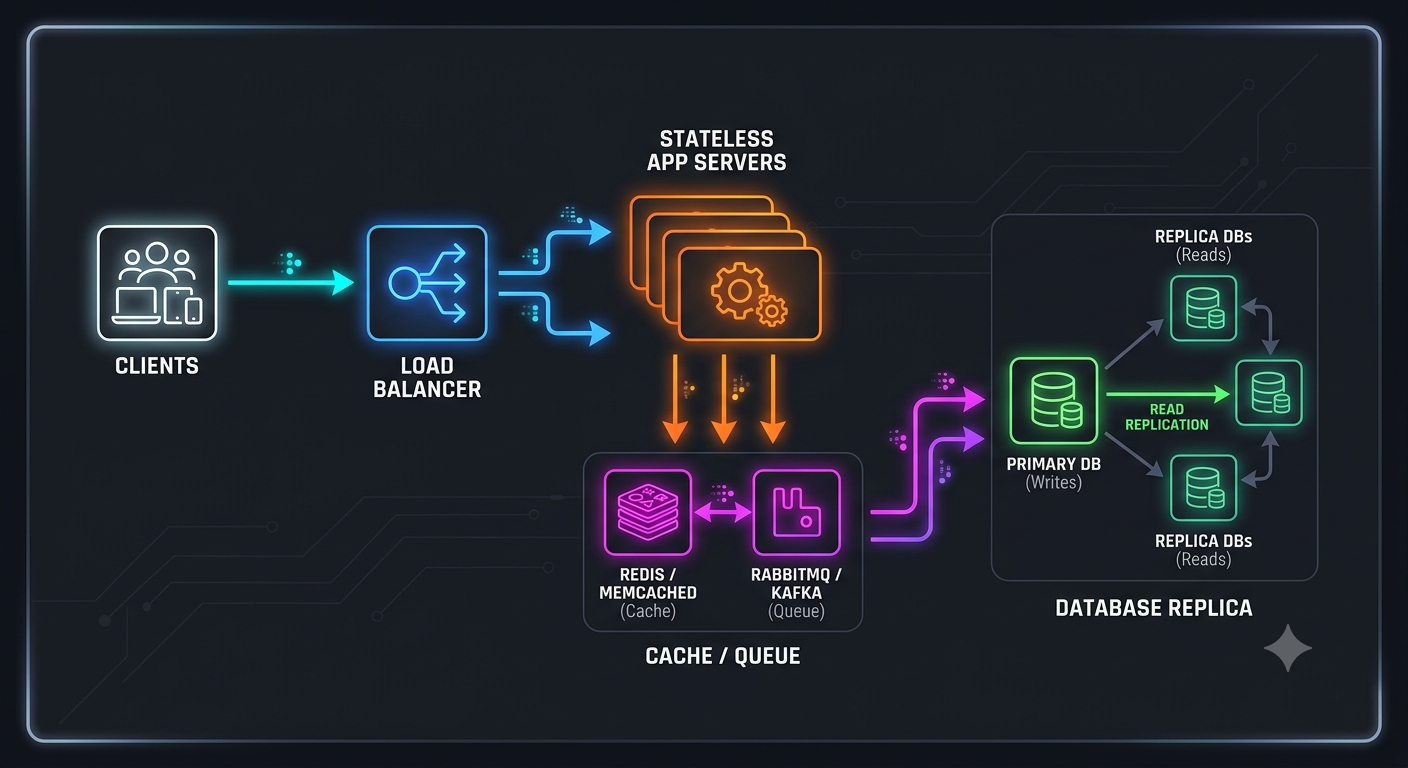
System design isn't just for senior architects; it’s a muscle every software engineer needs to build. When traffic spikes or data volume grows exponentially, unoptimized architectures fail in predictable ways: database bottlenecks, unhandled latency, and single points of failure.
To build systems that scale gracefully and remain easy to maintain, evaluate your stack against these five core layers:
Stateless Application Layers
Keep your application servers stateless.
Store user sessions in an in-memory datastore (like Redis) rather than local server memory. This allows you to scale horizontally by simply spinning up extra instances behind a load balancer.
Database Optimization & Caching
Never let read-heavy operations hit your primary database directly.
Implement a caching layer (Write-Through or Cache-Aside pattern) for frequently accessed, slow-changing data. Index your query fields properly to prevent full table scans.
Asynchronous Processing
Decouple heavy, non-critical tasks (e.g., sending emails, video processing, generating reports) from the main request-response cycle.
Use message queues (such as RabbitMQ or Apache Kafka) to handle background jobs without blocking the client.
Redundancy & Failover Systems
Identify your Single Points of Failure (SPOFs).
Ensure multi-region or multi-zone database replication with automated failovers so your system stays operational even if an entire availability zone goes down.
Observability & Rate Limiting
You can't fix what you can't see. Implement structured logging, distributed tracing, and real-time metrics.
Apply API rate limiting at the gateway layer to protect your downstream services from accidental self-DOS or bad actors.
Key Takeaways
Decouple everything: Asynchronous queues prevent cascading system failures.
Cache aggressively, but invalidate wisely: Protect your database from repetitive read loads.
Design for failure: Assume servers will crash, network calls will time out, and databases will fail over.
CTA
Looking to master high-availability systems and refine your tech stack?
[Join the Techawks General Community] to collaborate with thousands of developers, share architecture blueprints, and elevate your engineering skills daily.
System design isn't just for senior architects; it’s a muscle every software engineer needs to build. When traffic spikes or data volume grows exponentially, unoptimized architectures fail in predictable ways: database bottlenecks, unhandled latency, and single points of failure.
To build systems that scale gracefully and remain easy to maintain, evaluate your stack against these five core layers:
Stateless Application Layers
Keep your application servers stateless.
Store user sessions in an in-memory datastore (like Redis) rather than local server memory. This allows you to scale horizontally by simply spinning up extra instances behind a load balancer.
Database Optimization & Caching
Never let read-heavy operations hit your primary database directly.
Implement a caching layer (Write-Through or Cache-Aside pattern) for frequently accessed, slow-changing data. Index your query fields properly to prevent full table scans.
Asynchronous Processing
Decouple heavy, non-critical tasks (e.g., sending emails, video processing, generating reports) from the main request-response cycle.
Use message queues (such as RabbitMQ or Apache Kafka) to handle background jobs without blocking the client.
Redundancy & Failover Systems
Identify your Single Points of Failure (SPOFs).
Ensure multi-region or multi-zone database replication with automated failovers so your system stays operational even if an entire availability zone goes down.
Observability & Rate Limiting
You can't fix what you can't see. Implement structured logging, distributed tracing, and real-time metrics.
Apply API rate limiting at the gateway layer to protect your downstream services from accidental self-DOS or bad actors.
Key Takeaways
Decouple everything: Asynchronous queues prevent cascading system failures.
Cache aggressively, but invalidate wisely: Protect your database from repetitive read loads.
Design for failure: Assume servers will crash, network calls will time out, and databases will fail over.
CTA
Looking to master high-availability systems and refine your tech stack?
[Join the Techawks General Community] to collaborate with thousands of developers, share architecture blueprints, and elevate your engineering skills daily.
The 5-Step System Architecture Checklist Every Engineer Needs Before Scaling
System design isn't just for senior architects; it’s a muscle every software engineer needs to build. When traffic spikes or data volume grows exponentially, unoptimized architectures fail in predictable ways: database bottlenecks, unhandled latency, and single points of failure.
To build systems that scale gracefully and remain easy to maintain, evaluate your stack against these five core layers:
Stateless Application Layers
Keep your application servers stateless.
Store user sessions in an in-memory datastore (like Redis) rather than local server memory. This allows you to scale horizontally by simply spinning up extra instances behind a load balancer.
Database Optimization & Caching
Never let read-heavy operations hit your primary database directly.
Implement a caching layer (Write-Through or Cache-Aside pattern) for frequently accessed, slow-changing data. Index your query fields properly to prevent full table scans.
Asynchronous Processing
Decouple heavy, non-critical tasks (e.g., sending emails, video processing, generating reports) from the main request-response cycle.
Use message queues (such as RabbitMQ or Apache Kafka) to handle background jobs without blocking the client.
Redundancy & Failover Systems
Identify your Single Points of Failure (SPOFs).
Ensure multi-region or multi-zone database replication with automated failovers so your system stays operational even if an entire availability zone goes down.
Observability & Rate Limiting
You can't fix what you can't see. Implement structured logging, distributed tracing, and real-time metrics.
Apply API rate limiting at the gateway layer to protect your downstream services from accidental self-DOS or bad actors.
Key Takeaways
Decouple everything: Asynchronous queues prevent cascading system failures.
Cache aggressively, but invalidate wisely: Protect your database from repetitive read loads.
Design for failure: Assume servers will crash, network calls will time out, and databases will fail over.
CTA
Looking to master high-availability systems and refine your tech stack?
[Join the Techawks General Community] to collaborate with thousands of developers, share architecture blueprints, and elevate your engineering skills daily.

 English
 Arabic
 French
 Spanish
 Portuguese
 Deutsch
 Turkish
 Dutch
Dutch
 Italiano
 Russian
 Romaian
 Greek
Greek