


Your Biggest Untracked Cost Isn’t Cloud Spend: It’s the "Validation Valley of Death"
Founders often fall into the "Building Trap." Fresh off a pre-seed or seed raise, the temptation is to hire engineers and build the definitive, containerized, microservice-based vision of your product.
But in early-stage ventures, early engineering is frequently premature optimization.
When you build a robust backend too soon, three deadly things happen:
Financial Squeeze: Engineering salaries and bloated infrastructure chew up 50–68% of early operating costs. That is runway you are burning before proving anyone wants what you’re making.
Feature Debt: Early code is a liability, not an asset. Every custom database schema or authorization loop you build is a concrete anchor that makes pivoting your product model 10x harder.
The Illusory Validate-after-Build Loop: "If we build it, they will come" is a fallacy. Building first leads to trying to retroactively fit a market to your expensive tech, rather than vice versa.
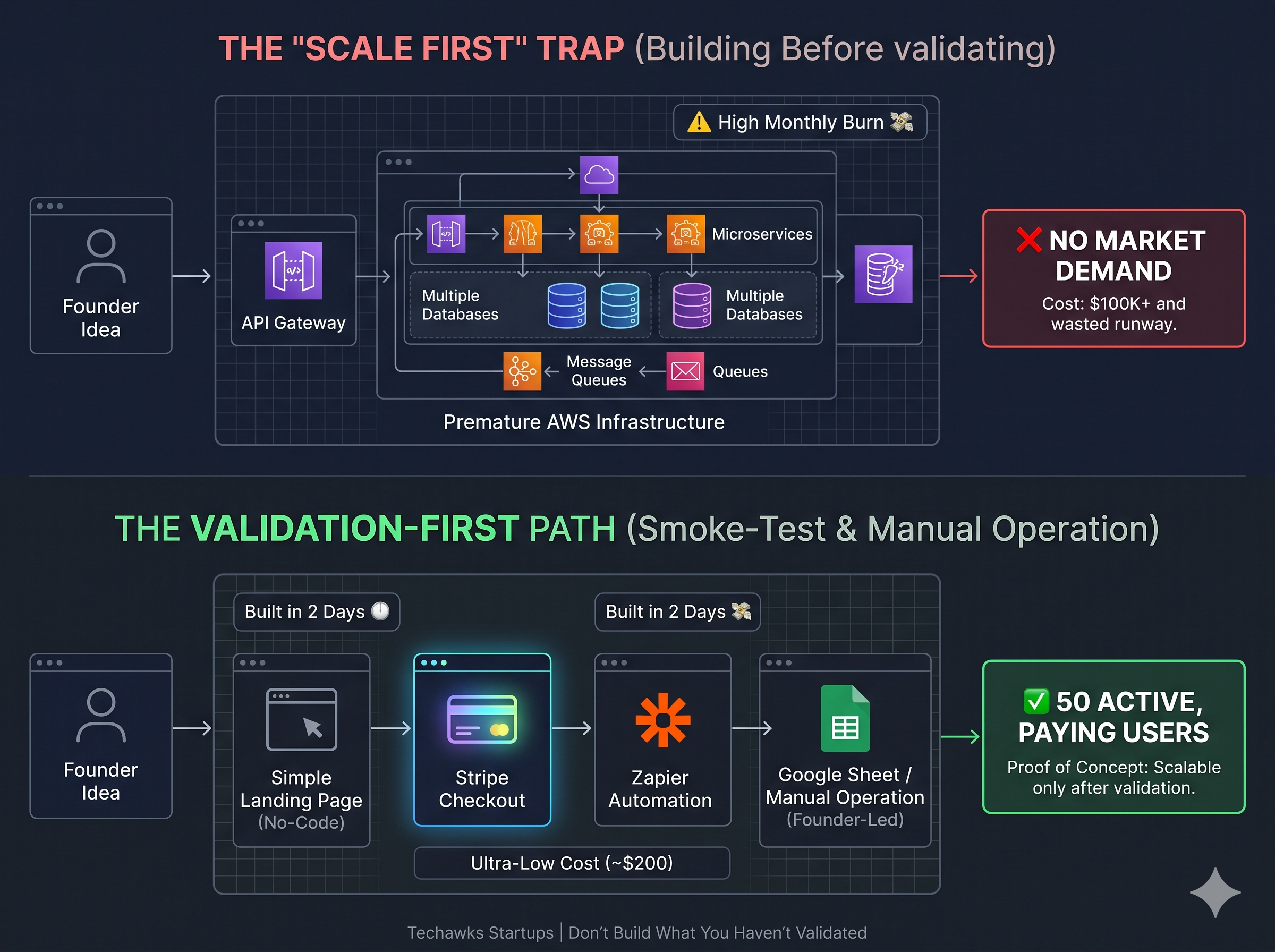
The founders who survive to Series A in 2026 practice Validation-First Prototyping (or the "Mechanical Turk" strategy):
[ Traditional Trap ]
API / DB / Cloud Cost --> Months of Dev --> ❌ Lack of Demand
▲
│
[ FOUNDER IDEA ]
│
▼
[ validation-first prototyping ]
┌───────────────────────────┼───────────────────────────┐
▼ ▼ ▼
[ The Promise Layer ] [ The Action Layer ] [ The Reality Layer ]
• High-converting lander• AirTable / No-Code • High-touch manual work
• Paid ads / Outbound • Trigger automations • Direct user feedback
• Explicit pre-orders • Scraped / manual tasks • Unverified = Pivot instantly
The Validation-First Startup Playbook
1. Market-Test with "Fake Features" First:
Before you write a single line of backend logic for a complex new tool, build the landing page, UI buttons, and workflows. Show users a "Priority Access" or "Generating your report—we'll email you shortly" screen. This allows you to verify that they actually want the output before you build the engine to generate it.
2. Rely on a "Manual API" (The Mechanical Turk Method):
Do not automate what you can do yourself in a spreadsheet. Run your startup on Airtable, Google Sheets, Zapier, and manual effort for the first 50 customers. If you can’t make 50 people happy using manual labor, a million-dollar SaaS platform won’t help either.
3. Swap Big Infrastructure for Throwaway Platforms:
Don't mess with Kubernetes or multi-region setups on AWS on day one. Use Vercel, Supabase, or standard no-code/low-code tools to get things live in hours. If your servers crash because of too much traffic, that's a good problem to have—and a strong signal that it’s actually time to hire developers and invest in scale.
4. Maximize Your Runaway with Bare-Bones "Micro-Tests":
Set tight, 2-week validation deadlines. Give yourself a small budget ($500–$1,000) for ads or outreach to see if you can get clicks and sign-ups. If nobody bites, change your focus. Finding out something doesn't work in 14 days is a major win compared to finding out in 6 months after spending $80k.
Do not build a rocket ship if you do not know where you are flying. Build a kite first, see where the wind is going, and then invest in the engine.
Discussion Question
For early-stage founders: What did you build early on that you ended up completely throwing away? If you could do it over, how would you have "smoke-tested" that idea manually with zero code?
CTA
Ready to build, launch, and validate your business alongside hundreds of savvy founders and tech leaders?
👉 Join the Techawks Startup Founders & Entrepreneurs Community today: [techawks.io/join-startups]
Your Biggest Untracked Cost Isn’t Cloud Spend: It’s the "Validation Valley of Death"
Founders often fall into the "Building Trap." Fresh off a pre-seed or seed raise, the temptation is to hire engineers and build the definitive, containerized, microservice-based vision of your product.
But in early-stage ventures, early engineering is frequently premature optimization.
When you build a robust backend too soon, three deadly things happen:
Financial Squeeze: Engineering salaries and bloated infrastructure chew up 50–68% of early operating costs. That is runway you are burning before proving anyone wants what you’re making.
Feature Debt: Early code is a liability, not an asset. Every custom database schema or authorization loop you build is a concrete anchor that makes pivoting your product model 10x harder.
The Illusory Validate-after-Build Loop: "If we build it, they will come" is a fallacy. Building first leads to trying to retroactively fit a market to your expensive tech, rather than vice versa.
The founders who survive to Series A in 2026 practice Validation-First Prototyping (or the "Mechanical Turk" strategy):
[ Traditional Trap ]
API / DB / Cloud Cost --> Months of Dev --> ❌ Lack of Demand
▲
│
[ FOUNDER IDEA ]
│
▼
[ validation-first prototyping ]
┌───────────────────────────┼───────────────────────────┐
▼ ▼ ▼
[ The Promise Layer ] [ The Action Layer ] [ The Reality Layer ]
• High-converting lander• AirTable / No-Code • High-touch manual work
• Paid ads / Outbound • Trigger automations • Direct user feedback
• Explicit pre-orders • Scraped / manual tasks • Unverified = Pivot instantly
The Validation-First Startup Playbook
1. Market-Test with "Fake Features" First:
Before you write a single line of backend logic for a complex new tool, build the landing page, UI buttons, and workflows. Show users a "Priority Access" or "Generating your report—we'll email you shortly" screen. This allows you to verify that they actually want the output before you build the engine to generate it.
2. Rely on a "Manual API" (The Mechanical Turk Method):
Do not automate what you can do yourself in a spreadsheet. Run your startup on Airtable, Google Sheets, Zapier, and manual effort for the first 50 customers. If you can’t make 50 people happy using manual labor, a million-dollar SaaS platform won’t help either.
3. Swap Big Infrastructure for Throwaway Platforms:
Don't mess with Kubernetes or multi-region setups on AWS on day one. Use Vercel, Supabase, or standard no-code/low-code tools to get things live in hours. If your servers crash because of too much traffic, that's a good problem to have—and a strong signal that it’s actually time to hire developers and invest in scale.
4. Maximize Your Runaway with Bare-Bones "Micro-Tests":
Set tight, 2-week validation deadlines. Give yourself a small budget ($500–$1,000) for ads or outreach to see if you can get clicks and sign-ups. If nobody bites, change your focus. Finding out something doesn't work in 14 days is a major win compared to finding out in 6 months after spending $80k.
Do not build a rocket ship if you do not know where you are flying. Build a kite first, see where the wind is going, and then invest in the engine.
Discussion Question
For early-stage founders: What did you build early on that you ended up completely throwing away? If you could do it over, how would you have "smoke-tested" that idea manually with zero code?
CTA
Ready to build, launch, and validate your business alongside hundreds of savvy founders and tech leaders?
👉 Join the Techawks Startup Founders & Entrepreneurs Community today: [techawks.io/join-startups]

 English
 Arabic
 French
 Spanish
 Portuguese
 Deutsch
 Turkish
 Italiano
 Russian
 Romaian
 Portuguese (Brazil)
 Greek