


Demystifying API Protocols: REST, GraphQL, and gRPC Explained
As modern applications grow increasingly modular, how your services communicate with each other becomes a critical design choice. While REST remains the default for web APIs, specialized alternatives like GraphQL and gRPC have become essential tools for solving specific scale challenges.
Here is how the three major protocols stack up and when to deploy each:
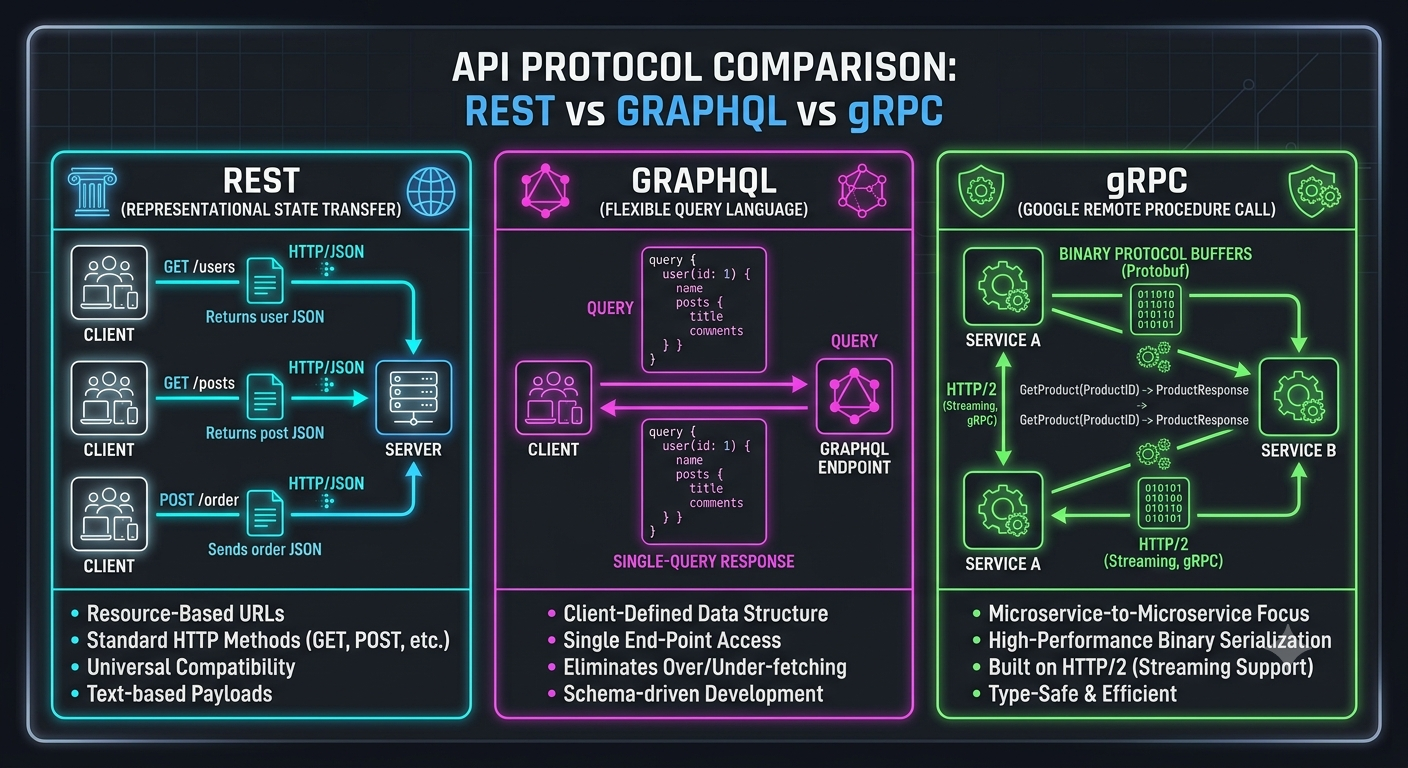
1 REST (Representational State Transfer)
How it works: Relies on standard HTTP verbs (GET, POST, PUT, DELETE) and resources identified by URLs.
Best for: Public-facing web APIs, standard CRUD applications, and scenarios where HTTP caching is heavily leveraged.
Trade-off: Vulnerable to over-fetching (getting data you don't need) or under-fetching (requiring multiple round trips for complex UI screens).
2 GraphQL
How it works: Uses a single endpoint where clients declare the exact structure of the data they require using a flexible query language.
Best for: Mobile applications, rich front-end interfaces, and multi-device platforms where bandwidth efficiency and minimizing network round-trips are crucial.
Trade-off: Adds complexity to backend caching and can expose your server to expensive, deeply nested queries if not properly rate-limited.
3 gRPC (Google Remote Procedure Call)
How it works: Runs over HTTP/2 using Protocol Buffers (Protobuf) to serialize data into binary payloads instead of text-based JSON.
Best for: Microservice-to-microservice internal communication, real-time streaming, and high-performance networks requiring ultra-low latency.
Trade-off: Lacks native web browser support (requires proxy translation) and human-readable payload debugging without dedicated tooling.
Key Takeaways
REST for simple, universally compatible, public-facing services.
GraphQL for frontend-driven apps needing granular data control and minimal network calls.
gRPC for high-throughput, low-latency microservice architectures.
CTA
Want to sharpen your software architecture skills and stay ahead of modern backend practices?
[Join the Techawks General Community] to connect with developers worldwide, share real-world code patterns, and learn together.
As modern applications grow increasingly modular, how your services communicate with each other becomes a critical design choice. While REST remains the default for web APIs, specialized alternatives like GraphQL and gRPC have become essential tools for solving specific scale challenges.
Here is how the three major protocols stack up and when to deploy each:
1 REST (Representational State Transfer)
How it works: Relies on standard HTTP verbs (GET, POST, PUT, DELETE) and resources identified by URLs.
Best for: Public-facing web APIs, standard CRUD applications, and scenarios where HTTP caching is heavily leveraged.
Trade-off: Vulnerable to over-fetching (getting data you don't need) or under-fetching (requiring multiple round trips for complex UI screens).
2 GraphQL
How it works: Uses a single endpoint where clients declare the exact structure of the data they require using a flexible query language.
Best for: Mobile applications, rich front-end interfaces, and multi-device platforms where bandwidth efficiency and minimizing network round-trips are crucial.
Trade-off: Adds complexity to backend caching and can expose your server to expensive, deeply nested queries if not properly rate-limited.
3 gRPC (Google Remote Procedure Call)
How it works: Runs over HTTP/2 using Protocol Buffers (Protobuf) to serialize data into binary payloads instead of text-based JSON.
Best for: Microservice-to-microservice internal communication, real-time streaming, and high-performance networks requiring ultra-low latency.
Trade-off: Lacks native web browser support (requires proxy translation) and human-readable payload debugging without dedicated tooling.
Key Takeaways
REST for simple, universally compatible, public-facing services.
GraphQL for frontend-driven apps needing granular data control and minimal network calls.
gRPC for high-throughput, low-latency microservice architectures.
CTA
Want to sharpen your software architecture skills and stay ahead of modern backend practices?
[Join the Techawks General Community] to connect with developers worldwide, share real-world code patterns, and learn together.
Demystifying API Protocols: REST, GraphQL, and gRPC Explained
As modern applications grow increasingly modular, how your services communicate with each other becomes a critical design choice. While REST remains the default for web APIs, specialized alternatives like GraphQL and gRPC have become essential tools for solving specific scale challenges.
Here is how the three major protocols stack up and when to deploy each:
1 REST (Representational State Transfer)
How it works: Relies on standard HTTP verbs (GET, POST, PUT, DELETE) and resources identified by URLs.
Best for: Public-facing web APIs, standard CRUD applications, and scenarios where HTTP caching is heavily leveraged.
Trade-off: Vulnerable to over-fetching (getting data you don't need) or under-fetching (requiring multiple round trips for complex UI screens).
2 GraphQL
How it works: Uses a single endpoint where clients declare the exact structure of the data they require using a flexible query language.
Best for: Mobile applications, rich front-end interfaces, and multi-device platforms where bandwidth efficiency and minimizing network round-trips are crucial.
Trade-off: Adds complexity to backend caching and can expose your server to expensive, deeply nested queries if not properly rate-limited.
3 gRPC (Google Remote Procedure Call)
How it works: Runs over HTTP/2 using Protocol Buffers (Protobuf) to serialize data into binary payloads instead of text-based JSON.
Best for: Microservice-to-microservice internal communication, real-time streaming, and high-performance networks requiring ultra-low latency.
Trade-off: Lacks native web browser support (requires proxy translation) and human-readable payload debugging without dedicated tooling.
Key Takeaways
REST for simple, universally compatible, public-facing services.
GraphQL for frontend-driven apps needing granular data control and minimal network calls.
gRPC for high-throughput, low-latency microservice architectures.
CTA
Want to sharpen your software architecture skills and stay ahead of modern backend practices?
[Join the Techawks General Community] to connect with developers worldwide, share real-world code patterns, and learn together.

 English
 Arabic
 French
 Spanish
 Portuguese
 Deutsch
 Turkish
 Dutch
Dutch
 Italiano
 Russian
 Portuguese (Brazil)
 Greek
Greek