


Monolith vs. Microservices: How Do You Know When It’s Time to Split?
"Start with a monolith, then break it down into microservices." It’s standard industry advice—until you realize your team is spending more time managing Kubernetes clusters and network hops than shipping actual features. Where is the line?
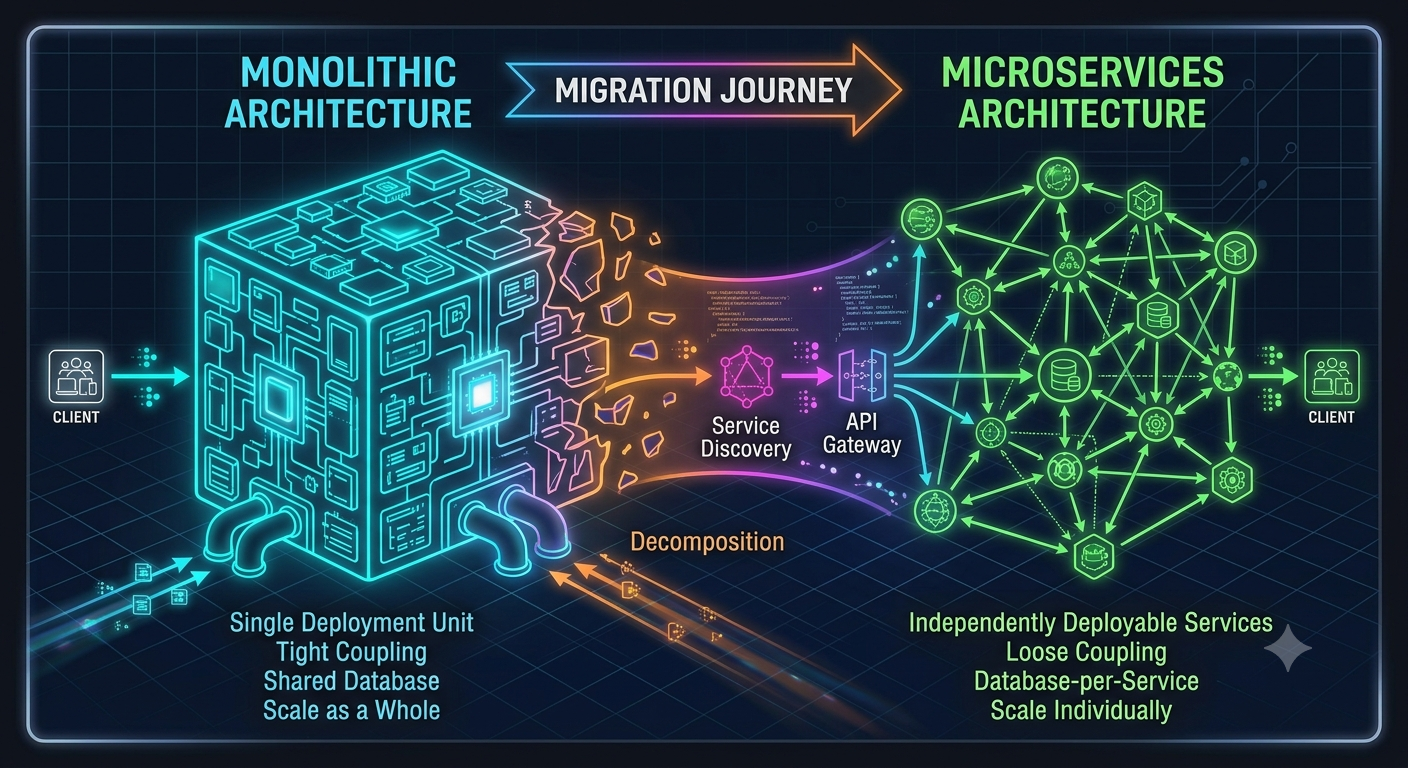
The debate between monolithic architectures and microservices isn't about which design is superior; it's about matching your software architecture to your organizational maturity and scale requirements.
While microservices promise independent deployments, isolated scaling, and tech-stack flexibility, they introduce distributed systems complexity: eventual consistency, network latency, distributed tracing headaches, and operational overhead.
Before you make the leap to split your application, evaluate these three foundational questions:
1 Domain Isolation: Are your business domain boundaries clear enough that splitting them won't lead to distributed monoliths and constant cross-service database joins?
2.Team Autonomy: Is developer throughput actually blocked by shared codebases and deployment queues, or are organizational bottlenecks the real issue?
3 Operational Readiness: Does your team have the observability, automated CI/CD pipelines, and infrastructure monitoring required to operate tens (or hundreds) of independent services?
Modular monoliths are often the sweet spot—offering clean domain separation in code without the distributed system tax.
Key Takeaways
Premature microservices create operational burden without solving architectural bottlenecks.
Domain boundaries matter most: If your domain model is fuzzy, splitting it will only create network-bound complexity.
Scale the team, then the architecture: Microservices solve organizational scaling problems as much as technical ones.
CTA
Where does your team currently stand on the architecture spectrum? Are you team Monolith, team Microservices, or somewhere in between?
Drop your experiences in the comments below, and [Join the Techawks General Community] to jump into deeper architectural debates with engineers around the globe.
"Start with a monolith, then break it down into microservices." It’s standard industry advice—until you realize your team is spending more time managing Kubernetes clusters and network hops than shipping actual features. Where is the line?
The debate between monolithic architectures and microservices isn't about which design is superior; it's about matching your software architecture to your organizational maturity and scale requirements.
While microservices promise independent deployments, isolated scaling, and tech-stack flexibility, they introduce distributed systems complexity: eventual consistency, network latency, distributed tracing headaches, and operational overhead.
Before you make the leap to split your application, evaluate these three foundational questions:
1 Domain Isolation: Are your business domain boundaries clear enough that splitting them won't lead to distributed monoliths and constant cross-service database joins?
2.Team Autonomy: Is developer throughput actually blocked by shared codebases and deployment queues, or are organizational bottlenecks the real issue?
3 Operational Readiness: Does your team have the observability, automated CI/CD pipelines, and infrastructure monitoring required to operate tens (or hundreds) of independent services?
Modular monoliths are often the sweet spot—offering clean domain separation in code without the distributed system tax.
Key Takeaways
Premature microservices create operational burden without solving architectural bottlenecks.
Domain boundaries matter most: If your domain model is fuzzy, splitting it will only create network-bound complexity.
Scale the team, then the architecture: Microservices solve organizational scaling problems as much as technical ones.
CTA
Where does your team currently stand on the architecture spectrum? Are you team Monolith, team Microservices, or somewhere in between?
Drop your experiences in the comments below, and [Join the Techawks General Community] to jump into deeper architectural debates with engineers around the globe.
Monolith vs. Microservices: How Do You Know When It’s Time to Split?
"Start with a monolith, then break it down into microservices." It’s standard industry advice—until you realize your team is spending more time managing Kubernetes clusters and network hops than shipping actual features. Where is the line?
The debate between monolithic architectures and microservices isn't about which design is superior; it's about matching your software architecture to your organizational maturity and scale requirements.
While microservices promise independent deployments, isolated scaling, and tech-stack flexibility, they introduce distributed systems complexity: eventual consistency, network latency, distributed tracing headaches, and operational overhead.
Before you make the leap to split your application, evaluate these three foundational questions:
1 Domain Isolation: Are your business domain boundaries clear enough that splitting them won't lead to distributed monoliths and constant cross-service database joins?
2.Team Autonomy: Is developer throughput actually blocked by shared codebases and deployment queues, or are organizational bottlenecks the real issue?
3 Operational Readiness: Does your team have the observability, automated CI/CD pipelines, and infrastructure monitoring required to operate tens (or hundreds) of independent services?
Modular monoliths are often the sweet spot—offering clean domain separation in code without the distributed system tax.
Key Takeaways
Premature microservices create operational burden without solving architectural bottlenecks.
Domain boundaries matter most: If your domain model is fuzzy, splitting it will only create network-bound complexity.
Scale the team, then the architecture: Microservices solve organizational scaling problems as much as technical ones.
CTA
Where does your team currently stand on the architecture spectrum? Are you team Monolith, team Microservices, or somewhere in between?
Drop your experiences in the comments below, and [Join the Techawks General Community] to jump into deeper architectural debates with engineers around the globe.

 English
 Arabic
 French
 Spanish
 Portuguese
 Deutsch
 Turkish
 Dutch
Dutch
 Russian
 Romaian
 Portuguese (Brazil)
 Greek
Greek