


The Death of Legacy Environment Copy-Pasting: Why "Zero-Copy Cloning" Is Essential for High-Fidelity Data Testing
In the age of massive datasets and real-time operations, duplicating multiple terabytes to a separate testing environment wastes cloud budget, creates security risks, and severely slows down delivery cycles.
Modern data platforms—leveraging built-in functions or open-table formats like Apache Iceberg—resolve this bottleneck with a critical technique: Zero-Copy Cloning (also known as Shallow Cloning or Metadata-Based Cloning).
The Mechanics: How You Clone Without Copying
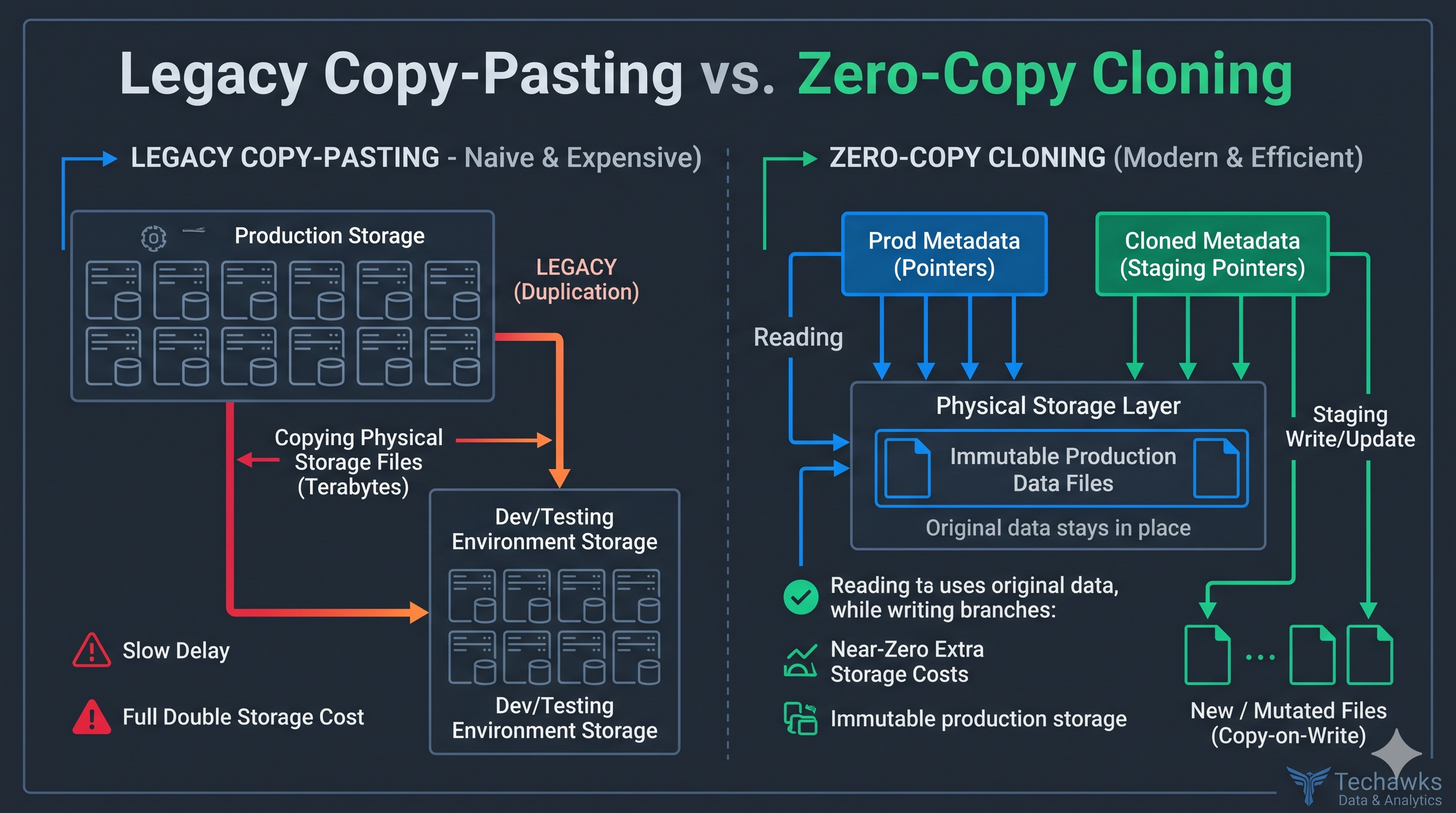
Traditional clones force your infrastructure to physically replicate entire underlying data files. Zero-Copy Cloning operates entirely at the metadata layer:
Metadata Replication: When you run a clone operation, the system does not touch or move the underlying storage files (such as Parquet or ORC micro-partitions). It simply creates a new set of metadata pointers referencing the exact same raw files.
Instant Environments: Because it is only creating pointers, a multi-terabyte production database, schema, or table can be "duplicated" into a staging or dev workspace in seconds.
Copy-on-Write Isolation: What happens when your staging tests mutate data? Since both environments use isolated metadata trees, any write, update, or deletion in the staging copy creates new storage files. Staging points to these new variations, while your production pointers and historical time-travel snapshots remain untouched.
Plaintext
Original Metadata (Prod) ──> [ Micro-Partition A ] <── cloned Metadata (staging)
[ Micro-Partition B ]
(Mutation in Staging) [ Micro-Partition C ] <── staging updates make new file
[ Micro-Partition D_new ]
Why Zero-Copy Cloning Matters for Data Teams
Immediate Dev/QA Environments: Run validation scripts, schema migrations, or exploratory model training on actual production data structures instantly, without waiting for batch transfers.
Near-Zero Extra Storage Fees: You only pay for mutated files or new data generated in the staging environment. If you only run read-heavy tests or update 1% of the data, your staging environment’s storage footprint remains negligible.
Risk-Free Sandboxing: Allow analysts and engineers to run write-heavy queries or delete operations on production data snapshots with zero fear of breaking active BI dashboards or operational databases.
Stop copying data; clone its pointers. Mastering the metadata layer is key to scaling your data architecture.
Discussion Question
Community Poll: How is your team currently creating and managing test or staging data environments for analytical transformations and pipeline testing?
A) Instant Zero-Copy Cloning (Snowflake CREATE CLONE, Delta/Iceberg shallow clone, etc.)
B) Traditional ETL/ELT physical copy-and-paste to a separate QA environment
C) Operating on sampled/synthetic subsets instead of full production scale
D) Directly running transformations in isolated sandboxes using production files as read-only inputs
CTA
Looking to master high-throughput data architectures, optimize cloud warehousing costs, and collaborate on real-world engineering patterns?
👉 Join Data Science & Analytics to connect with data engineers, architects, and analytics professionals shaping the next generation of data tech with Techawks.
In the age of massive datasets and real-time operations, duplicating multiple terabytes to a separate testing environment wastes cloud budget, creates security risks, and severely slows down delivery cycles.
Modern data platforms—leveraging built-in functions or open-table formats like Apache Iceberg—resolve this bottleneck with a critical technique: Zero-Copy Cloning (also known as Shallow Cloning or Metadata-Based Cloning).
The Mechanics: How You Clone Without Copying
Traditional clones force your infrastructure to physically replicate entire underlying data files. Zero-Copy Cloning operates entirely at the metadata layer:
Metadata Replication: When you run a clone operation, the system does not touch or move the underlying storage files (such as Parquet or ORC micro-partitions). It simply creates a new set of metadata pointers referencing the exact same raw files.
Instant Environments: Because it is only creating pointers, a multi-terabyte production database, schema, or table can be "duplicated" into a staging or dev workspace in seconds.
Copy-on-Write Isolation: What happens when your staging tests mutate data? Since both environments use isolated metadata trees, any write, update, or deletion in the staging copy creates new storage files. Staging points to these new variations, while your production pointers and historical time-travel snapshots remain untouched.
Plaintext
Original Metadata (Prod) ──> [ Micro-Partition A ] <── cloned Metadata (staging)
[ Micro-Partition B ]
(Mutation in Staging) [ Micro-Partition C ] <── staging updates make new file
[ Micro-Partition D_new ]
Why Zero-Copy Cloning Matters for Data Teams
Immediate Dev/QA Environments: Run validation scripts, schema migrations, or exploratory model training on actual production data structures instantly, without waiting for batch transfers.
Near-Zero Extra Storage Fees: You only pay for mutated files or new data generated in the staging environment. If you only run read-heavy tests or update 1% of the data, your staging environment’s storage footprint remains negligible.
Risk-Free Sandboxing: Allow analysts and engineers to run write-heavy queries or delete operations on production data snapshots with zero fear of breaking active BI dashboards or operational databases.
Stop copying data; clone its pointers. Mastering the metadata layer is key to scaling your data architecture.
Discussion Question
Community Poll: How is your team currently creating and managing test or staging data environments for analytical transformations and pipeline testing?
A) Instant Zero-Copy Cloning (Snowflake CREATE CLONE, Delta/Iceberg shallow clone, etc.)
B) Traditional ETL/ELT physical copy-and-paste to a separate QA environment
C) Operating on sampled/synthetic subsets instead of full production scale
D) Directly running transformations in isolated sandboxes using production files as read-only inputs
CTA
Looking to master high-throughput data architectures, optimize cloud warehousing costs, and collaborate on real-world engineering patterns?
👉 Join Data Science & Analytics to connect with data engineers, architects, and analytics professionals shaping the next generation of data tech with Techawks.
The Death of Legacy Environment Copy-Pasting: Why "Zero-Copy Cloning" Is Essential for High-Fidelity Data Testing
In the age of massive datasets and real-time operations, duplicating multiple terabytes to a separate testing environment wastes cloud budget, creates security risks, and severely slows down delivery cycles.
Modern data platforms—leveraging built-in functions or open-table formats like Apache Iceberg—resolve this bottleneck with a critical technique: Zero-Copy Cloning (also known as Shallow Cloning or Metadata-Based Cloning).
The Mechanics: How You Clone Without Copying
Traditional clones force your infrastructure to physically replicate entire underlying data files. Zero-Copy Cloning operates entirely at the metadata layer:
Metadata Replication: When you run a clone operation, the system does not touch or move the underlying storage files (such as Parquet or ORC micro-partitions). It simply creates a new set of metadata pointers referencing the exact same raw files.
Instant Environments: Because it is only creating pointers, a multi-terabyte production database, schema, or table can be "duplicated" into a staging or dev workspace in seconds.
Copy-on-Write Isolation: What happens when your staging tests mutate data? Since both environments use isolated metadata trees, any write, update, or deletion in the staging copy creates new storage files. Staging points to these new variations, while your production pointers and historical time-travel snapshots remain untouched.
Plaintext
Original Metadata (Prod) ──> [ Micro-Partition A ] <── cloned Metadata (staging)
[ Micro-Partition B ]
(Mutation in Staging) [ Micro-Partition C ] <── staging updates make new file
[ Micro-Partition D_new ]
Why Zero-Copy Cloning Matters for Data Teams
Immediate Dev/QA Environments: Run validation scripts, schema migrations, or exploratory model training on actual production data structures instantly, without waiting for batch transfers.
Near-Zero Extra Storage Fees: You only pay for mutated files or new data generated in the staging environment. If you only run read-heavy tests or update 1% of the data, your staging environment’s storage footprint remains negligible.
Risk-Free Sandboxing: Allow analysts and engineers to run write-heavy queries or delete operations on production data snapshots with zero fear of breaking active BI dashboards or operational databases.
Stop copying data; clone its pointers. Mastering the metadata layer is key to scaling your data architecture.
Discussion Question
Community Poll: How is your team currently creating and managing test or staging data environments for analytical transformations and pipeline testing?
A) Instant Zero-Copy Cloning (Snowflake CREATE CLONE, Delta/Iceberg shallow clone, etc.)
B) Traditional ETL/ELT physical copy-and-paste to a separate QA environment
C) Operating on sampled/synthetic subsets instead of full production scale
D) Directly running transformations in isolated sandboxes using production files as read-only inputs
CTA
Looking to master high-throughput data architectures, optimize cloud warehousing costs, and collaborate on real-world engineering patterns?
👉 Join Data Science & Analytics to connect with data engineers, architects, and analytics professionals shaping the next generation of data tech with Techawks.

 English
 Arabic
 Spanish
 Portuguese
 Deutsch
 Turkish
 Dutch
 Italiano
 Russian
 Romaian
 Portuguese (Brazil)
 Greek