


The Early-Stage Capital Cap Table: A Founder’s Guide to Equity Allocation
For early-stage founders, navigating co-founder splits, equity incentive pools, and SAFE notes (Simple Agreements for Future Equity) can feel like navigating a minefield. Mistaking valuation caps or granting non-vesting equity early on can permanently alter your company's control dynamics.
Here is a practical, step-by-step resource guide to structuring a clean, investor-ready cap table from day one:
Implement Dynamic, Equal, or Contribution-Based Splits (With Vesting)
The Pitfall: Dividing equity 50/50 on day one without vesting terms. If a co-founder leaves six months later, they walk away with half your company.
The Action: Standardize a 4-year vesting schedule with a 1-year cliff. This ensures everyone earns their equity over time and protects the venture if a founder departs early.
Set Up an Option Pool (ESOP) Before Your Seed Round
The Pitfall: Delaying your Employee Stock Option Pool until investors demand it during terms negotiation.
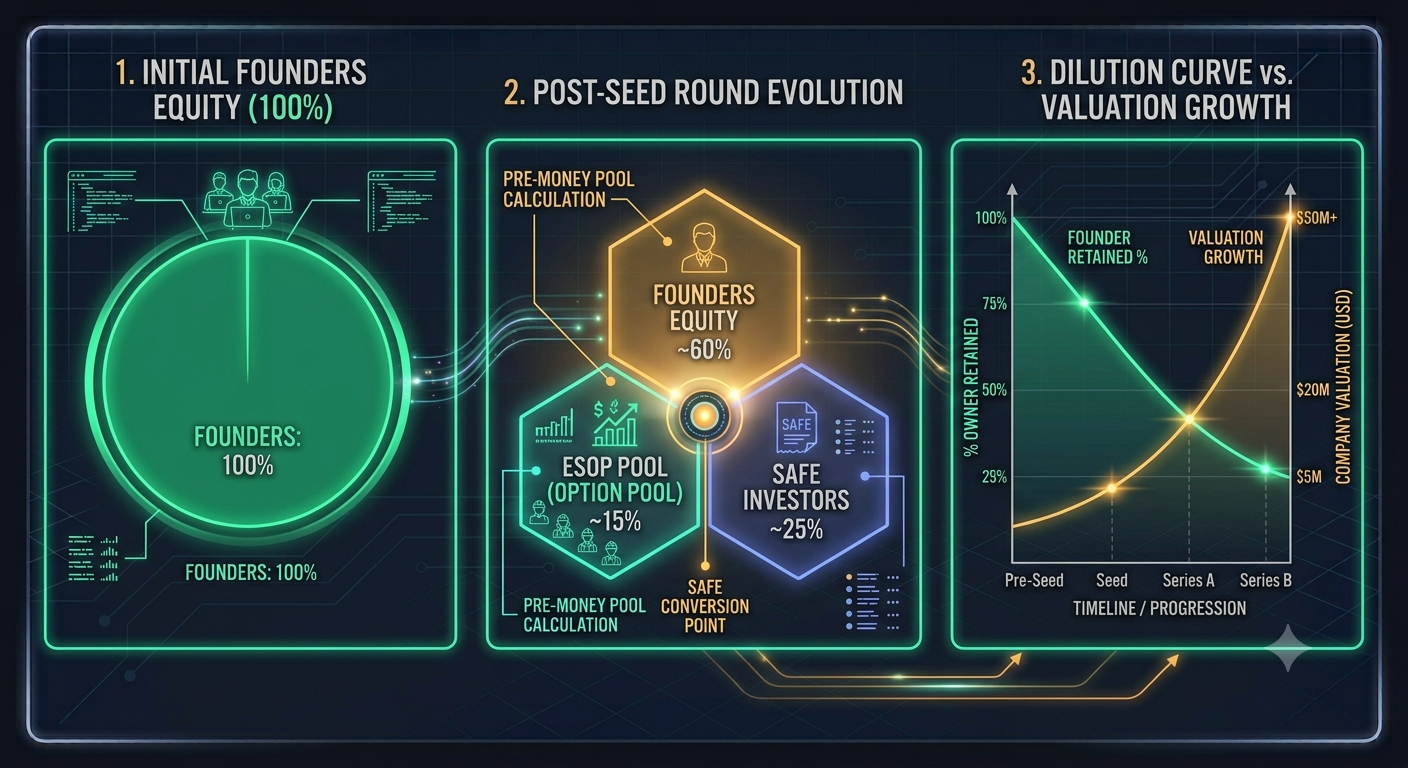
The Action: Create an unallocated option pool of 10% to 15% early on. Be aware that investors typically calculate this option pool pre-money, meaning the dilution comes primarily out of the founding team's share, not the investor's.
Track Conversion Dilution from SAFEs and Convertible Notes
The Pitfall: Raising multiple uncapped SAFEs across different valuation caps without calculating their cumulative dilutive effect on conversion.
The Action: Use cap table modeling software (or a structured spreadsheet) to model post-money conversions before signing any note. Always calculate what percentage of ownership you will retain once all SAFEs convert during your priced equity round.
Reserve Equity for Key Strategic Advisors Wisely
The Pitfall: Handing over 3% to 5% equity to advisors who offer casual advice or introductions.
The Action: Benchmark advisor equity between 0.25% and 1%, tied to explicit deliverables, milestones, and standard FAST (Founder Advisor Standard Template) vesting agreements.
Key Takeaways
Vesting is non-negotiable: Protect your company with a standard 4-year schedule and a 1-year cliff for all founders and early hires.
Model SAFE conversions early: Uncapped or stacked SAFEs convert into significant equity loss during your first priced round.
Protect the ESOP: Budget a 10%–15% option pool intentionally rather than letting term-sheet negotiations dictate it.
CTA
Building a company, preparing for fundraising, or optimizing your cap table structure?
[Join Startup Founders & Entrepreneurs] to exchange cap table templates, join fundraising teardown sessions, and connect with experienced founders and angel investors.
For early-stage founders, navigating co-founder splits, equity incentive pools, and SAFE notes (Simple Agreements for Future Equity) can feel like navigating a minefield. Mistaking valuation caps or granting non-vesting equity early on can permanently alter your company's control dynamics.
Here is a practical, step-by-step resource guide to structuring a clean, investor-ready cap table from day one:
Implement Dynamic, Equal, or Contribution-Based Splits (With Vesting)
The Pitfall: Dividing equity 50/50 on day one without vesting terms. If a co-founder leaves six months later, they walk away with half your company.
The Action: Standardize a 4-year vesting schedule with a 1-year cliff. This ensures everyone earns their equity over time and protects the venture if a founder departs early.
Set Up an Option Pool (ESOP) Before Your Seed Round
The Pitfall: Delaying your Employee Stock Option Pool until investors demand it during terms negotiation.
The Action: Create an unallocated option pool of 10% to 15% early on. Be aware that investors typically calculate this option pool pre-money, meaning the dilution comes primarily out of the founding team's share, not the investor's.
Track Conversion Dilution from SAFEs and Convertible Notes
The Pitfall: Raising multiple uncapped SAFEs across different valuation caps without calculating their cumulative dilutive effect on conversion.
The Action: Use cap table modeling software (or a structured spreadsheet) to model post-money conversions before signing any note. Always calculate what percentage of ownership you will retain once all SAFEs convert during your priced equity round.
Reserve Equity for Key Strategic Advisors Wisely
The Pitfall: Handing over 3% to 5% equity to advisors who offer casual advice or introductions.
The Action: Benchmark advisor equity between 0.25% and 1%, tied to explicit deliverables, milestones, and standard FAST (Founder Advisor Standard Template) vesting agreements.
Key Takeaways
Vesting is non-negotiable: Protect your company with a standard 4-year schedule and a 1-year cliff for all founders and early hires.
Model SAFE conversions early: Uncapped or stacked SAFEs convert into significant equity loss during your first priced round.
Protect the ESOP: Budget a 10%–15% option pool intentionally rather than letting term-sheet negotiations dictate it.
CTA
Building a company, preparing for fundraising, or optimizing your cap table structure?
[Join Startup Founders & Entrepreneurs] to exchange cap table templates, join fundraising teardown sessions, and connect with experienced founders and angel investors.
The Early-Stage Capital Cap Table: A Founder’s Guide to Equity Allocation
For early-stage founders, navigating co-founder splits, equity incentive pools, and SAFE notes (Simple Agreements for Future Equity) can feel like navigating a minefield. Mistaking valuation caps or granting non-vesting equity early on can permanently alter your company's control dynamics.
Here is a practical, step-by-step resource guide to structuring a clean, investor-ready cap table from day one:
Implement Dynamic, Equal, or Contribution-Based Splits (With Vesting)
The Pitfall: Dividing equity 50/50 on day one without vesting terms. If a co-founder leaves six months later, they walk away with half your company.
The Action: Standardize a 4-year vesting schedule with a 1-year cliff. This ensures everyone earns their equity over time and protects the venture if a founder departs early.
Set Up an Option Pool (ESOP) Before Your Seed Round
The Pitfall: Delaying your Employee Stock Option Pool until investors demand it during terms negotiation.
The Action: Create an unallocated option pool of 10% to 15% early on. Be aware that investors typically calculate this option pool pre-money, meaning the dilution comes primarily out of the founding team's share, not the investor's.
Track Conversion Dilution from SAFEs and Convertible Notes
The Pitfall: Raising multiple uncapped SAFEs across different valuation caps without calculating their cumulative dilutive effect on conversion.
The Action: Use cap table modeling software (or a structured spreadsheet) to model post-money conversions before signing any note. Always calculate what percentage of ownership you will retain once all SAFEs convert during your priced equity round.
Reserve Equity for Key Strategic Advisors Wisely
The Pitfall: Handing over 3% to 5% equity to advisors who offer casual advice or introductions.
The Action: Benchmark advisor equity between 0.25% and 1%, tied to explicit deliverables, milestones, and standard FAST (Founder Advisor Standard Template) vesting agreements.
Key Takeaways
Vesting is non-negotiable: Protect your company with a standard 4-year schedule and a 1-year cliff for all founders and early hires.
Model SAFE conversions early: Uncapped or stacked SAFEs convert into significant equity loss during your first priced round.
Protect the ESOP: Budget a 10%–15% option pool intentionally rather than letting term-sheet negotiations dictate it.
CTA
Building a company, preparing for fundraising, or optimizing your cap table structure?
[Join Startup Founders & Entrepreneurs] to exchange cap table templates, join fundraising teardown sessions, and connect with experienced founders and angel investors.

 English
 Arabic
 French
 Spanish
 Portuguese
 Turkish
 Dutch
Dutch
 Italiano
 Russian
 Romaian
 Portuguese (Brazil)
 Greek
Greek