


The Product-Market Fit Engine: A Framework for Measuring Retention Before Scaling
Product-Market Fit isn't a vague feeling or a spike in press coverage. It is a measurable, repeatable state where a specific market segment consistently derives enough value from your core offering to retain, pay, and advocate for it.
To evaluate whether your startup has achieved true PMF, run your analytics through this 4-step framework:
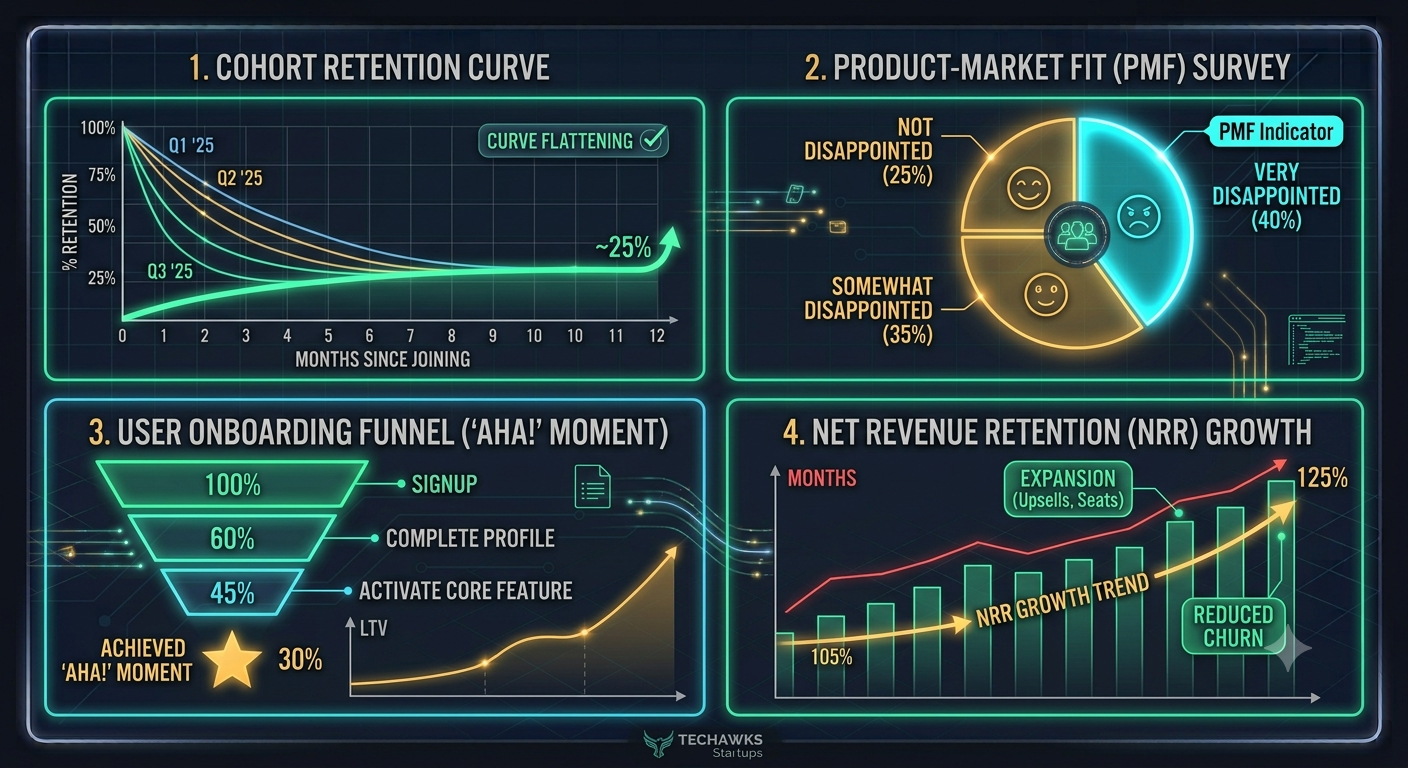
Track the Cohort Retention Curve (The Ultimate Proof)
The Metric: Plot user activity over time (Day 1, Day 7, Day 30, Day 90) grouped by sign-up cohort.
The Indicator: If your retention curve continues to decline down toward zero, you do not have PMF. If the curve flattens out parallel to the x-axis (even at 20–30%), you have found a stable core audience.
Deploy the "Very Disappointed" Survey (Sean Ellis Test)
The Action: Ask active users: "How would you feel if you could no longer use [Product Name]?" (Options: Very disappointed, Somewhat disappointed, Not disappointed).
The Benchmark: If 40% or more of your respondents answer "Very disappointed," you have reached a critical baseline of necessity in your target segment.
Measure Your Net Revenue Retention (NRR) for B2B
The Metric: Account for expansion revenue (upsells, seat additions) minus churn and downgrades over a given period.
The Benchmark: Strong B2B SaaS startups target an NRR above 110%–120%, meaning revenue grows from existing customers even without acquiring new ones.
Identify Your "Aha!" Moment Metric
Determine the exact user behavior early in the onboarding flow that correlates most strongly with long-term retention.
Examples: Slack found that teams sending 2,000 messages retained permanently; Dropbox found that saving 1 file in 1 folder on 1 device unlocked long-term usage. Optimize your entire product onboarding to get users to this threshold as fast as possible.
Key Takeaways
Retention over acquisition: A flattening cohort retention curve is the single most reliable quantitative proof of PMF.
The 40% Rule: Aim for at least 40% of survey respondents stating they would be "very disappointed" without your product.
Shorten time-to-value: Identify your product's "Aha!" moment and streamline onboarding to guide new users directly to that core value.
CTA
Struggling to improve your onboarding conversion, reduce churn, or identify your startup's core metric?
[Join Startup Founders & Entrepreneurs] to share retention benchmarks, participate in product tear-downs, and learn growth strategies directly from seasoned operators and venture mentors.
Product-Market Fit isn't a vague feeling or a spike in press coverage. It is a measurable, repeatable state where a specific market segment consistently derives enough value from your core offering to retain, pay, and advocate for it.
To evaluate whether your startup has achieved true PMF, run your analytics through this 4-step framework:
Track the Cohort Retention Curve (The Ultimate Proof)
The Metric: Plot user activity over time (Day 1, Day 7, Day 30, Day 90) grouped by sign-up cohort.
The Indicator: If your retention curve continues to decline down toward zero, you do not have PMF. If the curve flattens out parallel to the x-axis (even at 20–30%), you have found a stable core audience.
Deploy the "Very Disappointed" Survey (Sean Ellis Test)
The Action: Ask active users: "How would you feel if you could no longer use [Product Name]?" (Options: Very disappointed, Somewhat disappointed, Not disappointed).
The Benchmark: If 40% or more of your respondents answer "Very disappointed," you have reached a critical baseline of necessity in your target segment.
Measure Your Net Revenue Retention (NRR) for B2B
The Metric: Account for expansion revenue (upsells, seat additions) minus churn and downgrades over a given period.
The Benchmark: Strong B2B SaaS startups target an NRR above 110%–120%, meaning revenue grows from existing customers even without acquiring new ones.
Identify Your "Aha!" Moment Metric
Determine the exact user behavior early in the onboarding flow that correlates most strongly with long-term retention.
Examples: Slack found that teams sending 2,000 messages retained permanently; Dropbox found that saving 1 file in 1 folder on 1 device unlocked long-term usage. Optimize your entire product onboarding to get users to this threshold as fast as possible.
Key Takeaways
Retention over acquisition: A flattening cohort retention curve is the single most reliable quantitative proof of PMF.
The 40% Rule: Aim for at least 40% of survey respondents stating they would be "very disappointed" without your product.
Shorten time-to-value: Identify your product's "Aha!" moment and streamline onboarding to guide new users directly to that core value.
CTA
Struggling to improve your onboarding conversion, reduce churn, or identify your startup's core metric?
[Join Startup Founders & Entrepreneurs] to share retention benchmarks, participate in product tear-downs, and learn growth strategies directly from seasoned operators and venture mentors.
The Product-Market Fit Engine: A Framework for Measuring Retention Before Scaling
Product-Market Fit isn't a vague feeling or a spike in press coverage. It is a measurable, repeatable state where a specific market segment consistently derives enough value from your core offering to retain, pay, and advocate for it.
To evaluate whether your startup has achieved true PMF, run your analytics through this 4-step framework:
Track the Cohort Retention Curve (The Ultimate Proof)
The Metric: Plot user activity over time (Day 1, Day 7, Day 30, Day 90) grouped by sign-up cohort.
The Indicator: If your retention curve continues to decline down toward zero, you do not have PMF. If the curve flattens out parallel to the x-axis (even at 20–30%), you have found a stable core audience.
Deploy the "Very Disappointed" Survey (Sean Ellis Test)
The Action: Ask active users: "How would you feel if you could no longer use [Product Name]?" (Options: Very disappointed, Somewhat disappointed, Not disappointed).
The Benchmark: If 40% or more of your respondents answer "Very disappointed," you have reached a critical baseline of necessity in your target segment.
Measure Your Net Revenue Retention (NRR) for B2B
The Metric: Account for expansion revenue (upsells, seat additions) minus churn and downgrades over a given period.
The Benchmark: Strong B2B SaaS startups target an NRR above 110%–120%, meaning revenue grows from existing customers even without acquiring new ones.
Identify Your "Aha!" Moment Metric
Determine the exact user behavior early in the onboarding flow that correlates most strongly with long-term retention.
Examples: Slack found that teams sending 2,000 messages retained permanently; Dropbox found that saving 1 file in 1 folder on 1 device unlocked long-term usage. Optimize your entire product onboarding to get users to this threshold as fast as possible.
Key Takeaways
Retention over acquisition: A flattening cohort retention curve is the single most reliable quantitative proof of PMF.
The 40% Rule: Aim for at least 40% of survey respondents stating they would be "very disappointed" without your product.
Shorten time-to-value: Identify your product's "Aha!" moment and streamline onboarding to guide new users directly to that core value.
CTA
Struggling to improve your onboarding conversion, reduce churn, or identify your startup's core metric?
[Join Startup Founders & Entrepreneurs] to share retention benchmarks, participate in product tear-downs, and learn growth strategies directly from seasoned operators and venture mentors.

 English
 Arabic
 French
 Spanish
 Portuguese
 Deutsch
 Turkish
 Dutch
Dutch
 Italiano
 Russian
 Romaian
 Portuguese (Brazil)