


Bootstrap vs. Venture Capital: How to Choose the Right Fuel for Your Business Model
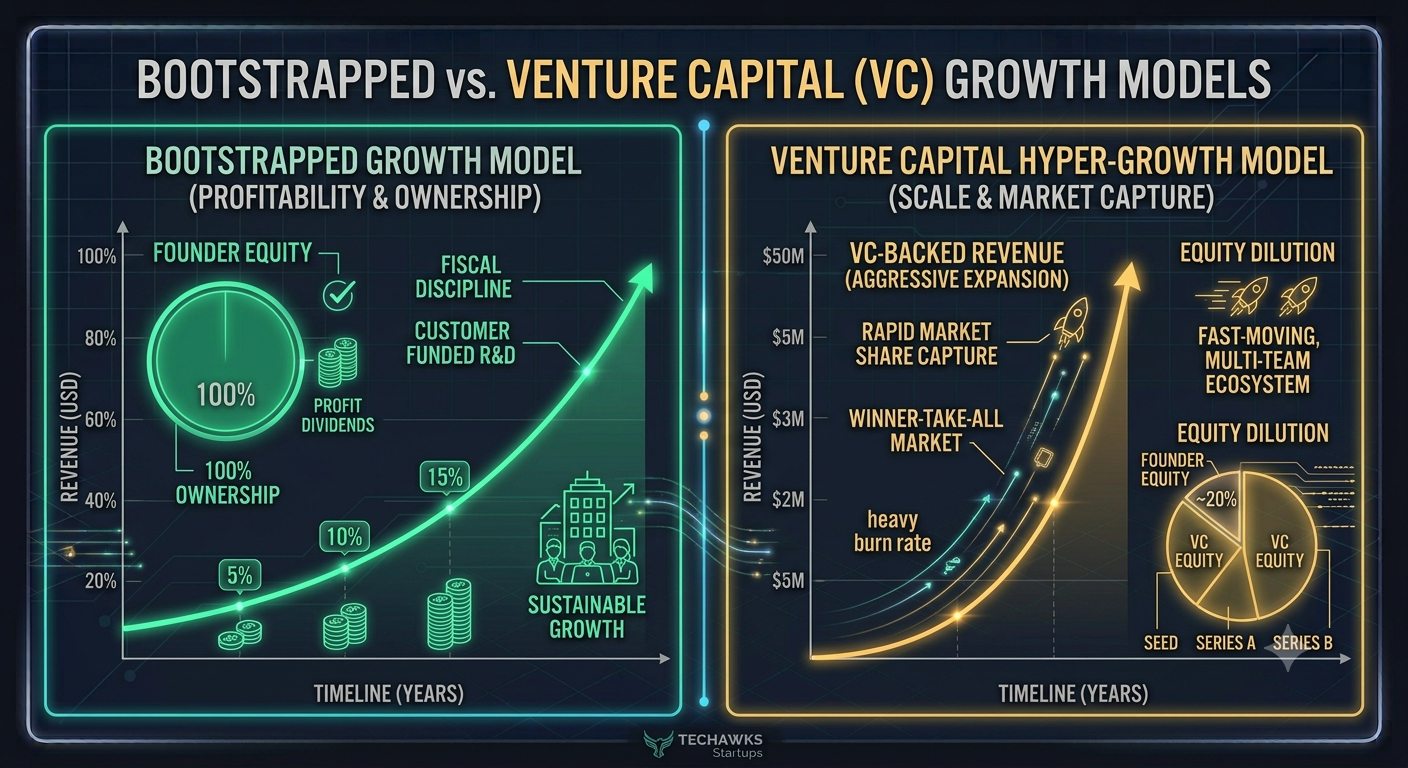
The debate between venture backing and self-funding isn't about which path is "better"—it's about which mechanism aligns with your business fundamentals, market cap, and personal definition of success.
Before pitching investors or pouring personal savings into your venture, evaluate your operational model against these four core dimensions:
Market Size & Winner-Take-All Dynamics
Venture Capital: Requires massive total addressable markets (TAM > $1B+) with strong network effects where market share capture must happen aggressively before competitors lock in the space.
Bootstrapping: Ideal for focused B2B SaaS, niche vertical software, or high-margin services where capturing even a modest 1%–2% of a sub-market creates a highly lucrative, multi-million dollar business.
Capital Intensity & Speed to Product-Market Fit
Venture Capital: Necessary for deep tech, hardware, AI infrastructure, or complex enterprise platforms that require years of heavy R&D before generating meaningful revenue.
Bootstrapping: Highly effective for light-overhead software or digital products that can launch an MVP quickly, land paying design partners, and fund future feature development directly from customer cash flow.
Control, Governance, and Exit Expectations
Venture Capital: Brings board seats, preferred stock liquidation preferences, and a strict 7–10 year timeline to deliver a 10x+ return through an acquisition or IPO.
Bootstrapping: Gives you 100% strategic ownership, complete control over dividend distribution, product roadmap decisions, and the option to run the business indefinitely.
The Hybrid Approach: Bootstrapping to VC
Bootstrapping early forces extreme fiscal discipline, Lean operations, and immediate focus on customer value.
Transitioning to VC after reaching profitable traction gives you maximum leverage, higher valuations, and significantly reduced dilution during your Seed or Series A rounds.
Key Takeaways
Match capital to market dynamics: VC is fuel for high-velocity, winner-take-all markets; bootstrapping thrives on profitability, focus, and niche dominance.
Funding dictates governance: Taking venture capital enters you into an exit-driven timeline with external board oversight.
Leverage bootstrapping for traction: Building initial revenue independently gives you vastly superior valuation leverage if you choose to raise later.
CTA
Did you choose to bootstrap your startup or go the institutional fundraising route? What key factors drove your decision, and would you make the same choice again today?
The debate between venture backing and self-funding isn't about which path is "better"—it's about which mechanism aligns with your business fundamentals, market cap, and personal definition of success.
Before pitching investors or pouring personal savings into your venture, evaluate your operational model against these four core dimensions:
Market Size & Winner-Take-All Dynamics
Venture Capital: Requires massive total addressable markets (TAM > $1B+) with strong network effects where market share capture must happen aggressively before competitors lock in the space.
Bootstrapping: Ideal for focused B2B SaaS, niche vertical software, or high-margin services where capturing even a modest 1%–2% of a sub-market creates a highly lucrative, multi-million dollar business.
Capital Intensity & Speed to Product-Market Fit
Venture Capital: Necessary for deep tech, hardware, AI infrastructure, or complex enterprise platforms that require years of heavy R&D before generating meaningful revenue.
Bootstrapping: Highly effective for light-overhead software or digital products that can launch an MVP quickly, land paying design partners, and fund future feature development directly from customer cash flow.
Control, Governance, and Exit Expectations
Venture Capital: Brings board seats, preferred stock liquidation preferences, and a strict 7–10 year timeline to deliver a 10x+ return through an acquisition or IPO.
Bootstrapping: Gives you 100% strategic ownership, complete control over dividend distribution, product roadmap decisions, and the option to run the business indefinitely.
The Hybrid Approach: Bootstrapping to VC
Bootstrapping early forces extreme fiscal discipline, Lean operations, and immediate focus on customer value.
Transitioning to VC after reaching profitable traction gives you maximum leverage, higher valuations, and significantly reduced dilution during your Seed or Series A rounds.
Key Takeaways
Match capital to market dynamics: VC is fuel for high-velocity, winner-take-all markets; bootstrapping thrives on profitability, focus, and niche dominance.
Funding dictates governance: Taking venture capital enters you into an exit-driven timeline with external board oversight.
Leverage bootstrapping for traction: Building initial revenue independently gives you vastly superior valuation leverage if you choose to raise later.
CTA
Did you choose to bootstrap your startup or go the institutional fundraising route? What key factors drove your decision, and would you make the same choice again today?
Bootstrap vs. Venture Capital: How to Choose the Right Fuel for Your Business Model
The debate between venture backing and self-funding isn't about which path is "better"—it's about which mechanism aligns with your business fundamentals, market cap, and personal definition of success.
Before pitching investors or pouring personal savings into your venture, evaluate your operational model against these four core dimensions:
Market Size & Winner-Take-All Dynamics
Venture Capital: Requires massive total addressable markets (TAM > $1B+) with strong network effects where market share capture must happen aggressively before competitors lock in the space.
Bootstrapping: Ideal for focused B2B SaaS, niche vertical software, or high-margin services where capturing even a modest 1%–2% of a sub-market creates a highly lucrative, multi-million dollar business.
Capital Intensity & Speed to Product-Market Fit
Venture Capital: Necessary for deep tech, hardware, AI infrastructure, or complex enterprise platforms that require years of heavy R&D before generating meaningful revenue.
Bootstrapping: Highly effective for light-overhead software or digital products that can launch an MVP quickly, land paying design partners, and fund future feature development directly from customer cash flow.
Control, Governance, and Exit Expectations
Venture Capital: Brings board seats, preferred stock liquidation preferences, and a strict 7–10 year timeline to deliver a 10x+ return through an acquisition or IPO.
Bootstrapping: Gives you 100% strategic ownership, complete control over dividend distribution, product roadmap decisions, and the option to run the business indefinitely.
The Hybrid Approach: Bootstrapping to VC
Bootstrapping early forces extreme fiscal discipline, Lean operations, and immediate focus on customer value.
Transitioning to VC after reaching profitable traction gives you maximum leverage, higher valuations, and significantly reduced dilution during your Seed or Series A rounds.
Key Takeaways
Match capital to market dynamics: VC is fuel for high-velocity, winner-take-all markets; bootstrapping thrives on profitability, focus, and niche dominance.
Funding dictates governance: Taking venture capital enters you into an exit-driven timeline with external board oversight.
Leverage bootstrapping for traction: Building initial revenue independently gives you vastly superior valuation leverage if you choose to raise later.
CTA
Did you choose to bootstrap your startup or go the institutional fundraising route? What key factors drove your decision, and would you make the same choice again today?

 English
 Arabic
 French
 Portuguese
 Deutsch
 Turkish
 Dutch
Dutch
 Italiano
 Russian
 Romaian
 Portuguese (Brazil)
 Greek
Greek