


Tool Teardown: Why Early-Stage Founders Are Ditching Enterprise Cloud PaaS for Self-Hosted Engines (Coolify)
Founders frequently fall into a costly architectural trap: offloading early deployment to high-markup proprietary PaaS providers (Heroku, Render, AWS managed services) for the sake of "developer velocity."
Within six months, the trap snaps shut:
Compute and memory scale at steep non-linear price markups.
Ephemeral preview environments add hidden costs per pull request.
Staging, staging databases, and cache layers multiply baseline operational burn.
The emerging consensus among lean engineering teams is self-hosted PaaS control planes—most prominently Coolify. Running on top of bare-metal VPS providers (Hetzner, OVH, or raw EC2), self-hosted engines deliver the full developer experience of managed platforms without the 5x infrastructure markup.
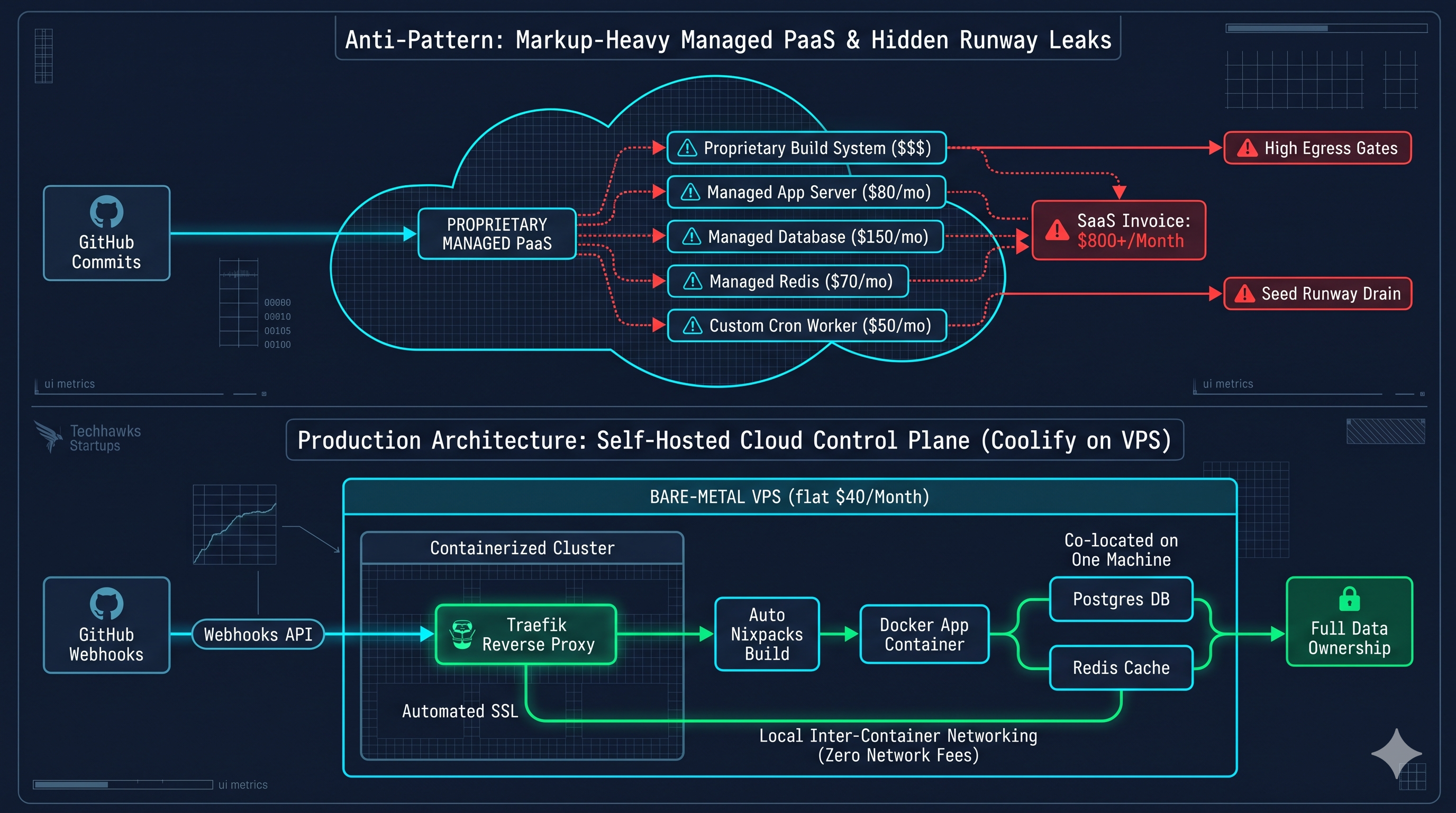
Systems Architecture: Proprietary Managed PaaS vs. Self-Hosted Control Plane
Plaintext
[ ANTI-PATTERN: HIGH-MARKUP MULTI-TENANT MANAGED PAAS ]
Git Push ---> Proprietary Build System ---> Locked Egress/Add-on Routing ---> $800+/mo SaaS Invoices
(Local Repo) (Opaque CI Minutes) (Multiplied DB/Cache Tiers) (Seed Runway Drain)
[ RESILIENT PATTERN: SELF-HOSTED OPEN CONTROL PLANE (COOLIFY) ]
Git Push ---> Traefik Reverse Proxy ---> Docker/Nixpacks Container Cluster ---> Flat $40/mo Compute VPS
(GitHub Webhook) (Auto-SSL / SNI Routing) (Postgres + Redis + App Co-located) (Full Data Ownership)
Production-Grade Evaluation: Why Lean Startups Should Care
Uncapped Co-Location Economics
Managed providers bill separately—and aggressively—for every background worker, Redis instance, and cron trigger. A single $40/month bare-metal instance (16GB RAM, 8 vCPUs) running a self-hosted engine can host your primary API, web frontend, Redis cache, and PostgreSQL database with near-zero latency inter-container networking.
Automated Nixpacks & Docker Build Orchestration
Modern self-hosted tooling eliminates manual server administration. By leveraging Nixpacks and buildpacks, the system automatically detects languages, installs runtimes, handles zero-downtime rolling deployments, and auto-provisions Let's Encrypt SSL certificates via Traefik reverse proxies.
No Vendor Lock-In & Portable Disaster Recovery
Proprietary PaaS systems obscure configuration logic behind dashboard toggles. Self-hosted platforms store service topology, environment secrets, and volumes as standardized Docker Compose configurations. If you ever need to migrate providers, you transfer standard Docker containers rather than refactoring cloud-specific infrastructure manifests.
The Boundary Constraint: When to Graduate
Self-hosted single-box setups are ideal from day zero up to $50k+ MRR. You only graduate to managed Kubernetes (EKS/GKE) or specialized multi-region cloud tiers when your team has dedicated platform engineering staff and regulatory compliance demands (SOC 2 Type II, multi-region failover, distributed write replication) that justify the overhead.
Discussion Question
What is your startup's current infrastructure burn rate? At what ARR or traffic threshold do you consider migrating from simple VPS/self-hosted setups to complex managed cloud clusters?
CTA (Join Startup Founders & Entrepreneurs)
Want to optimize your engineering runway, validate tech stacks, and scale your product without draining investor capital?
👉 Join Startup Founders & Entrepreneurs to collaborate with fellow technical founders and CTOs building high-efficiency startups.
Tool Teardown: Why Early-Stage Founders Are Ditching Enterprise Cloud PaaS for Self-Hosted Engines (Coolify)
Founders frequently fall into a costly architectural trap: offloading early deployment to high-markup proprietary PaaS providers (Heroku, Render, AWS managed services) for the sake of "developer velocity."
Within six months, the trap snaps shut:
Compute and memory scale at steep non-linear price markups.
Ephemeral preview environments add hidden costs per pull request.
Staging, staging databases, and cache layers multiply baseline operational burn.
The emerging consensus among lean engineering teams is self-hosted PaaS control planes—most prominently Coolify. Running on top of bare-metal VPS providers (Hetzner, OVH, or raw EC2), self-hosted engines deliver the full developer experience of managed platforms without the 5x infrastructure markup.
Systems Architecture: Proprietary Managed PaaS vs. Self-Hosted Control Plane
Plaintext
[ ANTI-PATTERN: HIGH-MARKUP MULTI-TENANT MANAGED PAAS ]
Git Push ---> Proprietary Build System ---> Locked Egress/Add-on Routing ---> $800+/mo SaaS Invoices
(Local Repo) (Opaque CI Minutes) (Multiplied DB/Cache Tiers) (Seed Runway Drain)
[ RESILIENT PATTERN: SELF-HOSTED OPEN CONTROL PLANE (COOLIFY) ]
Git Push ---> Traefik Reverse Proxy ---> Docker/Nixpacks Container Cluster ---> Flat $40/mo Compute VPS
(GitHub Webhook) (Auto-SSL / SNI Routing) (Postgres + Redis + App Co-located) (Full Data Ownership)
Production-Grade Evaluation: Why Lean Startups Should Care
Uncapped Co-Location Economics
Managed providers bill separately—and aggressively—for every background worker, Redis instance, and cron trigger. A single $40/month bare-metal instance (16GB RAM, 8 vCPUs) running a self-hosted engine can host your primary API, web frontend, Redis cache, and PostgreSQL database with near-zero latency inter-container networking.
Automated Nixpacks & Docker Build Orchestration
Modern self-hosted tooling eliminates manual server administration. By leveraging Nixpacks and buildpacks, the system automatically detects languages, installs runtimes, handles zero-downtime rolling deployments, and auto-provisions Let's Encrypt SSL certificates via Traefik reverse proxies.
No Vendor Lock-In & Portable Disaster Recovery
Proprietary PaaS systems obscure configuration logic behind dashboard toggles. Self-hosted platforms store service topology, environment secrets, and volumes as standardized Docker Compose configurations. If you ever need to migrate providers, you transfer standard Docker containers rather than refactoring cloud-specific infrastructure manifests.
The Boundary Constraint: When to Graduate
Self-hosted single-box setups are ideal from day zero up to $50k+ MRR. You only graduate to managed Kubernetes (EKS/GKE) or specialized multi-region cloud tiers when your team has dedicated platform engineering staff and regulatory compliance demands (SOC 2 Type II, multi-region failover, distributed write replication) that justify the overhead.
Discussion Question
What is your startup's current infrastructure burn rate? At what ARR or traffic threshold do you consider migrating from simple VPS/self-hosted setups to complex managed cloud clusters?
CTA (Join Startup Founders & Entrepreneurs)
Want to optimize your engineering runway, validate tech stacks, and scale your product without draining investor capital?
👉 Join Startup Founders & Entrepreneurs to collaborate with fellow technical founders and CTOs building high-efficiency startups.

 Arabic
 French
 Spanish
 Portuguese
 Deutsch
 Turkish
 Dutch
 Italiano
 Russian
 Romaian
 Portuguese (Brazil)
 Greek