


Flat-Rate Pricing Destroys Modern Software Margins: The Unit Economics Reality
Across tech accelerators and early-stage pitch decks, a dangerous operating assumption has reappeared: "Price aggressively low on a flat monthly subscription to maximize seat growth, and optimize gross margins later at scale."
Here is why that assumption is causing modern SaaS and AI startups to collapse under their own customer volume:
Myth vs Fact
Myth: Cloud software inherently delivers 80%+ software gross margins; more active users automatically improve fixed-cost amortization.
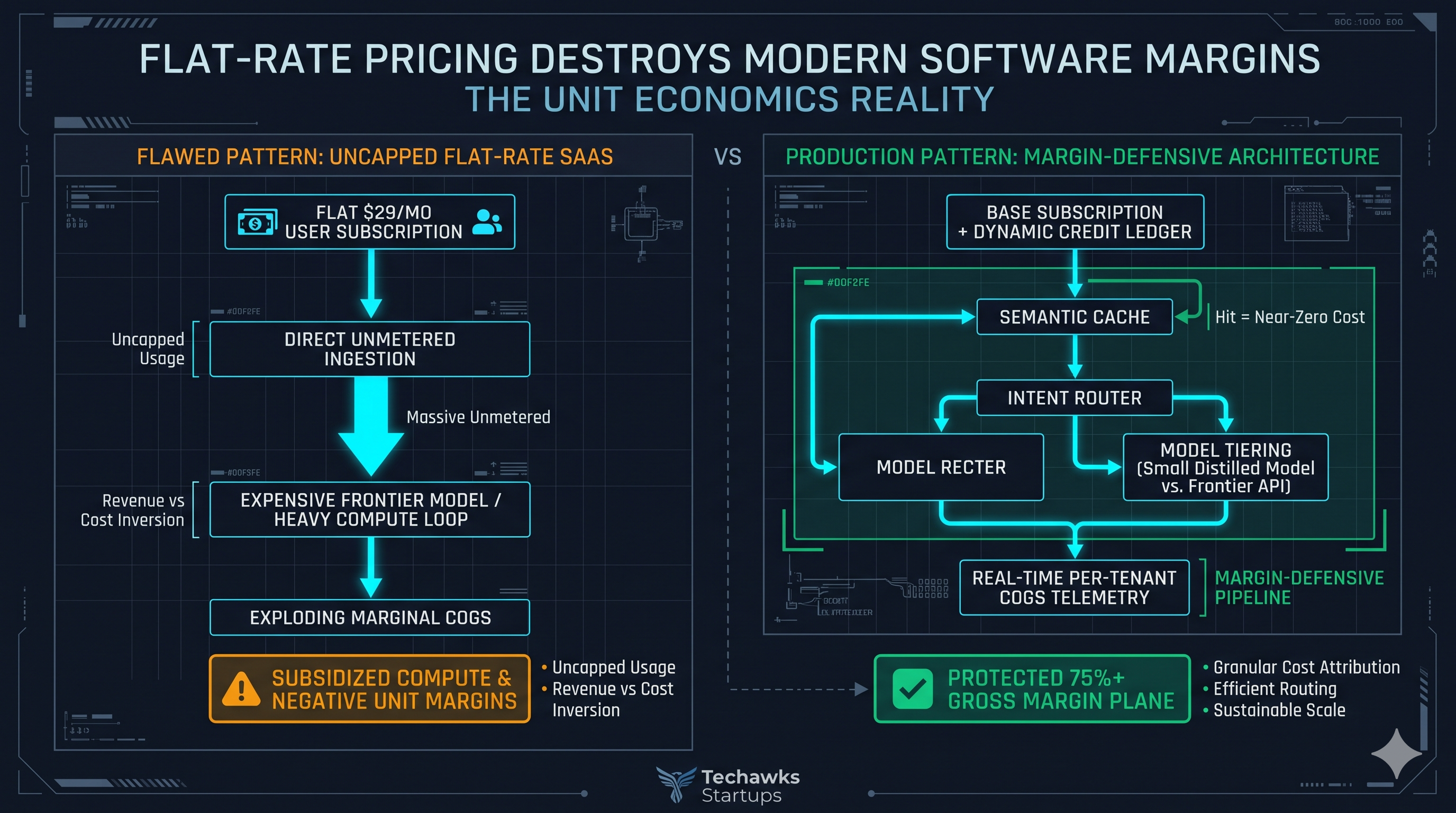
Fact: Modern application architectures increasingly depend on variable marginal costs—vector embeddings, token inference, database read units, and third-party API calls. Under flat-rate billing, power users invert your unit economics, driving individual customer gross margins into negative territory.
The Core Problem: The Silent Margin Squeeze
Traditional SaaS scaled on nearly zero marginal cost: serving one extra user HTML and JSON cost fractions of a cent.
In modern architectures, every session can trigger complex multi-agent reasoning chains, vector similarity searches, and external tool calls:
Unbounded Marginal COGS: When a flat-rate user executes 500 complex analytical prompts a day, their raw infrastructure Cost of Goods Sold (COGS) outpaces their subscription tier within 48 hours.
Hidden Negative LTV: Startups calculate a blended 70% gross margin on paper, blinded by dormant users. However, their highest-retaining, most engaged customer segment is actually generating negative Lifetime Value (LTV).
The Dilution Trap: In classic software, scaling users diluted infrastructure costs. In compute-heavy backends, scaling usage without consumption guardrails scales costs linearly—or superlinearly.
What to Implement Instead: Value-Metric Architecture
Defensible modern startups protect their runway by aligning architecture directly with billing:
Hybrid Value Metric Pricing: Combine a base subscription (platform access and baseline volume) with credit-based or usage-tiered metering for compute-heavy actions.
Deterministic Model Tiering & Semantic Caching: Route 80% of repetitive user requests through fast semantic caches (e.g., Redis vector caches) and lightweight distilled models. Reserve expensive frontier models strictly for high-entropy tasks.
Application-Layer COGS Attribution: Instrument your backend to tag every API invocation, database query, and worker cycle with a tenant_id. If you cannot see gross margin per customer segment in real time, you cannot price defensibly.
Discussion Question
How does your startup track and control the variable cloud and API costs generated by your top 5% most active users?
CTA (Join Startup Founders & Entrepreneurs)
Want to build a venture that scales efficiently without burning capital on hidden infrastructure leaks? Join the Techawks Startup Founders & Entrepreneurs Community to access unit-economics calculators, pricing playbooks, and direct peer teardowns.
Flat-Rate Pricing Destroys Modern Software Margins: The Unit Economics Reality
Across tech accelerators and early-stage pitch decks, a dangerous operating assumption has reappeared: "Price aggressively low on a flat monthly subscription to maximize seat growth, and optimize gross margins later at scale."
Here is why that assumption is causing modern SaaS and AI startups to collapse under their own customer volume:
Myth vs Fact
Myth: Cloud software inherently delivers 80%+ software gross margins; more active users automatically improve fixed-cost amortization.
Fact: Modern application architectures increasingly depend on variable marginal costs—vector embeddings, token inference, database read units, and third-party API calls. Under flat-rate billing, power users invert your unit economics, driving individual customer gross margins into negative territory.
The Core Problem: The Silent Margin Squeeze
Traditional SaaS scaled on nearly zero marginal cost: serving one extra user HTML and JSON cost fractions of a cent.
In modern architectures, every session can trigger complex multi-agent reasoning chains, vector similarity searches, and external tool calls:
Unbounded Marginal COGS: When a flat-rate user executes 500 complex analytical prompts a day, their raw infrastructure Cost of Goods Sold (COGS) outpaces their subscription tier within 48 hours.
Hidden Negative LTV: Startups calculate a blended 70% gross margin on paper, blinded by dormant users. However, their highest-retaining, most engaged customer segment is actually generating negative Lifetime Value (LTV).
The Dilution Trap: In classic software, scaling users diluted infrastructure costs. In compute-heavy backends, scaling usage without consumption guardrails scales costs linearly—or superlinearly.
What to Implement Instead: Value-Metric Architecture
Defensible modern startups protect their runway by aligning architecture directly with billing:
Hybrid Value Metric Pricing: Combine a base subscription (platform access and baseline volume) with credit-based or usage-tiered metering for compute-heavy actions.
Deterministic Model Tiering & Semantic Caching: Route 80% of repetitive user requests through fast semantic caches (e.g., Redis vector caches) and lightweight distilled models. Reserve expensive frontier models strictly for high-entropy tasks.
Application-Layer COGS Attribution: Instrument your backend to tag every API invocation, database query, and worker cycle with a tenant_id. If you cannot see gross margin per customer segment in real time, you cannot price defensibly.
Discussion Question
How does your startup track and control the variable cloud and API costs generated by your top 5% most active users?
CTA (Join Startup Founders & Entrepreneurs)
Want to build a venture that scales efficiently without burning capital on hidden infrastructure leaks? Join the Techawks Startup Founders & Entrepreneurs Community to access unit-economics calculators, pricing playbooks, and direct peer teardowns.

 English
 Arabic
 French
 Spanish
 Deutsch
 Turkish
 Dutch
 Italiano
 Russian
 Romaian
 Portuguese (Brazil)
 Greek