


Open Table Formats Do Not Eliminate Query Planning Latency: The Lakehouse Metadata Bloat Reality
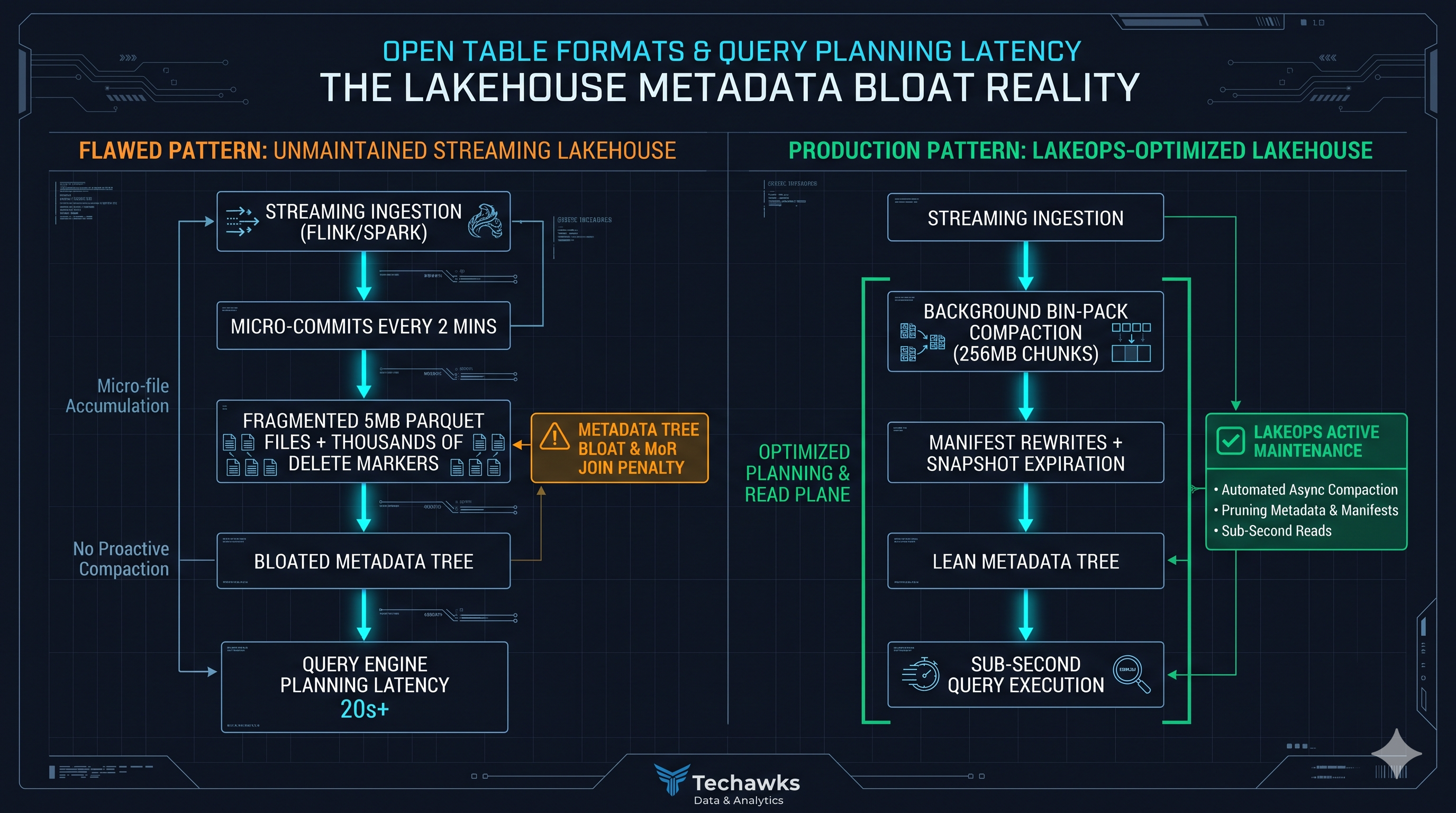
Across modern data engineering teams, a widespread architectural misconception has taken root: "Switching from raw Parquet files to an open table format (like Apache Iceberg) automatically eliminates the 'small file problem' and scales query performance indefinitely."Here is why lakehouse performance silently degrades when teams ignore metadata lifecycle engineering:Myth vs FactMyth: Open table formats handle streaming writes and transactional mutations out-of-the-box without requiring maintenance jobs or file rewriting.Fact: Open table formats never modify files in place. Every streaming commit, row-level UPDATE, or DELETE appends new data files, positional delete markers, and metadata manifests. Without scheduled compaction and metadata expiration, query planning time explodes into tens of seconds.The Core Problem: The Metadata Tree ExplosionIn legacy data lakes (Hive-style partitioning), engines struggled with expensive filesystem directory listings (LIST operations on S3/GCS). Formats like Iceberg solved this by tracking table state in a hierarchical metadata tree: Catalog $\rightarrow$ Metadata File $\rightarrow$ Manifest List $\rightarrow$ Manifest Files $\rightarrow$ Data Files.
However, continuous streaming ingestion creates a new failure mode:
The Small-File Ingestion Debt: When Flink or Spark streams commit every 2–5 minutes, they generate thousands of tiny 5–15 MB Parquet files instead of the optimal 128–512 MB chunk size.Metadata Planning Bottlenecks: Before reading a single row of data, a query engine (Trino, DuckDB, Spark, Snowflake) must parse the metadata tree. When a table accumulates 50,000+ uncompacted manifests and delete files, query planning overhead escalates from milliseconds to 20+ seconds.
Merge-on-Read Penalty: If your table uses Merge-on-Read (MoR), the engine must join data files against thousands of delete vectors at query time, burning compute memory and killing BI dashboard responsiveness.
What to Implement Instead: Active LakeOps MaintenanceTo maintain sub-second query performance at scale, decouple real-time write pipelines from read-optimized storage:
Automated Asynchronous Compaction: Run continuous background compaction procedures (e.g., Iceberg rewrite_data_files with bin-packing or Z-ordering) to merge tiny streaming files into 256 MB or 512 MB targets.Aggressive Snapshot Expiration & Manifest Rewrites: Regularly prune stale snapshots (expire_snapshots) and consolidate small manifest files (rewrite_manifests) so that query planners only traverse lean, optimized metadata trees.
Selective Copy-on-Write for Read-Heavy Gold Layers: While Merge-on-Read (MoR) is fast for streaming ingestion into Bronze/Silver layers, rewrite mutated data using Copy-on-Write (CoW) or scheduled merge jobs before exposing tables to low-latency BI analysts.
Discussion Question
How does your team schedule and manage table compaction and metadata pruning for streaming lakehouse tables—custom orchestration (Airflow/Dagster) or native engine auto-maintenance?
CTA (Join Data Science & Analytics)
Master the architecture behind production lakehouses, high-performance SQL query planning, and modern analytics engineering. Join the Techawks Data Science & Analytics Community today to access production benchmarks, catalog patterns, and live architecture reviews.
Across modern data engineering teams, a widespread architectural misconception has taken root: "Switching from raw Parquet files to an open table format (like Apache Iceberg) automatically eliminates the 'small file problem' and scales query performance indefinitely."Here is why lakehouse performance silently degrades when teams ignore metadata lifecycle engineering:Myth vs FactMyth: Open table formats handle streaming writes and transactional mutations out-of-the-box without requiring maintenance jobs or file rewriting.Fact: Open table formats never modify files in place. Every streaming commit, row-level UPDATE, or DELETE appends new data files, positional delete markers, and metadata manifests. Without scheduled compaction and metadata expiration, query planning time explodes into tens of seconds.The Core Problem: The Metadata Tree ExplosionIn legacy data lakes (Hive-style partitioning), engines struggled with expensive filesystem directory listings (LIST operations on S3/GCS). Formats like Iceberg solved this by tracking table state in a hierarchical metadata tree: Catalog $\rightarrow$ Metadata File $\rightarrow$ Manifest List $\rightarrow$ Manifest Files $\rightarrow$ Data Files.
However, continuous streaming ingestion creates a new failure mode:
The Small-File Ingestion Debt: When Flink or Spark streams commit every 2–5 minutes, they generate thousands of tiny 5–15 MB Parquet files instead of the optimal 128–512 MB chunk size.Metadata Planning Bottlenecks: Before reading a single row of data, a query engine (Trino, DuckDB, Spark, Snowflake) must parse the metadata tree. When a table accumulates 50,000+ uncompacted manifests and delete files, query planning overhead escalates from milliseconds to 20+ seconds.
Merge-on-Read Penalty: If your table uses Merge-on-Read (MoR), the engine must join data files against thousands of delete vectors at query time, burning compute memory and killing BI dashboard responsiveness.
What to Implement Instead: Active LakeOps MaintenanceTo maintain sub-second query performance at scale, decouple real-time write pipelines from read-optimized storage:
Automated Asynchronous Compaction: Run continuous background compaction procedures (e.g., Iceberg rewrite_data_files with bin-packing or Z-ordering) to merge tiny streaming files into 256 MB or 512 MB targets.Aggressive Snapshot Expiration & Manifest Rewrites: Regularly prune stale snapshots (expire_snapshots) and consolidate small manifest files (rewrite_manifests) so that query planners only traverse lean, optimized metadata trees.
Selective Copy-on-Write for Read-Heavy Gold Layers: While Merge-on-Read (MoR) is fast for streaming ingestion into Bronze/Silver layers, rewrite mutated data using Copy-on-Write (CoW) or scheduled merge jobs before exposing tables to low-latency BI analysts.
Discussion Question
How does your team schedule and manage table compaction and metadata pruning for streaming lakehouse tables—custom orchestration (Airflow/Dagster) or native engine auto-maintenance?
CTA (Join Data Science & Analytics)
Master the architecture behind production lakehouses, high-performance SQL query planning, and modern analytics engineering. Join the Techawks Data Science & Analytics Community today to access production benchmarks, catalog patterns, and live architecture reviews.
Open Table Formats Do Not Eliminate Query Planning Latency: The Lakehouse Metadata Bloat Reality
Across modern data engineering teams, a widespread architectural misconception has taken root: "Switching from raw Parquet files to an open table format (like Apache Iceberg) automatically eliminates the 'small file problem' and scales query performance indefinitely."Here is why lakehouse performance silently degrades when teams ignore metadata lifecycle engineering:Myth vs FactMyth: Open table formats handle streaming writes and transactional mutations out-of-the-box without requiring maintenance jobs or file rewriting.Fact: Open table formats never modify files in place. Every streaming commit, row-level UPDATE, or DELETE appends new data files, positional delete markers, and metadata manifests. Without scheduled compaction and metadata expiration, query planning time explodes into tens of seconds.The Core Problem: The Metadata Tree ExplosionIn legacy data lakes (Hive-style partitioning), engines struggled with expensive filesystem directory listings (LIST operations on S3/GCS). Formats like Iceberg solved this by tracking table state in a hierarchical metadata tree: Catalog $\rightarrow$ Metadata File $\rightarrow$ Manifest List $\rightarrow$ Manifest Files $\rightarrow$ Data Files.
However, continuous streaming ingestion creates a new failure mode:
The Small-File Ingestion Debt: When Flink or Spark streams commit every 2–5 minutes, they generate thousands of tiny 5–15 MB Parquet files instead of the optimal 128–512 MB chunk size.Metadata Planning Bottlenecks: Before reading a single row of data, a query engine (Trino, DuckDB, Spark, Snowflake) must parse the metadata tree. When a table accumulates 50,000+ uncompacted manifests and delete files, query planning overhead escalates from milliseconds to 20+ seconds.
Merge-on-Read Penalty: If your table uses Merge-on-Read (MoR), the engine must join data files against thousands of delete vectors at query time, burning compute memory and killing BI dashboard responsiveness.
What to Implement Instead: Active LakeOps MaintenanceTo maintain sub-second query performance at scale, decouple real-time write pipelines from read-optimized storage:
Automated Asynchronous Compaction: Run continuous background compaction procedures (e.g., Iceberg rewrite_data_files with bin-packing or Z-ordering) to merge tiny streaming files into 256 MB or 512 MB targets.Aggressive Snapshot Expiration & Manifest Rewrites: Regularly prune stale snapshots (expire_snapshots) and consolidate small manifest files (rewrite_manifests) so that query planners only traverse lean, optimized metadata trees.
Selective Copy-on-Write for Read-Heavy Gold Layers: While Merge-on-Read (MoR) is fast for streaming ingestion into Bronze/Silver layers, rewrite mutated data using Copy-on-Write (CoW) or scheduled merge jobs before exposing tables to low-latency BI analysts.
Discussion Question
How does your team schedule and manage table compaction and metadata pruning for streaming lakehouse tables—custom orchestration (Airflow/Dagster) or native engine auto-maintenance?
CTA (Join Data Science & Analytics)
Master the architecture behind production lakehouses, high-performance SQL query planning, and modern analytics engineering. Join the Techawks Data Science & Analytics Community today to access production benchmarks, catalog patterns, and live architecture reviews.

 Arabic
 French
 Spanish
 Portuguese
 Deutsch
 Turkish
 Dutch
 Italiano
 Russian
 Romaian
 Portuguese (Brazil)
 Greek