


How to Master Any Tech Concept: The Feynman Technique for Student Developers
When learning complex technical topics—whether it’s Object-Oriented Programming, API design, or Data Structures—passive reading creates an illusion of competence. You feel like you understand it because it makes sense on screen, but your brain hasn't processed the underlying logic.
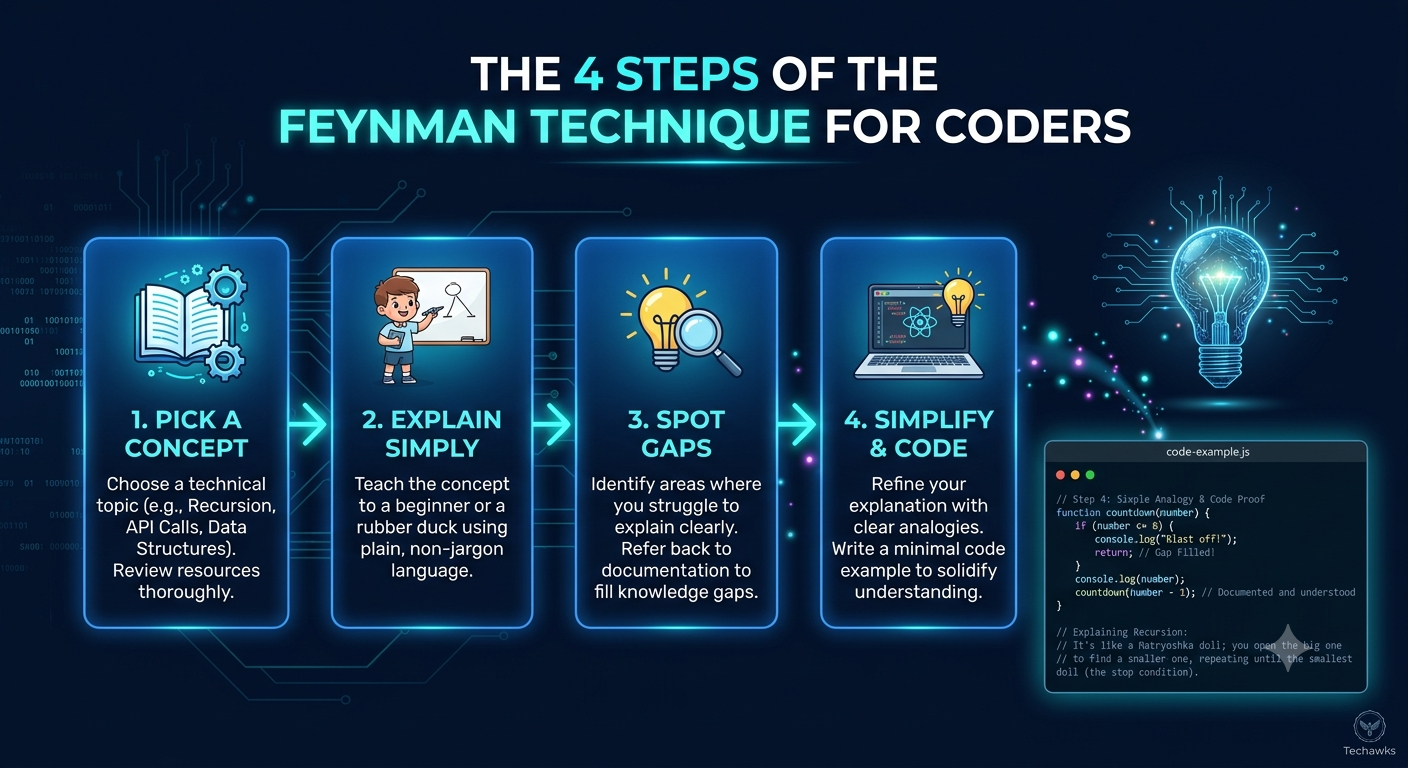
To truly master difficult concepts and make them stick long-term, top engineering students use The Feynman Technique. Here is how to apply it step-by-step:
Step 1: Choose a Concept and Study It
Pick a single topic you want to learn (e.g., Recursion, Promises in JavaScript, or SQL Joins). Read your docs or watch a lesson once to grasp the basics.
Step 2: Explain It to a 10-Year-Old
Open a blank document or grab a notepad. Write down an explanation of the concept in plain language, avoiding all jargon.
Bad: "A Promise is an object representing the eventual completion or failure of an asynchronous operation."
Good: "A Promise is like a restaurant buzzer. It doesn't give you your food right away, but it guarantees to alert you when your meal is ready or if something went wrong in the kitchen."
Step 3: Identify Gaps in Your Knowledge
The moment you find yourself reaching for a buzzword or stumbling to complete an explanation, stop. That exact spot is your knowledge gap. Go back to the original learning material and study only that specific missing piece until you can explain it simply.
Step 4: Refine and Analogize
Re-write your explanation using real-world analogies. Once you can explain how and why a technical concept works using simple terms, write a minimal code example to prove your theory.
Key Takeaways
Simplicity Equals Understanding: If you can't explain a concept simply, you don't understand it deeply enough yet.
Locate the Friction: Identifying where your explanation breaks down highlights the exact gaps you need to review.
Build Analogy Maps: Connecting abstract code logic to tangible, everyday scenarios cements long-term memory retention.
CTA (Join Students in Tech)
Stuck trying to explain a complex concept or want to test your understanding on real people?
👉 [Join Students in Tech] to practice explaining your code, collaborate with fellow learners, and accelerate your tech journey together!
When learning complex technical topics—whether it’s Object-Oriented Programming, API design, or Data Structures—passive reading creates an illusion of competence. You feel like you understand it because it makes sense on screen, but your brain hasn't processed the underlying logic.
To truly master difficult concepts and make them stick long-term, top engineering students use The Feynman Technique. Here is how to apply it step-by-step:
Step 1: Choose a Concept and Study It
Pick a single topic you want to learn (e.g., Recursion, Promises in JavaScript, or SQL Joins). Read your docs or watch a lesson once to grasp the basics.
Step 2: Explain It to a 10-Year-Old
Open a blank document or grab a notepad. Write down an explanation of the concept in plain language, avoiding all jargon.
Bad: "A Promise is an object representing the eventual completion or failure of an asynchronous operation."
Good: "A Promise is like a restaurant buzzer. It doesn't give you your food right away, but it guarantees to alert you when your meal is ready or if something went wrong in the kitchen."
Step 3: Identify Gaps in Your Knowledge
The moment you find yourself reaching for a buzzword or stumbling to complete an explanation, stop. That exact spot is your knowledge gap. Go back to the original learning material and study only that specific missing piece until you can explain it simply.
Step 4: Refine and Analogize
Re-write your explanation using real-world analogies. Once you can explain how and why a technical concept works using simple terms, write a minimal code example to prove your theory.
Key Takeaways
Simplicity Equals Understanding: If you can't explain a concept simply, you don't understand it deeply enough yet.
Locate the Friction: Identifying where your explanation breaks down highlights the exact gaps you need to review.
Build Analogy Maps: Connecting abstract code logic to tangible, everyday scenarios cements long-term memory retention.
CTA (Join Students in Tech)
Stuck trying to explain a complex concept or want to test your understanding on real people?
👉 [Join Students in Tech] to practice explaining your code, collaborate with fellow learners, and accelerate your tech journey together!
How to Master Any Tech Concept: The Feynman Technique for Student Developers
When learning complex technical topics—whether it’s Object-Oriented Programming, API design, or Data Structures—passive reading creates an illusion of competence. You feel like you understand it because it makes sense on screen, but your brain hasn't processed the underlying logic.
To truly master difficult concepts and make them stick long-term, top engineering students use The Feynman Technique. Here is how to apply it step-by-step:
Step 1: Choose a Concept and Study It
Pick a single topic you want to learn (e.g., Recursion, Promises in JavaScript, or SQL Joins). Read your docs or watch a lesson once to grasp the basics.
Step 2: Explain It to a 10-Year-Old
Open a blank document or grab a notepad. Write down an explanation of the concept in plain language, avoiding all jargon.
Bad: "A Promise is an object representing the eventual completion or failure of an asynchronous operation."
Good: "A Promise is like a restaurant buzzer. It doesn't give you your food right away, but it guarantees to alert you when your meal is ready or if something went wrong in the kitchen."
Step 3: Identify Gaps in Your Knowledge
The moment you find yourself reaching for a buzzword or stumbling to complete an explanation, stop. That exact spot is your knowledge gap. Go back to the original learning material and study only that specific missing piece until you can explain it simply.
Step 4: Refine and Analogize
Re-write your explanation using real-world analogies. Once you can explain how and why a technical concept works using simple terms, write a minimal code example to prove your theory.
Key Takeaways
Simplicity Equals Understanding: If you can't explain a concept simply, you don't understand it deeply enough yet.
Locate the Friction: Identifying where your explanation breaks down highlights the exact gaps you need to review.
Build Analogy Maps: Connecting abstract code logic to tangible, everyday scenarios cements long-term memory retention.
CTA (Join Students in Tech)
Stuck trying to explain a complex concept or want to test your understanding on real people?
👉 [Join Students in Tech] to practice explaining your code, collaborate with fellow learners, and accelerate your tech journey together!

 English
 Arabic
 French
 Spanish
 Deutsch
 Turkish
 Dutch
Dutch
 Italiano
 Russian
 Romaian
 Portuguese (Brazil)
 Greek
Greek