


Monolith vs. Microservices: How Do You Decide Which Architecture to Learn First?
When you're learning software development or system design, it's easy to get overwhelmed by complex, industry-hyped architectures. You hear about Netflix running thousands of microservices, and suddenly building a single, unified codebase feels outdated.
However, jumping straight into distributed systems can slow down your core learning. Here’s a practical framework to evaluate where to focus your engineering energy:
1. The Monolith-First Approach (Best for Fundamentals)
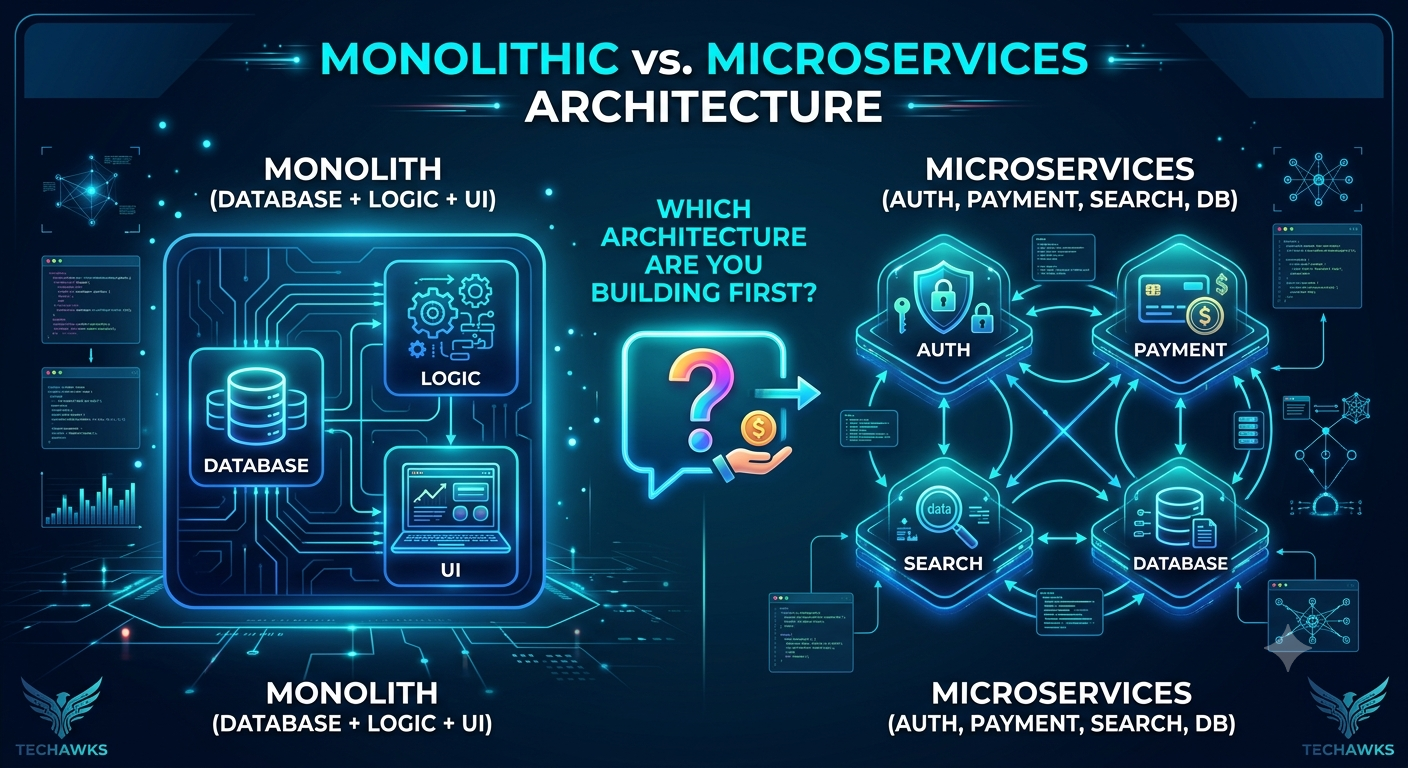
Why Learn It First: Monoliths keep everything—database, backend logic, and routing—in one codebase. They let you master core programming concepts, data modeling, and end-to-end user flows without worrying about network latency or service communication.
When to Use: Small-to-medium personal projects, quick prototypes, and initial learning stages.
2. The Microservices Shift (Best for Advanced Systems)
Why Learn It Next: Microservices break an app into small, independent services communicating via APIs (REST, gRPC) or message queues. They teach you scalability, distributed systems, containerization (Docker/Kubernetes), and fault tolerance.
When to Use: Large-scale systems with distinct team ownership, independent scaling needs, and complex deployments.
The Practical Rule of Thumb
"Don't distribute your system until you understand how to organize your code monolithically."
Learning to write clean, modular code inside a single project makes transitioning to microservices significantly easier later on.
Key Takeaways
Start Simple: Master monolithic patterns first to build strong foundational knowledge in backend architecture.
Understand the Trade-Offs: Microservices add infrastructure complexity, network overhead, and deployment challenges that beginners often don't need.
Focus on Modular Design: Writing clean, decoupled code in a monolith makes breaking it into microservices seamless when the time comes.
CTA (Join Students in Tech)
What’s your take? Are you currently building your portfolio with monolithic apps, or have you already made the leap into microservices?
Drop your thoughts, experiences, or project architecture questions in the comments below!
👉 [Join Students in Tech] to jump into the discussion, exchange architecture advice with fellow student developers, and get feedback on your system designs!
When you're learning software development or system design, it's easy to get overwhelmed by complex, industry-hyped architectures. You hear about Netflix running thousands of microservices, and suddenly building a single, unified codebase feels outdated.
However, jumping straight into distributed systems can slow down your core learning. Here’s a practical framework to evaluate where to focus your engineering energy:
1. The Monolith-First Approach (Best for Fundamentals)
Why Learn It First: Monoliths keep everything—database, backend logic, and routing—in one codebase. They let you master core programming concepts, data modeling, and end-to-end user flows without worrying about network latency or service communication.
When to Use: Small-to-medium personal projects, quick prototypes, and initial learning stages.
2. The Microservices Shift (Best for Advanced Systems)
Why Learn It Next: Microservices break an app into small, independent services communicating via APIs (REST, gRPC) or message queues. They teach you scalability, distributed systems, containerization (Docker/Kubernetes), and fault tolerance.
When to Use: Large-scale systems with distinct team ownership, independent scaling needs, and complex deployments.
The Practical Rule of Thumb
"Don't distribute your system until you understand how to organize your code monolithically."
Learning to write clean, modular code inside a single project makes transitioning to microservices significantly easier later on.
Key Takeaways
Start Simple: Master monolithic patterns first to build strong foundational knowledge in backend architecture.
Understand the Trade-Offs: Microservices add infrastructure complexity, network overhead, and deployment challenges that beginners often don't need.
Focus on Modular Design: Writing clean, decoupled code in a monolith makes breaking it into microservices seamless when the time comes.
CTA (Join Students in Tech)
What’s your take? Are you currently building your portfolio with monolithic apps, or have you already made the leap into microservices?
Drop your thoughts, experiences, or project architecture questions in the comments below!
👉 [Join Students in Tech] to jump into the discussion, exchange architecture advice with fellow student developers, and get feedback on your system designs!
Monolith vs. Microservices: How Do You Decide Which Architecture to Learn First?
When you're learning software development or system design, it's easy to get overwhelmed by complex, industry-hyped architectures. You hear about Netflix running thousands of microservices, and suddenly building a single, unified codebase feels outdated.
However, jumping straight into distributed systems can slow down your core learning. Here’s a practical framework to evaluate where to focus your engineering energy:
1. The Monolith-First Approach (Best for Fundamentals)
Why Learn It First: Monoliths keep everything—database, backend logic, and routing—in one codebase. They let you master core programming concepts, data modeling, and end-to-end user flows without worrying about network latency or service communication.
When to Use: Small-to-medium personal projects, quick prototypes, and initial learning stages.
2. The Microservices Shift (Best for Advanced Systems)
Why Learn It Next: Microservices break an app into small, independent services communicating via APIs (REST, gRPC) or message queues. They teach you scalability, distributed systems, containerization (Docker/Kubernetes), and fault tolerance.
When to Use: Large-scale systems with distinct team ownership, independent scaling needs, and complex deployments.
The Practical Rule of Thumb
"Don't distribute your system until you understand how to organize your code monolithically."
Learning to write clean, modular code inside a single project makes transitioning to microservices significantly easier later on.
Key Takeaways
Start Simple: Master monolithic patterns first to build strong foundational knowledge in backend architecture.
Understand the Trade-Offs: Microservices add infrastructure complexity, network overhead, and deployment challenges that beginners often don't need.
Focus on Modular Design: Writing clean, decoupled code in a monolith makes breaking it into microservices seamless when the time comes.
CTA (Join Students in Tech)
What’s your take? Are you currently building your portfolio with monolithic apps, or have you already made the leap into microservices?
Drop your thoughts, experiences, or project architecture questions in the comments below!
👉 [Join Students in Tech] to jump into the discussion, exchange architecture advice with fellow student developers, and get feedback on your system designs!

 English
 French
 Spanish
 Portuguese
 Deutsch
 Turkish
 Dutch
Dutch
 Italiano
 Russian
 Romaian
 Portuguese (Brazil)
 Greek
Greek