


How Hackers Map Your Network: The Anatomy of a Port Scan
In cybersecurity, ports act like digital doors. Web servers usually listen on Port 80 (HTTP) or Port 443 (HTTPS), while databases might listen on Port 5432 (PostgreSQL) or Port 3306 (MySQL).
When security professionals or attackers perform network reconnaissance, they use tools like Nmap to perform port scanning. Here is how the process works under the hood and how to analyze the results:
1. The Three Primary Port States
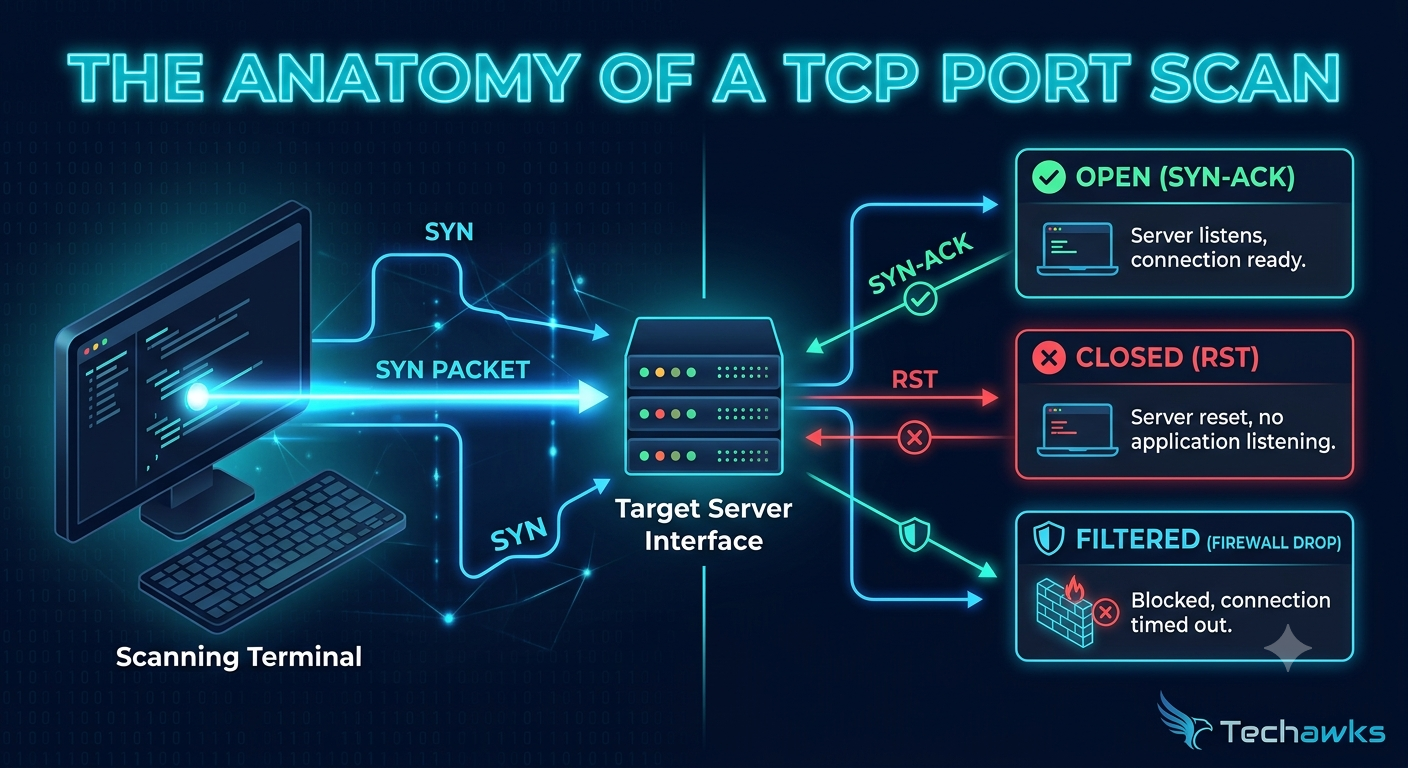
When a scanner sends packets to a target IP address, ports will respond in one of three ways:
Open: An application is actively listening and ready to accept incoming connections.
Closed: The target system receives the request, but no application is listening. It responds with a RST (Reset) packet.
Filtered: A firewall or network control blocks the probe, meaning the scanner cannot determine if the port is open or closed.
2. SYN Scanning ("Stealth Scanning")
The most common port scanning technique relies on TCP handshake mechanics:
The scanner sends a SYN (Synchronize) packet to a port.
If open, the server responds with a SYN-ACK (Synchronize-Acknowledge).
Instead of completing the connection with an ACK, the scanner immediately sends a RST packet to tear down the connection before full logging occurs.
3. Actionable Defense Strategy
To secure a network against unauthorized recon:
Close Unused Ports: Stop running services you don't need on public interfaces.
Implement Stateful Firewalls: Configure rules to drop incoming probes on non-essential ports, turning "Closed" ports into "Filtered" ones.
Monitor with IDS/IPS: Deploy intrusion detection systems (like Snort or Suricata) to detect high-frequency TCP scanning activity.
Key Takeaways
Recon Precedes Attacks: Port scanning is always the first phase of network exploitation.
TCP Mechanics Matter: Understanding handshake signals (SYN, SYN-ACK, RST) reveals how network tools identify open services.
Minimize Attack Surface: Disabling unneeded services and filtering open ports neutralizes initial threat vectors.
CTA (Join Cybersecurity & Ethical Hacking)
Want to get hands-on experience using industry-standard tools like Nmap, Wireshark, and Metasploit in safe, isolated lab environments?
👉 [Join Cybersecurity & Ethical Hacking] to start mastering network defense and penetration testing alongside fellow cybersecurity enthusiasts!
In cybersecurity, ports act like digital doors. Web servers usually listen on Port 80 (HTTP) or Port 443 (HTTPS), while databases might listen on Port 5432 (PostgreSQL) or Port 3306 (MySQL).
When security professionals or attackers perform network reconnaissance, they use tools like Nmap to perform port scanning. Here is how the process works under the hood and how to analyze the results:
1. The Three Primary Port States
When a scanner sends packets to a target IP address, ports will respond in one of three ways:
Open: An application is actively listening and ready to accept incoming connections.
Closed: The target system receives the request, but no application is listening. It responds with a RST (Reset) packet.
Filtered: A firewall or network control blocks the probe, meaning the scanner cannot determine if the port is open or closed.
2. SYN Scanning ("Stealth Scanning")
The most common port scanning technique relies on TCP handshake mechanics:
The scanner sends a SYN (Synchronize) packet to a port.
If open, the server responds with a SYN-ACK (Synchronize-Acknowledge).
Instead of completing the connection with an ACK, the scanner immediately sends a RST packet to tear down the connection before full logging occurs.
3. Actionable Defense Strategy
To secure a network against unauthorized recon:
Close Unused Ports: Stop running services you don't need on public interfaces.
Implement Stateful Firewalls: Configure rules to drop incoming probes on non-essential ports, turning "Closed" ports into "Filtered" ones.
Monitor with IDS/IPS: Deploy intrusion detection systems (like Snort or Suricata) to detect high-frequency TCP scanning activity.
Key Takeaways
Recon Precedes Attacks: Port scanning is always the first phase of network exploitation.
TCP Mechanics Matter: Understanding handshake signals (SYN, SYN-ACK, RST) reveals how network tools identify open services.
Minimize Attack Surface: Disabling unneeded services and filtering open ports neutralizes initial threat vectors.
CTA (Join Cybersecurity & Ethical Hacking)
Want to get hands-on experience using industry-standard tools like Nmap, Wireshark, and Metasploit in safe, isolated lab environments?
👉 [Join Cybersecurity & Ethical Hacking] to start mastering network defense and penetration testing alongside fellow cybersecurity enthusiasts!
How Hackers Map Your Network: The Anatomy of a Port Scan
In cybersecurity, ports act like digital doors. Web servers usually listen on Port 80 (HTTP) or Port 443 (HTTPS), while databases might listen on Port 5432 (PostgreSQL) or Port 3306 (MySQL).
When security professionals or attackers perform network reconnaissance, they use tools like Nmap to perform port scanning. Here is how the process works under the hood and how to analyze the results:
1. The Three Primary Port States
When a scanner sends packets to a target IP address, ports will respond in one of three ways:
Open: An application is actively listening and ready to accept incoming connections.
Closed: The target system receives the request, but no application is listening. It responds with a RST (Reset) packet.
Filtered: A firewall or network control blocks the probe, meaning the scanner cannot determine if the port is open or closed.
2. SYN Scanning ("Stealth Scanning")
The most common port scanning technique relies on TCP handshake mechanics:
The scanner sends a SYN (Synchronize) packet to a port.
If open, the server responds with a SYN-ACK (Synchronize-Acknowledge).
Instead of completing the connection with an ACK, the scanner immediately sends a RST packet to tear down the connection before full logging occurs.
3. Actionable Defense Strategy
To secure a network against unauthorized recon:
Close Unused Ports: Stop running services you don't need on public interfaces.
Implement Stateful Firewalls: Configure rules to drop incoming probes on non-essential ports, turning "Closed" ports into "Filtered" ones.
Monitor with IDS/IPS: Deploy intrusion detection systems (like Snort or Suricata) to detect high-frequency TCP scanning activity.
Key Takeaways
Recon Precedes Attacks: Port scanning is always the first phase of network exploitation.
TCP Mechanics Matter: Understanding handshake signals (SYN, SYN-ACK, RST) reveals how network tools identify open services.
Minimize Attack Surface: Disabling unneeded services and filtering open ports neutralizes initial threat vectors.
CTA (Join Cybersecurity & Ethical Hacking)
Want to get hands-on experience using industry-standard tools like Nmap, Wireshark, and Metasploit in safe, isolated lab environments?
👉 [Join Cybersecurity & Ethical Hacking] to start mastering network defense and penetration testing alongside fellow cybersecurity enthusiasts!

 English
 Arabic
 Spanish
 Portuguese
 Deutsch
 Turkish
 Dutch
Dutch
 Italiano
 Russian
 Romaian
 Portuguese (Brazil)
 Greek
Greek