


The Analytics Engineer’s Toolkit: 5 SQL Habits That Prevent Broken Pipelines
In data analytics, writing a query that returns the right numbers once is easy. Writing SQL transformations that remain accurate as your underlying data scales and evolves is where true analytics engineering lies.
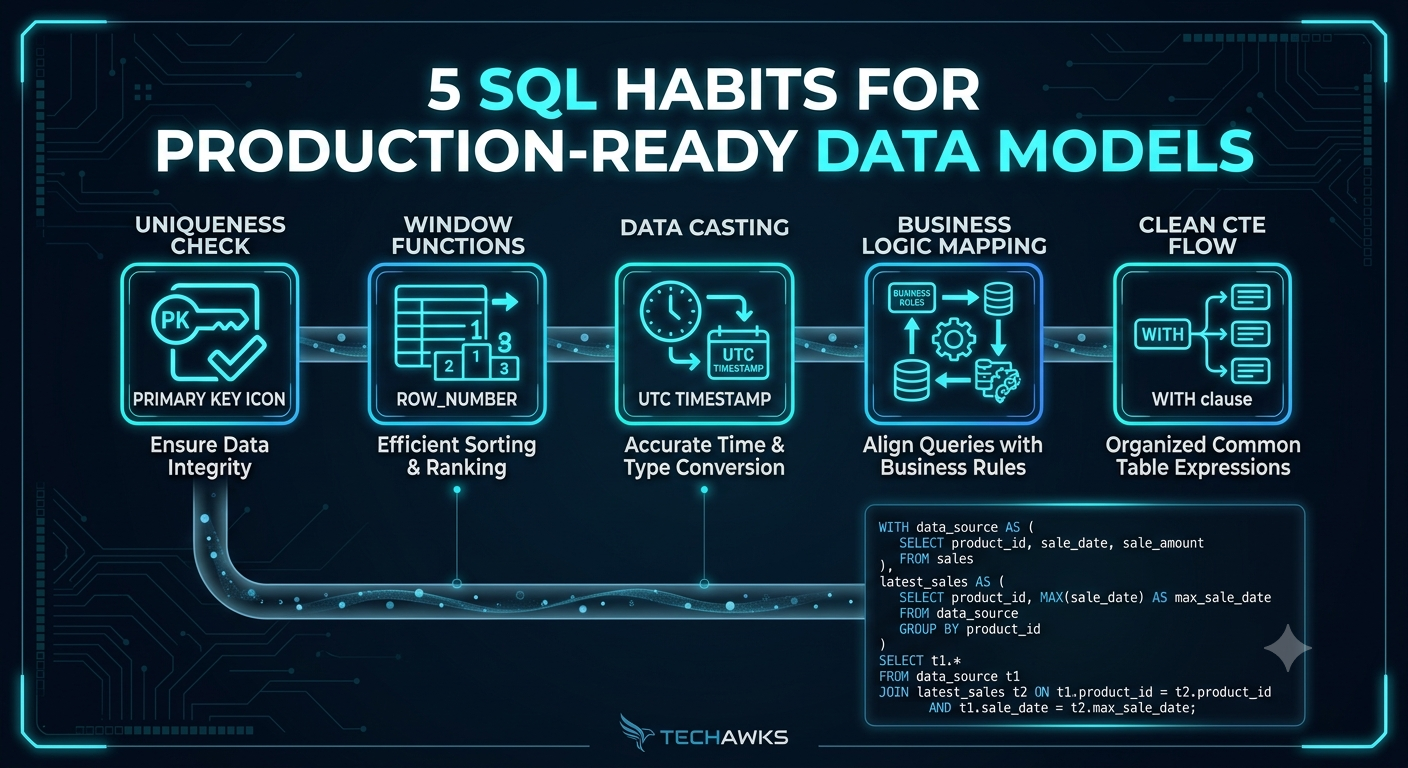
Whether you're building dbt models, writing scheduled ETL jobs, or prepping datasets for BI dashboards, apply these 5 practical habits to every query:
1. Always Test for Uniqueness and Nulls On Primary Keys
The Risk: Joining tables without verifying primary key uniqueness creates fan-out joins, artificially multiplying your metrics (e.g., doubling sales figures).
The Fix: Before performing any LEFT JOIN, explicitly check for duplicates and null values using aggregate checks:
SQL
SELECT primary_key, COUNT(*)
FROM staging_table
GROUP BY 1
HAVING COUNT(*) > 1 OR primary_key IS NULL;
2. Use Window Functions Over Self-Joins for Deduplication
The Risk: Joining a table back onto itself to find the "latest record per user" is computationally expensive and prone to syntax errors.
The Fix: Use ROW_NUMBER() OVER (PARTITION BY ... ORDER BY ...) inside a CTE (Common Table Expression) to partition and rank your event logs cleanly.
3. Explicitly Cast Data Types Early in Staging
The Risk: Implicit data type coercion leads to silent failures, inaccurate string sorting, and unexpected timezone mismatches.
The Fix: Convert raw strings into TIMESTAMP, DATE, NUMERIC, or BOOLEAN types in your initial staging layer, standardizing timezones (e.g., UTC) right at the entry point.
4. Replace Magic Numbers with Documented Business Logic
The Risk: Filtering queries with hardcoded values like WHERE status_id IN (3, 7, 12) makes your code unmaintainable for team members who don't know what those status IDs represent.
The Fix: Map status codes to clear business definitions in early CTEs or reference tables, or document them clearly inline using comments.
5. Prefer CTEs Over Nested Subqueries
The Risk: Deeply nested subqueries force analysts to read your SQL from the inside out, making debugging a nightmare.
The Fix: Structure your logic linearly using CTEs (WITH table_a AS (...), table_b AS (...)). Name each CTE based on its functional step (e.g., stg_orders, filtered_events, final_metrics).
Key Takeaways
Validate Granularity First: Always confirm primary key uniqueness to avoid metric-inflating fan-out joins.
Linear Structure Wins: Use CTEs to make complex transformation pipelines readable, modular, and easy to debug.
Standardize at Staging: Handle data type casting, timezone conversions, and status definitions early in your data flow.
CTA (Join Data Science & Analytics)
Ready to level up your data modeling, master advanced SQL techniques, and build reliable end-to-end data pipelines?
👉 [Join Data Science & Analytics] to collaborate with fellow data professionals, access hands-on analytical projects, and sharpen your workflow!
In data analytics, writing a query that returns the right numbers once is easy. Writing SQL transformations that remain accurate as your underlying data scales and evolves is where true analytics engineering lies.
Whether you're building dbt models, writing scheduled ETL jobs, or prepping datasets for BI dashboards, apply these 5 practical habits to every query:
1. Always Test for Uniqueness and Nulls On Primary Keys
The Risk: Joining tables without verifying primary key uniqueness creates fan-out joins, artificially multiplying your metrics (e.g., doubling sales figures).
The Fix: Before performing any LEFT JOIN, explicitly check for duplicates and null values using aggregate checks:
SQL
SELECT primary_key, COUNT(*)
FROM staging_table
GROUP BY 1
HAVING COUNT(*) > 1 OR primary_key IS NULL;
2. Use Window Functions Over Self-Joins for Deduplication
The Risk: Joining a table back onto itself to find the "latest record per user" is computationally expensive and prone to syntax errors.
The Fix: Use ROW_NUMBER() OVER (PARTITION BY ... ORDER BY ...) inside a CTE (Common Table Expression) to partition and rank your event logs cleanly.
3. Explicitly Cast Data Types Early in Staging
The Risk: Implicit data type coercion leads to silent failures, inaccurate string sorting, and unexpected timezone mismatches.
The Fix: Convert raw strings into TIMESTAMP, DATE, NUMERIC, or BOOLEAN types in your initial staging layer, standardizing timezones (e.g., UTC) right at the entry point.
4. Replace Magic Numbers with Documented Business Logic
The Risk: Filtering queries with hardcoded values like WHERE status_id IN (3, 7, 12) makes your code unmaintainable for team members who don't know what those status IDs represent.
The Fix: Map status codes to clear business definitions in early CTEs or reference tables, or document them clearly inline using comments.
5. Prefer CTEs Over Nested Subqueries
The Risk: Deeply nested subqueries force analysts to read your SQL from the inside out, making debugging a nightmare.
The Fix: Structure your logic linearly using CTEs (WITH table_a AS (...), table_b AS (...)). Name each CTE based on its functional step (e.g., stg_orders, filtered_events, final_metrics).
Key Takeaways
Validate Granularity First: Always confirm primary key uniqueness to avoid metric-inflating fan-out joins.
Linear Structure Wins: Use CTEs to make complex transformation pipelines readable, modular, and easy to debug.
Standardize at Staging: Handle data type casting, timezone conversions, and status definitions early in your data flow.
CTA (Join Data Science & Analytics)
Ready to level up your data modeling, master advanced SQL techniques, and build reliable end-to-end data pipelines?
👉 [Join Data Science & Analytics] to collaborate with fellow data professionals, access hands-on analytical projects, and sharpen your workflow!
The Analytics Engineer’s Toolkit: 5 SQL Habits That Prevent Broken Pipelines
In data analytics, writing a query that returns the right numbers once is easy. Writing SQL transformations that remain accurate as your underlying data scales and evolves is where true analytics engineering lies.
Whether you're building dbt models, writing scheduled ETL jobs, or prepping datasets for BI dashboards, apply these 5 practical habits to every query:
1. Always Test for Uniqueness and Nulls On Primary Keys
The Risk: Joining tables without verifying primary key uniqueness creates fan-out joins, artificially multiplying your metrics (e.g., doubling sales figures).
The Fix: Before performing any LEFT JOIN, explicitly check for duplicates and null values using aggregate checks:
SQL
SELECT primary_key, COUNT(*)
FROM staging_table
GROUP BY 1
HAVING COUNT(*) > 1 OR primary_key IS NULL;
2. Use Window Functions Over Self-Joins for Deduplication
The Risk: Joining a table back onto itself to find the "latest record per user" is computationally expensive and prone to syntax errors.
The Fix: Use ROW_NUMBER() OVER (PARTITION BY ... ORDER BY ...) inside a CTE (Common Table Expression) to partition and rank your event logs cleanly.
3. Explicitly Cast Data Types Early in Staging
The Risk: Implicit data type coercion leads to silent failures, inaccurate string sorting, and unexpected timezone mismatches.
The Fix: Convert raw strings into TIMESTAMP, DATE, NUMERIC, or BOOLEAN types in your initial staging layer, standardizing timezones (e.g., UTC) right at the entry point.
4. Replace Magic Numbers with Documented Business Logic
The Risk: Filtering queries with hardcoded values like WHERE status_id IN (3, 7, 12) makes your code unmaintainable for team members who don't know what those status IDs represent.
The Fix: Map status codes to clear business definitions in early CTEs or reference tables, or document them clearly inline using comments.
5. Prefer CTEs Over Nested Subqueries
The Risk: Deeply nested subqueries force analysts to read your SQL from the inside out, making debugging a nightmare.
The Fix: Structure your logic linearly using CTEs (WITH table_a AS (...), table_b AS (...)). Name each CTE based on its functional step (e.g., stg_orders, filtered_events, final_metrics).
Key Takeaways
Validate Granularity First: Always confirm primary key uniqueness to avoid metric-inflating fan-out joins.
Linear Structure Wins: Use CTEs to make complex transformation pipelines readable, modular, and easy to debug.
Standardize at Staging: Handle data type casting, timezone conversions, and status definitions early in your data flow.
CTA (Join Data Science & Analytics)
Ready to level up your data modeling, master advanced SQL techniques, and build reliable end-to-end data pipelines?
👉 [Join Data Science & Analytics] to collaborate with fellow data professionals, access hands-on analytical projects, and sharpen your workflow!

 English
 Arabic
 French
 Spanish
 Portuguese
 Deutsch
 Turkish
 Dutch
Dutch
 Italiano
 Russian
 Romaian
 Portuguese (Brazil)