 English
 Arabic
 French
 Spanish
 Portuguese
 Deutsch
 Turkish
 Dutch
Dutch
 Italiano
 Russian
 Romaian
 Portuguese (Brazil)
 Greek
Greek
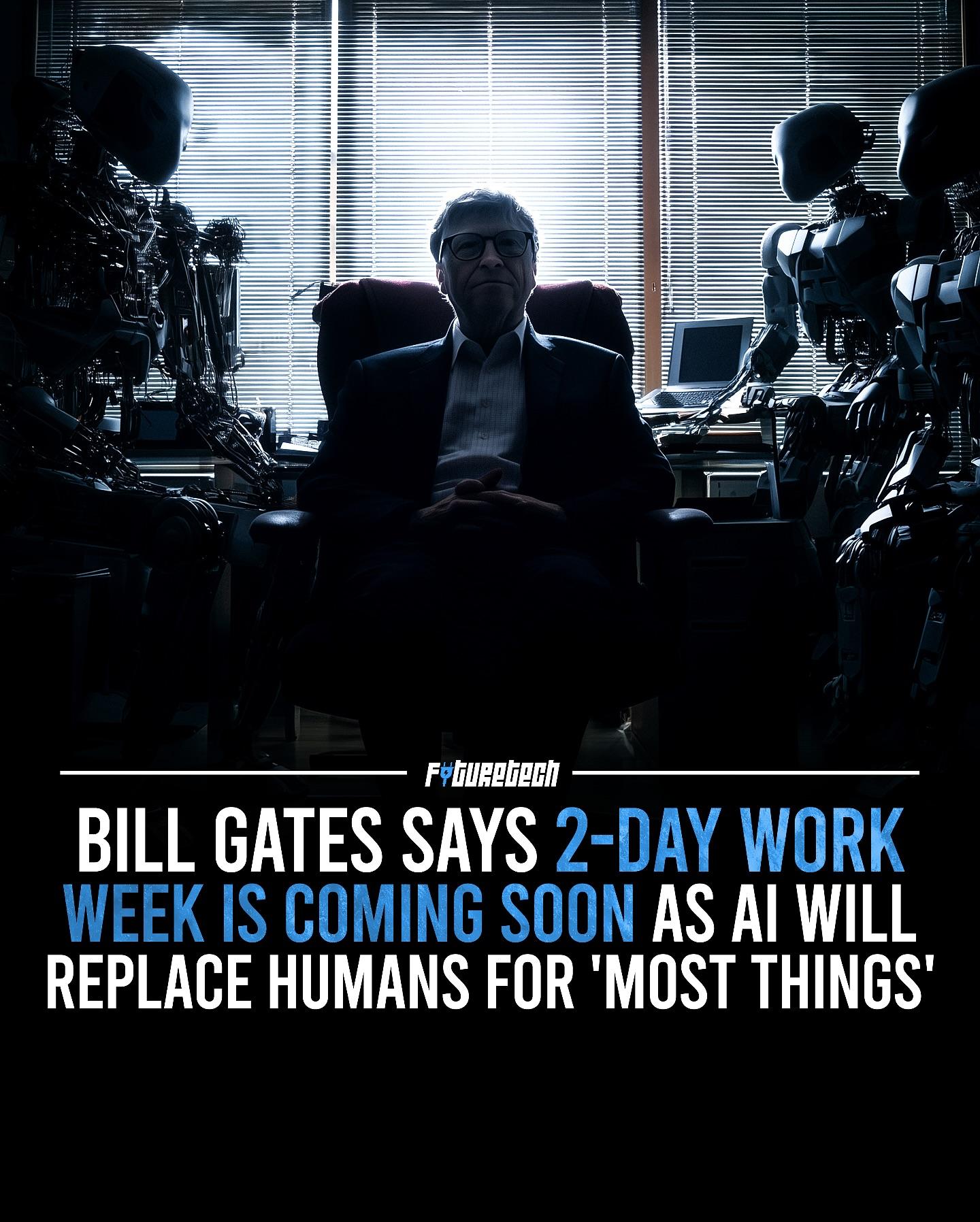
The traditional 9-to-5, five-day workweek could soon become a thing of the past, according to Bill Gates.
In a recent appearance on The Tonight Show, Gates predicted that advancements in artificial intelligence might eventually shorten our workweek to just two days. He explained that AI could outperform humans in many jobs, making high-level intelligence widely accessible. Professions like teaching and medicine, he said, could benefit significantly as AI helps fill existing gaps—potentially reshaping society and how we spend our time.
Gates went further, suggesting that once AI achieves artificial general intelligence (AGI), only a handful of roles will remain in human hands—mostly those we want to keep, such as creative arts or sports. Routine tasks like farming, manufacturing, and delivery could soon be entirely automated.
While some view this as a path to improved work-life balance, others see potential dangers. Experts like Geoffrey Hinton warn that without proper safeguards, AI could worsen inequality by displacing jobs faster than society can adapt. With growing concerns about AI ethics and control, many argue that careful oversight will be essential as this technology continues to evolve.
In a recent appearance on The Tonight Show, Gates predicted that advancements in artificial intelligence might eventually shorten our workweek to just two days. He explained that AI could outperform humans in many jobs, making high-level intelligence widely accessible. Professions like teaching and medicine, he said, could benefit significantly as AI helps fill existing gaps—potentially reshaping society and how we spend our time.
Gates went further, suggesting that once AI achieves artificial general intelligence (AGI), only a handful of roles will remain in human hands—mostly those we want to keep, such as creative arts or sports. Routine tasks like farming, manufacturing, and delivery could soon be entirely automated.
While some view this as a path to improved work-life balance, others see potential dangers. Experts like Geoffrey Hinton warn that without proper safeguards, AI could worsen inequality by displacing jobs faster than society can adapt. With growing concerns about AI ethics and control, many argue that careful oversight will be essential as this technology continues to evolve.
The traditional 9-to-5, five-day workweek could soon become a thing of the past, according to Bill Gates.
In a recent appearance on The Tonight Show, Gates predicted that advancements in artificial intelligence might eventually shorten our workweek to just two days. He explained that AI could outperform humans in many jobs, making high-level intelligence widely accessible. Professions like teaching and medicine, he said, could benefit significantly as AI helps fill existing gaps—potentially reshaping society and how we spend our time.
Gates went further, suggesting that once AI achieves artificial general intelligence (AGI), only a handful of roles will remain in human hands—mostly those we want to keep, such as creative arts or sports. Routine tasks like farming, manufacturing, and delivery could soon be entirely automated.
While some view this as a path to improved work-life balance, others see potential dangers. Experts like Geoffrey Hinton warn that without proper safeguards, AI could worsen inequality by displacing jobs faster than society can adapt. With growing concerns about AI ethics and control, many argue that careful oversight will be essential as this technology continues to evolve.
·266 Views
·0 Reviews
