


Shift-Left Data Contracts: The Production Reliability Checklist Every Data Team Needs
In traditional data architectures, data engineering and analytics exist in a passive, downstream vacuum. Application engineering teams push schema migrations, modify payload fields, or alter telemetry events without visibility into downstream data lakehouse dependencies. The resulting pipeline breakage leads to silent metric degradation, pipeline downtime, and eroded executive trust.
To build resilient analytics pipelines, data organizations must adopt Shift-Left Data Contracts: treating data as an explicit, versioned API contract negotiated between software producers and data consumers.
Plaintext
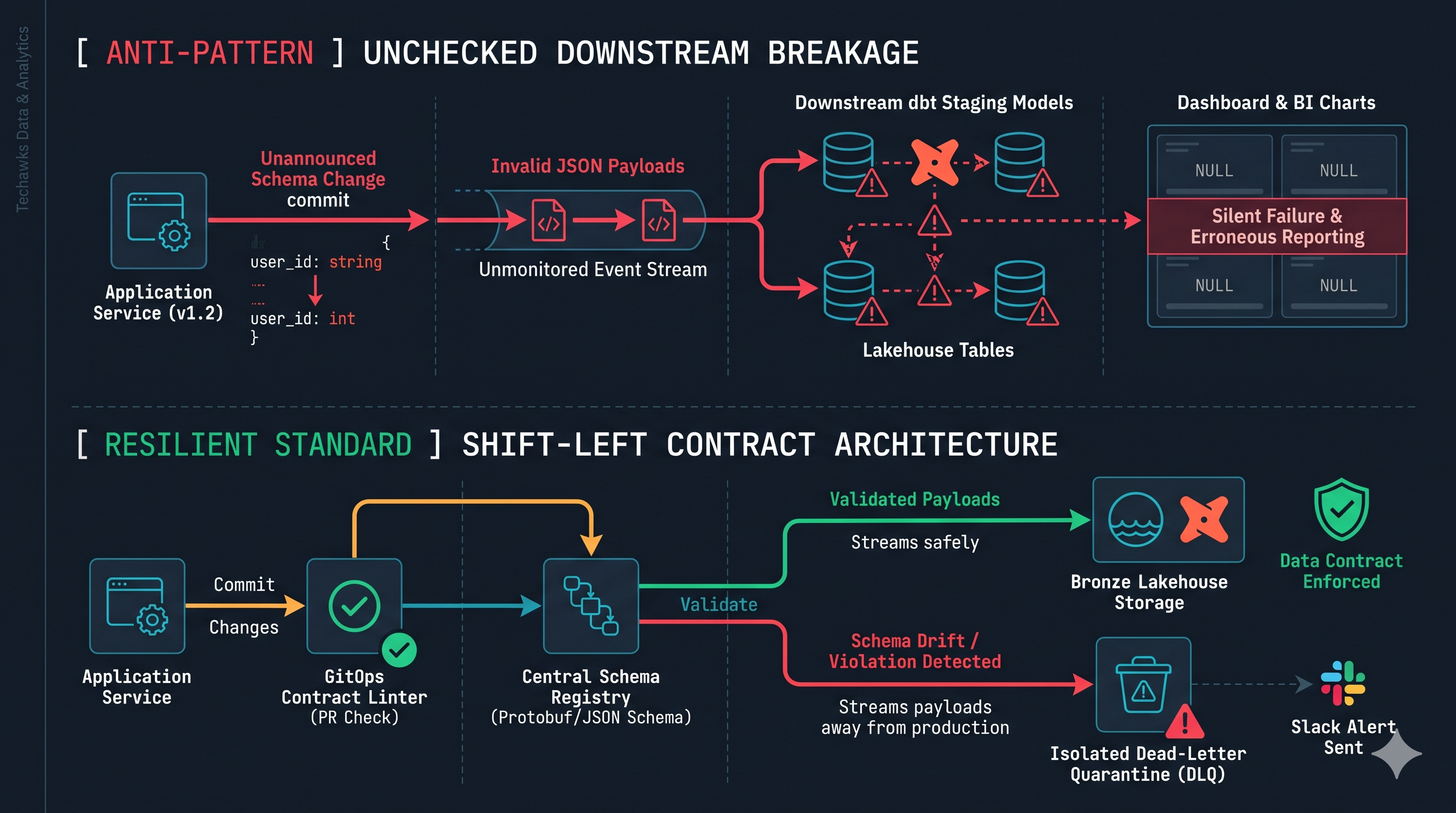
[ ANTI-PATTERN: SILENT DOWNSTREAM PIPELINE BREAKAGE ]
App Code Mutation ──> Unchecked JSON Payload ──> Kafka ──> Lakehouse (Bronze) ──> Broken dbt Transformation ──> Degraded Dashboards & Models
[ RESILIENT PATTERN: PRODUCER-ENFORCED DATA CONTRACTS ]
App Code Mutation ──> CI/CD Contract Linter (Protobuf/JSON Schema) ──> Schema Registry Gate ──> Validated Ingestion ──> Reliable Lakehouse Layer
│
└──[ Schema Drift / Violation ]──> BLOCKED AT BUILD / DEAD-LETTER QUEUE
Here is your production checklist to transition from reactive pipeline triage to proactive contract-driven reliability:
1. Contract Definition & Version Control
[ ] Declarative Schema Definitions: Define schemas upstream in a standardized format (JSON Schema, Protocol Buffers, or OpenDataContract Specification) declaring explicit data types, nullability, primary keys, and field descriptions.
[ ] Semantic Versioning (SemVer) for Schemas: Treat data schema changes like public software APIs. Field additions trigger minor updates; field removals, type changes, or altered business logic require major version increments.
[ ] Centralized Schema Registry: Maintain a single source of truth (e.g., Confluent Schema Registry or an internal Git-backed catalog) to enforce producer and consumer contract alignment before serialization.
2. CI/CD & Producer-Side Guardrails
[ ] Pre-Merge Schema Breaking Checks: Integrate contract linters into upstream application pull request pipelines to automatically fail builds if a backend code change alters or deletes an active contract field.
[ ] Producer Ownership Accountability: Assign direct domain ownership for emitted schemas to the software engineering teams originating the entities, moving accountability out of the central data team.
[ ] Automated Dead-Letter Queues (DLQ): Route invalid, malformed, or uncontracted payloads into a quarantine DLQ with automated alerting, ensuring valid downstream streams continue without halting batch or streaming jobs.
3. Semantic Validation & SLA Observability
[ ] Data Quality Constraints & Expectations: Embed business logic assertions within the contract (e.g., price >= 0, currency IN ('USD', 'EUR', 'INR')) validated directly at runtime or via ingestion hooks.
[ ] Explicit Freshness & Latency SLAs: Define non-functional requirements inside the contract specification, including ingestion frequency, allowed delivery latency, and volume thresholds.
[ ] Automated Lineage & Blast-Radius Mapping: Connect contract metadata to your data catalog (e.g., OpenLineage or Apache Atlas) to automatically visualize every downstream dashboard, lakehouse table, and ML feature store impacted by proposed contract updates.
Discussion Question
Where does your team experience the most friction when implementing data contracts: getting upstream software engineers to adopt schema PR checks, or enforcing contract validation on legacy streaming pipelines without adding ingestion latency?
CTA
Join Data Science & Analytics — Connect with data architects, analytics engineers, and data leaders to access production blueprints, lakehouse design patterns, and modern data governance frameworks.
In traditional data architectures, data engineering and analytics exist in a passive, downstream vacuum. Application engineering teams push schema migrations, modify payload fields, or alter telemetry events without visibility into downstream data lakehouse dependencies. The resulting pipeline breakage leads to silent metric degradation, pipeline downtime, and eroded executive trust.
To build resilient analytics pipelines, data organizations must adopt Shift-Left Data Contracts: treating data as an explicit, versioned API contract negotiated between software producers and data consumers.
Plaintext
[ ANTI-PATTERN: SILENT DOWNSTREAM PIPELINE BREAKAGE ]
App Code Mutation ──> Unchecked JSON Payload ──> Kafka ──> Lakehouse (Bronze) ──> Broken dbt Transformation ──> Degraded Dashboards & Models
[ RESILIENT PATTERN: PRODUCER-ENFORCED DATA CONTRACTS ]
App Code Mutation ──> CI/CD Contract Linter (Protobuf/JSON Schema) ──> Schema Registry Gate ──> Validated Ingestion ──> Reliable Lakehouse Layer
│
└──[ Schema Drift / Violation ]──> BLOCKED AT BUILD / DEAD-LETTER QUEUE
Here is your production checklist to transition from reactive pipeline triage to proactive contract-driven reliability:
1. Contract Definition & Version Control
[ ] Declarative Schema Definitions: Define schemas upstream in a standardized format (JSON Schema, Protocol Buffers, or OpenDataContract Specification) declaring explicit data types, nullability, primary keys, and field descriptions.
[ ] Semantic Versioning (SemVer) for Schemas: Treat data schema changes like public software APIs. Field additions trigger minor updates; field removals, type changes, or altered business logic require major version increments.
[ ] Centralized Schema Registry: Maintain a single source of truth (e.g., Confluent Schema Registry or an internal Git-backed catalog) to enforce producer and consumer contract alignment before serialization.
2. CI/CD & Producer-Side Guardrails
[ ] Pre-Merge Schema Breaking Checks: Integrate contract linters into upstream application pull request pipelines to automatically fail builds if a backend code change alters or deletes an active contract field.
[ ] Producer Ownership Accountability: Assign direct domain ownership for emitted schemas to the software engineering teams originating the entities, moving accountability out of the central data team.
[ ] Automated Dead-Letter Queues (DLQ): Route invalid, malformed, or uncontracted payloads into a quarantine DLQ with automated alerting, ensuring valid downstream streams continue without halting batch or streaming jobs.
3. Semantic Validation & SLA Observability
[ ] Data Quality Constraints & Expectations: Embed business logic assertions within the contract (e.g., price >= 0, currency IN ('USD', 'EUR', 'INR')) validated directly at runtime or via ingestion hooks.
[ ] Explicit Freshness & Latency SLAs: Define non-functional requirements inside the contract specification, including ingestion frequency, allowed delivery latency, and volume thresholds.
[ ] Automated Lineage & Blast-Radius Mapping: Connect contract metadata to your data catalog (e.g., OpenLineage or Apache Atlas) to automatically visualize every downstream dashboard, lakehouse table, and ML feature store impacted by proposed contract updates.
Discussion Question
Where does your team experience the most friction when implementing data contracts: getting upstream software engineers to adopt schema PR checks, or enforcing contract validation on legacy streaming pipelines without adding ingestion latency?
CTA
Join Data Science & Analytics — Connect with data architects, analytics engineers, and data leaders to access production blueprints, lakehouse design patterns, and modern data governance frameworks.
Shift-Left Data Contracts: The Production Reliability Checklist Every Data Team Needs
In traditional data architectures, data engineering and analytics exist in a passive, downstream vacuum. Application engineering teams push schema migrations, modify payload fields, or alter telemetry events without visibility into downstream data lakehouse dependencies. The resulting pipeline breakage leads to silent metric degradation, pipeline downtime, and eroded executive trust.
To build resilient analytics pipelines, data organizations must adopt Shift-Left Data Contracts: treating data as an explicit, versioned API contract negotiated between software producers and data consumers.
Plaintext
[ ANTI-PATTERN: SILENT DOWNSTREAM PIPELINE BREAKAGE ]
App Code Mutation ──> Unchecked JSON Payload ──> Kafka ──> Lakehouse (Bronze) ──> Broken dbt Transformation ──> Degraded Dashboards & Models
[ RESILIENT PATTERN: PRODUCER-ENFORCED DATA CONTRACTS ]
App Code Mutation ──> CI/CD Contract Linter (Protobuf/JSON Schema) ──> Schema Registry Gate ──> Validated Ingestion ──> Reliable Lakehouse Layer
│
└──[ Schema Drift / Violation ]──> BLOCKED AT BUILD / DEAD-LETTER QUEUE
Here is your production checklist to transition from reactive pipeline triage to proactive contract-driven reliability:
1. Contract Definition & Version Control
[ ] Declarative Schema Definitions: Define schemas upstream in a standardized format (JSON Schema, Protocol Buffers, or OpenDataContract Specification) declaring explicit data types, nullability, primary keys, and field descriptions.
[ ] Semantic Versioning (SemVer) for Schemas: Treat data schema changes like public software APIs. Field additions trigger minor updates; field removals, type changes, or altered business logic require major version increments.
[ ] Centralized Schema Registry: Maintain a single source of truth (e.g., Confluent Schema Registry or an internal Git-backed catalog) to enforce producer and consumer contract alignment before serialization.
2. CI/CD & Producer-Side Guardrails
[ ] Pre-Merge Schema Breaking Checks: Integrate contract linters into upstream application pull request pipelines to automatically fail builds if a backend code change alters or deletes an active contract field.
[ ] Producer Ownership Accountability: Assign direct domain ownership for emitted schemas to the software engineering teams originating the entities, moving accountability out of the central data team.
[ ] Automated Dead-Letter Queues (DLQ): Route invalid, malformed, or uncontracted payloads into a quarantine DLQ with automated alerting, ensuring valid downstream streams continue without halting batch or streaming jobs.
3. Semantic Validation & SLA Observability
[ ] Data Quality Constraints & Expectations: Embed business logic assertions within the contract (e.g., price >= 0, currency IN ('USD', 'EUR', 'INR')) validated directly at runtime or via ingestion hooks.
[ ] Explicit Freshness & Latency SLAs: Define non-functional requirements inside the contract specification, including ingestion frequency, allowed delivery latency, and volume thresholds.
[ ] Automated Lineage & Blast-Radius Mapping: Connect contract metadata to your data catalog (e.g., OpenLineage or Apache Atlas) to automatically visualize every downstream dashboard, lakehouse table, and ML feature store impacted by proposed contract updates.
Discussion Question
Where does your team experience the most friction when implementing data contracts: getting upstream software engineers to adopt schema PR checks, or enforcing contract validation on legacy streaming pipelines without adding ingestion latency?
CTA
Join Data Science & Analytics — Connect with data architects, analytics engineers, and data leaders to access production blueprints, lakehouse design patterns, and modern data governance frameworks.

 English
 Arabic
 Spanish
 Portuguese
 Deutsch
 Turkish
 Dutch
 Italiano
 Russian
 Romaian
 Portuguese (Brazil)
 Greek