


Stop Downloading Massive Datasets: Master Modern In-Process Data Filtering with DuckDB SQL
As data professionals, we’ve all been there: you need to analyze a subset of a massive dataset, but your computer slows to a crawl while loading the files. Traditional methods often require reading the entire dataset into memory or setting up complex database pipelines just for a quick query.
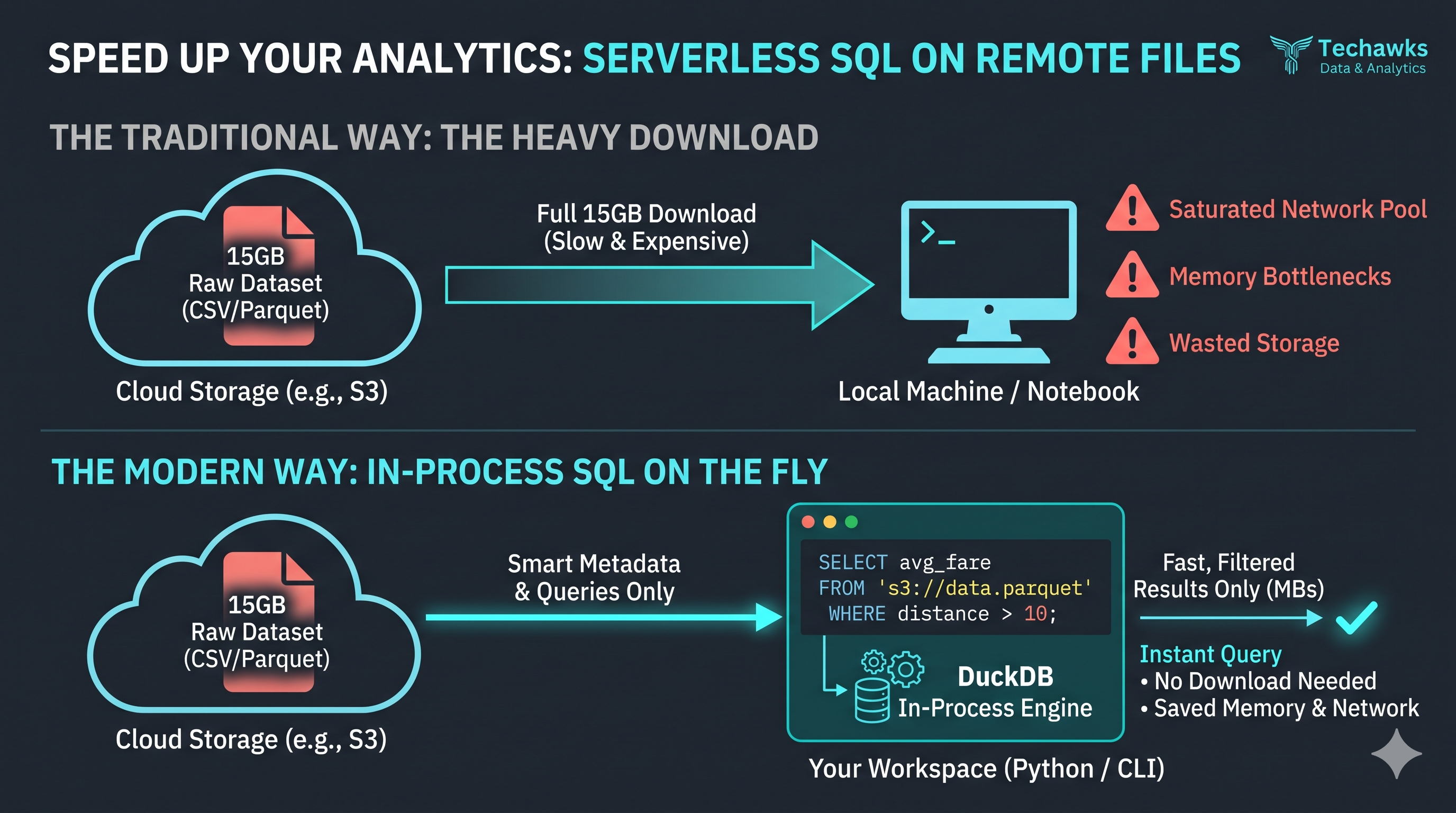
In modern analytics, we utilize In-Process OLAP (Online Analytical Processing) engines like DuckDB to run fast SQL queries on local or remote files—without the overhead of a server.
By querying files (like Parquet, CSV, or JSON) directly where they live, you bypass the slow extract-load-transform (ETL) loop entirely.
[ 15 GB Raw Parquet on S3 ]
│
(No massive download)
│
▼
┌──────────────────────────────────────────────┐
│ DuckDB In-Process Query Engine │
│ - Executes SQL directly on the remote file │
│ - Only pulls requested columns & rows │
└──────────────────────────────────────────────┘
│
▼
[ Megabytes of filtered ]
[ result in Python/R ]
💡 The Quick Tutorial: Querying Remote Files Fast
Instead of downloading a massive dataset, you can point DuckDB directly to the file's URL (or S3 bucket) and run SQL queries to extract only what you need:
SQL
-- 1. Install & import DuckDB (it runs embedded, no server needed)
-- 2. Enable HTTP/S3 support
INSTALL httpfs;
LOAD httpfs;
-- 3. Query a massive remote file directly
SELECT
passenger_count,
ROUND(AVG(trip_distance), 2) AS avg_distance,
ROUND(AVG(fare_amount), 2) AS avg_fare
FROM 'https://d37ci6vzurychx.cloudfront.net/trip-data/yellow_tripdata_2024-01.parquet'
WHERE trip_distance > 10
GROUP BY passenger_count
ORDER BY avg_distance DESC;
Why This Changes Your Workflow:
Zero Infrastructure Overhead: Runs instantly on your laptop as a Python library (import duckdb) or via CLI, no server configuration required.
Smart Data Pulls: Using Parquet’s columnar format, DuckDB only reads the exact bytes required for your query—reducing network transfer by up to 99%.
Rich SQL Dialect: Supports complex analytical functions, joins, and aggregations right out of the box.
Don't let big files slow your data exploration down. Streamline your analysis at the source.
Discussion Question
What is your go-to tool for quick data exploration on massive datasets? Do you rely on local pandas/polars, spin up a cloud warehouse like Snowflake/BigQuery, or use in-process SQL engines like DuckDB?
CTA
Ready to elevate your data engineering and analytics skills? Join Data Science & Analytics at Techawks to exchange optimization tips, architectural insights, and practical workflows with active data professionals.
As data professionals, we’ve all been there: you need to analyze a subset of a massive dataset, but your computer slows to a crawl while loading the files. Traditional methods often require reading the entire dataset into memory or setting up complex database pipelines just for a quick query.
In modern analytics, we utilize In-Process OLAP (Online Analytical Processing) engines like DuckDB to run fast SQL queries on local or remote files—without the overhead of a server.
By querying files (like Parquet, CSV, or JSON) directly where they live, you bypass the slow extract-load-transform (ETL) loop entirely.
[ 15 GB Raw Parquet on S3 ]
│
(No massive download)
│
▼
┌──────────────────────────────────────────────┐
│ DuckDB In-Process Query Engine │
│ - Executes SQL directly on the remote file │
│ - Only pulls requested columns & rows │
└──────────────────────────────────────────────┘
│
▼
[ Megabytes of filtered ]
[ result in Python/R ]
💡 The Quick Tutorial: Querying Remote Files Fast
Instead of downloading a massive dataset, you can point DuckDB directly to the file's URL (or S3 bucket) and run SQL queries to extract only what you need:
SQL
-- 1. Install & import DuckDB (it runs embedded, no server needed)
-- 2. Enable HTTP/S3 support
INSTALL httpfs;
LOAD httpfs;
-- 3. Query a massive remote file directly
SELECT
passenger_count,
ROUND(AVG(trip_distance), 2) AS avg_distance,
ROUND(AVG(fare_amount), 2) AS avg_fare
FROM 'https://d37ci6vzurychx.cloudfront.net/trip-data/yellow_tripdata_2024-01.parquet'
WHERE trip_distance > 10
GROUP BY passenger_count
ORDER BY avg_distance DESC;
Why This Changes Your Workflow:
Zero Infrastructure Overhead: Runs instantly on your laptop as a Python library (import duckdb) or via CLI, no server configuration required.
Smart Data Pulls: Using Parquet’s columnar format, DuckDB only reads the exact bytes required for your query—reducing network transfer by up to 99%.
Rich SQL Dialect: Supports complex analytical functions, joins, and aggregations right out of the box.
Don't let big files slow your data exploration down. Streamline your analysis at the source.
Discussion Question
What is your go-to tool for quick data exploration on massive datasets? Do you rely on local pandas/polars, spin up a cloud warehouse like Snowflake/BigQuery, or use in-process SQL engines like DuckDB?
CTA
Ready to elevate your data engineering and analytics skills? Join Data Science & Analytics at Techawks to exchange optimization tips, architectural insights, and practical workflows with active data professionals.
Stop Downloading Massive Datasets: Master Modern In-Process Data Filtering with DuckDB SQL
As data professionals, we’ve all been there: you need to analyze a subset of a massive dataset, but your computer slows to a crawl while loading the files. Traditional methods often require reading the entire dataset into memory or setting up complex database pipelines just for a quick query.
In modern analytics, we utilize In-Process OLAP (Online Analytical Processing) engines like DuckDB to run fast SQL queries on local or remote files—without the overhead of a server.
By querying files (like Parquet, CSV, or JSON) directly where they live, you bypass the slow extract-load-transform (ETL) loop entirely.
[ 15 GB Raw Parquet on S3 ]
│
(No massive download)
│
▼
┌──────────────────────────────────────────────┐
│ DuckDB In-Process Query Engine │
│ - Executes SQL directly on the remote file │
│ - Only pulls requested columns & rows │
└──────────────────────────────────────────────┘
│
▼
[ Megabytes of filtered ]
[ result in Python/R ]
💡 The Quick Tutorial: Querying Remote Files Fast
Instead of downloading a massive dataset, you can point DuckDB directly to the file's URL (or S3 bucket) and run SQL queries to extract only what you need:
SQL
-- 1. Install & import DuckDB (it runs embedded, no server needed)
-- 2. Enable HTTP/S3 support
INSTALL httpfs;
LOAD httpfs;
-- 3. Query a massive remote file directly
SELECT
passenger_count,
ROUND(AVG(trip_distance), 2) AS avg_distance,
ROUND(AVG(fare_amount), 2) AS avg_fare
FROM 'https://d37ci6vzurychx.cloudfront.net/trip-data/yellow_tripdata_2024-01.parquet'
WHERE trip_distance > 10
GROUP BY passenger_count
ORDER BY avg_distance DESC;
Why This Changes Your Workflow:
Zero Infrastructure Overhead: Runs instantly on your laptop as a Python library (import duckdb) or via CLI, no server configuration required.
Smart Data Pulls: Using Parquet’s columnar format, DuckDB only reads the exact bytes required for your query—reducing network transfer by up to 99%.
Rich SQL Dialect: Supports complex analytical functions, joins, and aggregations right out of the box.
Don't let big files slow your data exploration down. Streamline your analysis at the source.
Discussion Question
What is your go-to tool for quick data exploration on massive datasets? Do you rely on local pandas/polars, spin up a cloud warehouse like Snowflake/BigQuery, or use in-process SQL engines like DuckDB?
CTA
Ready to elevate your data engineering and analytics skills? Join Data Science & Analytics at Techawks to exchange optimization tips, architectural insights, and practical workflows with active data professionals.

 English
 Arabic
 French
 Spanish
 Portuguese
 Deutsch
 Dutch
 Italiano
 Russian
 Romaian
 Portuguese (Brazil)
 Greek