


The Death of 80% SaaS Gross Margins: How Early-Stage Founders Must Architect AI Unit Economics
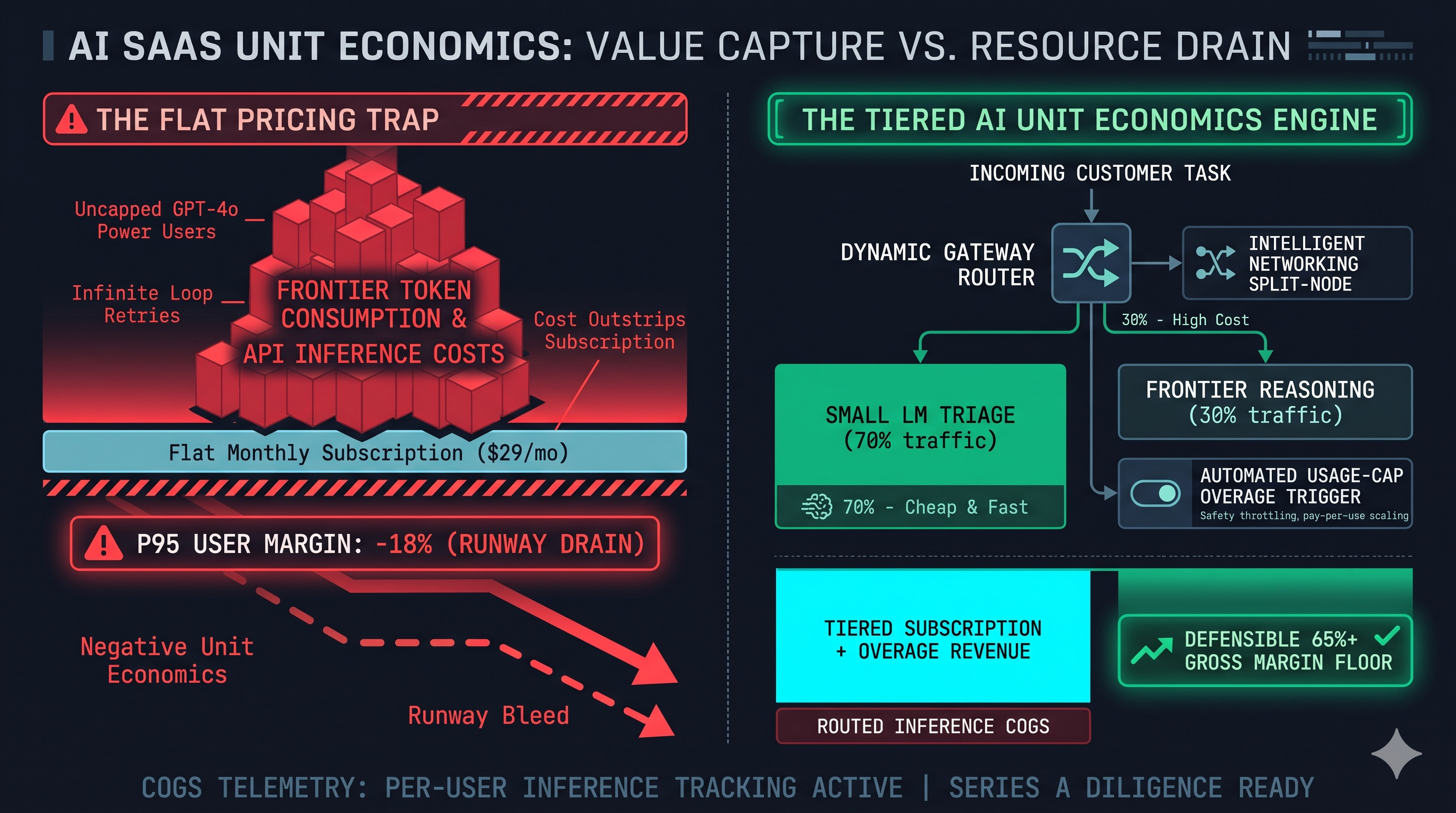
Traditional SaaS boasted near-zero marginal cost: serving a web dashboard costs fractions of a cent.AI-first architectures break that assumption. Every agentic loop, vector retrieval, and frontier LLM completion adds measurable compute costs straight to your COGS. Venture benchmarks show AI-native application gross margins compressing to 45%–55%, yet early-stage founders still pitch investors on 85% SaaS margins without modeling their per-user token floor.[❌ The Broken SaaS Playbook: Flat Pricing Trap]
User Pays: $49/mo (Flat Unlimited)
P50 User: Costs $4.20/mo in inference --> Margin: 91% (Healthy)
P95 User: Costs $58.00/mo in inference --> Margin: -18% (Underwater)
Result: Growth accelerates cash burn.
[✅ The Unit-Economics Aligned Architecture]
User Pays: Base $49/mo (Includes P50 token quota ~ 150k tokens)
Tiered Threshold:
├─ Layer 1: Semantic Caching & Small SLM Routing (Cuts COGS 60%)
├─ Layer 2: Frontier Model (Reserved strictly for high-value reasoning)
└─ Layer 3: Overage Multiplier / Outcome-Based Credit Billing past 3x P50
Result: Increasing customer usage expands gross margins.
To build a defensible AI business that survives Series A diligence, follow this 3-step unit economics framework:
1. Measure P50 vs. P95 Cost-to-Serve (Not Averages)A company-wide blended margin hides toxic power users. Instrument feature-level telemetry to calculate your inference cost per active user:$$\text{COGS}_{\text{user}} = \sum (\text{Input Tokens} \times P_{\text{in}} + \text{Output Tokens} \times P_{\text{out}}) + \text{Vector Retrieval Overhead}$$Set your base subscription tier to deliver at least a 65% gross margin on your P50 median user, and cap inclusive consumption at roughly 3x the P50 baseline before kicking in automated overages.
2. Decouple Task Complexity via Dynamic Model RoutingStop routing basic summarization, validation, or entity extraction through multi-billion-parameter frontier models. Implement a deterministic triage gateway:Tier 1 (Small Speculative / Open-Weight Models): Handle ~70% of commodity extraction and classification at a fraction of the cost.Tier 2 (Frontier Reasoning Models): Invoke only when ambiguity scores exceed established thresholds.
3. Shift from Per-Seat to Outcome or Hybrid Credit PricingSelling "seats" when your underlying infrastructure charges by "tokens" creates an inherent architectural mismatch. Transition your pricing page to a hybrid tier: a predictable monthly base fee paired with outcome units (e.g., verified leads enriched, pull requests reviewed, or customer workflows resolved).Investors aren't demanding immediate 85% gross margins from seed-stage AI startups; they are looking for founders who can mathematically prove their cost-per-outcome drops as usage scales.
Discussion Question
For founders running AI-native features: what percentage of your total monthly infrastructure bill is pure model inference versus traditional cloud compute and storage?
CTA
Join Startup Founders & Entrepreneurs to master product pricing frameworks, unit-economic modeling, and scalable go-to-market strategies with builders scaling production ventures.
Traditional SaaS boasted near-zero marginal cost: serving a web dashboard costs fractions of a cent.AI-first architectures break that assumption. Every agentic loop, vector retrieval, and frontier LLM completion adds measurable compute costs straight to your COGS. Venture benchmarks show AI-native application gross margins compressing to 45%–55%, yet early-stage founders still pitch investors on 85% SaaS margins without modeling their per-user token floor.[❌ The Broken SaaS Playbook: Flat Pricing Trap]
User Pays: $49/mo (Flat Unlimited)
P50 User: Costs $4.20/mo in inference --> Margin: 91% (Healthy)
P95 User: Costs $58.00/mo in inference --> Margin: -18% (Underwater)
Result: Growth accelerates cash burn.
[✅ The Unit-Economics Aligned Architecture]
User Pays: Base $49/mo (Includes P50 token quota ~ 150k tokens)
Tiered Threshold:
├─ Layer 1: Semantic Caching & Small SLM Routing (Cuts COGS 60%)
├─ Layer 2: Frontier Model (Reserved strictly for high-value reasoning)
└─ Layer 3: Overage Multiplier / Outcome-Based Credit Billing past 3x P50
Result: Increasing customer usage expands gross margins.
To build a defensible AI business that survives Series A diligence, follow this 3-step unit economics framework:
1. Measure P50 vs. P95 Cost-to-Serve (Not Averages)A company-wide blended margin hides toxic power users. Instrument feature-level telemetry to calculate your inference cost per active user:$$\text{COGS}_{\text{user}} = \sum (\text{Input Tokens} \times P_{\text{in}} + \text{Output Tokens} \times P_{\text{out}}) + \text{Vector Retrieval Overhead}$$Set your base subscription tier to deliver at least a 65% gross margin on your P50 median user, and cap inclusive consumption at roughly 3x the P50 baseline before kicking in automated overages.
2. Decouple Task Complexity via Dynamic Model RoutingStop routing basic summarization, validation, or entity extraction through multi-billion-parameter frontier models. Implement a deterministic triage gateway:Tier 1 (Small Speculative / Open-Weight Models): Handle ~70% of commodity extraction and classification at a fraction of the cost.Tier 2 (Frontier Reasoning Models): Invoke only when ambiguity scores exceed established thresholds.
3. Shift from Per-Seat to Outcome or Hybrid Credit PricingSelling "seats" when your underlying infrastructure charges by "tokens" creates an inherent architectural mismatch. Transition your pricing page to a hybrid tier: a predictable monthly base fee paired with outcome units (e.g., verified leads enriched, pull requests reviewed, or customer workflows resolved).Investors aren't demanding immediate 85% gross margins from seed-stage AI startups; they are looking for founders who can mathematically prove their cost-per-outcome drops as usage scales.
Discussion Question
For founders running AI-native features: what percentage of your total monthly infrastructure bill is pure model inference versus traditional cloud compute and storage?
CTA
Join Startup Founders & Entrepreneurs to master product pricing frameworks, unit-economic modeling, and scalable go-to-market strategies with builders scaling production ventures.
The Death of 80% SaaS Gross Margins: How Early-Stage Founders Must Architect AI Unit Economics
Traditional SaaS boasted near-zero marginal cost: serving a web dashboard costs fractions of a cent.AI-first architectures break that assumption. Every agentic loop, vector retrieval, and frontier LLM completion adds measurable compute costs straight to your COGS. Venture benchmarks show AI-native application gross margins compressing to 45%–55%, yet early-stage founders still pitch investors on 85% SaaS margins without modeling their per-user token floor.[❌ The Broken SaaS Playbook: Flat Pricing Trap]
User Pays: $49/mo (Flat Unlimited)
P50 User: Costs $4.20/mo in inference --> Margin: 91% (Healthy)
P95 User: Costs $58.00/mo in inference --> Margin: -18% (Underwater)
Result: Growth accelerates cash burn.
[✅ The Unit-Economics Aligned Architecture]
User Pays: Base $49/mo (Includes P50 token quota ~ 150k tokens)
Tiered Threshold:
├─ Layer 1: Semantic Caching & Small SLM Routing (Cuts COGS 60%)
├─ Layer 2: Frontier Model (Reserved strictly for high-value reasoning)
└─ Layer 3: Overage Multiplier / Outcome-Based Credit Billing past 3x P50
Result: Increasing customer usage expands gross margins.
To build a defensible AI business that survives Series A diligence, follow this 3-step unit economics framework:
1. Measure P50 vs. P95 Cost-to-Serve (Not Averages)A company-wide blended margin hides toxic power users. Instrument feature-level telemetry to calculate your inference cost per active user:$$\text{COGS}_{\text{user}} = \sum (\text{Input Tokens} \times P_{\text{in}} + \text{Output Tokens} \times P_{\text{out}}) + \text{Vector Retrieval Overhead}$$Set your base subscription tier to deliver at least a 65% gross margin on your P50 median user, and cap inclusive consumption at roughly 3x the P50 baseline before kicking in automated overages.
2. Decouple Task Complexity via Dynamic Model RoutingStop routing basic summarization, validation, or entity extraction through multi-billion-parameter frontier models. Implement a deterministic triage gateway:Tier 1 (Small Speculative / Open-Weight Models): Handle ~70% of commodity extraction and classification at a fraction of the cost.Tier 2 (Frontier Reasoning Models): Invoke only when ambiguity scores exceed established thresholds.
3. Shift from Per-Seat to Outcome or Hybrid Credit PricingSelling "seats" when your underlying infrastructure charges by "tokens" creates an inherent architectural mismatch. Transition your pricing page to a hybrid tier: a predictable monthly base fee paired with outcome units (e.g., verified leads enriched, pull requests reviewed, or customer workflows resolved).Investors aren't demanding immediate 85% gross margins from seed-stage AI startups; they are looking for founders who can mathematically prove their cost-per-outcome drops as usage scales.
Discussion Question
For founders running AI-native features: what percentage of your total monthly infrastructure bill is pure model inference versus traditional cloud compute and storage?
CTA
Join Startup Founders & Entrepreneurs to master product pricing frameworks, unit-economic modeling, and scalable go-to-market strategies with builders scaling production ventures.

 English
 Arabic
 Spanish
 Portuguese
 Deutsch
 Turkish
 Dutch
 Italiano
 Russian
 Romaian
 Portuguese (Brazil)
 Greek