


Breaking Free from Localhost: The 4 Distributed Systems Realities Every CS Student Must Learn
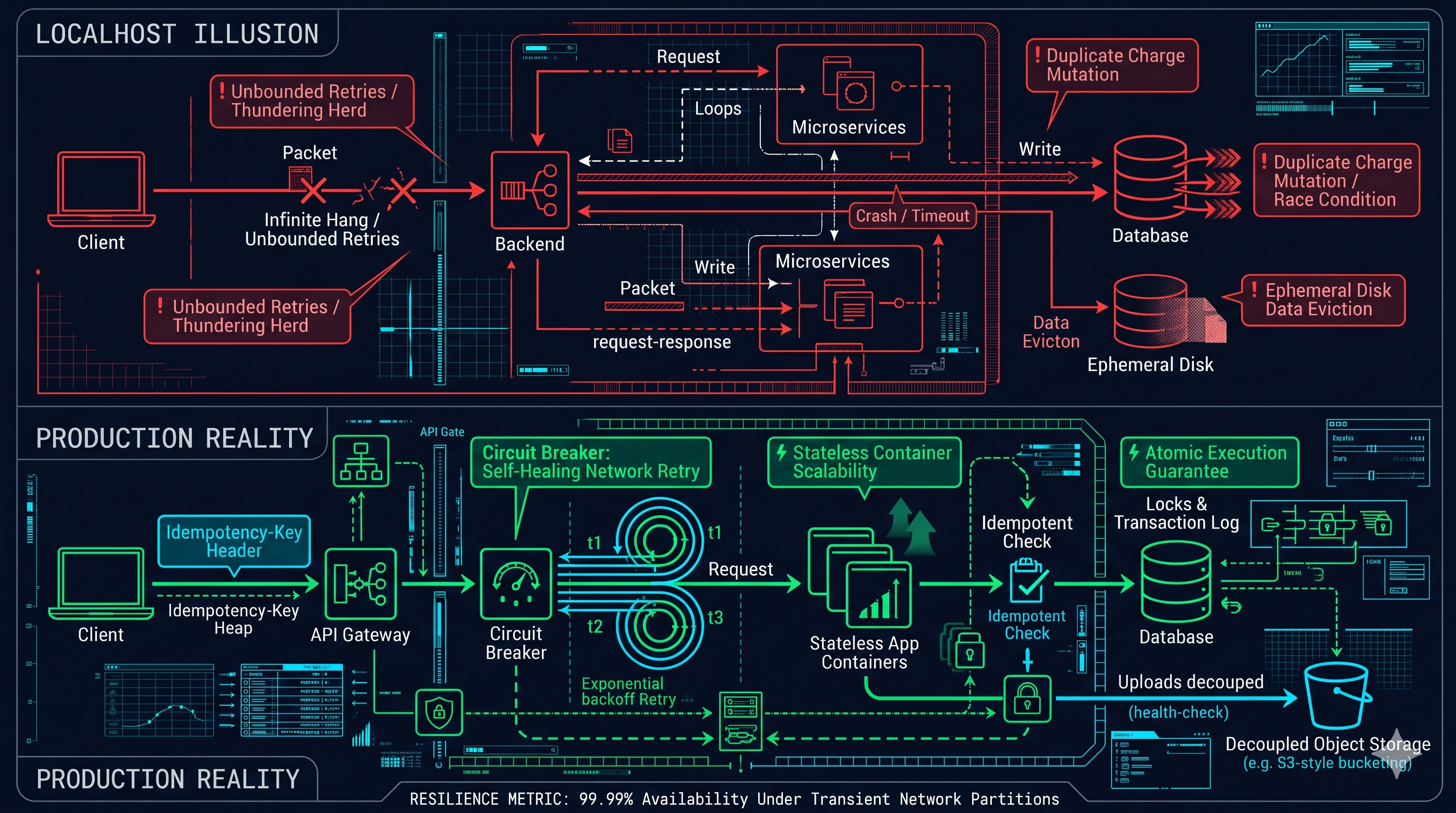
Computer science curriculums excel at teaching algorithmic complexity, compiler internals, and data structures. However, student side projects often hit a wall during production deployments or technical systems interviews because students treat remote cloud services like local function calls.On localhost, loopback traffic (127.0.0.1) has zero latency, boundless developer RAM, and guaranteed delivery. In production, the eight fallacies of distributed computing take over: packets drop, third-party APIs experience transient timeouts, and serverless runtimes wipe ephemeral disk storage clean between invocations.[❌ The Localhost Student Assumption]
Client Request ──(Guaranteed 0ms)──> Server ──(Instant)──> In-Memory State
Result: Any packet loss or crash corrupts session data and triggers duplicate writes.
[✅ The Production Distributed Architecture]
Client Request
│ (Idempotency Key: UUIDv4)
▼
[API Gateway] ──> [Circuit Breaker & Retry with Exponential Backoff]
│
├──> Idempotent Worker ──> Transactional DB (ACID / Rollback Guarantee)
└──> Ephemeral Storage Isolated ──> S3 / Object Store for Persistent Assets
Result: Transient network drops self-heal with zero double-execution risk.
To bridge the gap between academic programming and production software engineering, build these four distributed patterns into your next portfolio project:
1. Implement Idempotency Keys on Mutating EndpointsWhen an HTTP POST request times out, a browser or mobile client will automatically retry. If your endpoint charges a credit card, increments an inventory count, or provisions a resource, blind retries cause duplicate state mutations.Require an Idempotency-Key: <UUID> header on non-idempotent operations.Check a distributed key-value store (like Redis) before executing: if the key exists, return the cached result instead of executing the side-effect twice.
2. Replace Blind Retries with Exponential Backoff and JitterIf an external API is struggling under load, hammering it with instant while (!success) retry() loops will trigger a thundering herd problem that completely takes down downstream services.Use exponential backoff ($T_{\text{wait}} = 2^{\text{attempt}} \times \text{base\_delay}$) paired with random jitter (randomized entropy added to wait intervals) to desynchronize retrying clients.
3. Treat the Local Filesystem as Stateless and EphemeralOn your personal laptop, running fs.writeFileSync('/uploads/avatar.png') writes cleanly to your hard drive. In production environments (like AWS Lambda, Cloud Run, or Kubernetes pods), containers dynamically spin down, auto-scale, and migrate across hosts.Any file written to the local container disk is destroyed on pod recycling.Always stream static assets and file uploads directly to dedicated object storage (such as AWS S3 or Cloudflare R2) using pre-signed upload URLs.
4. Design for Partial FailureA function call on a single machine either returns a value or throws an exception. A network call can succeed, fail, or—most dangerously—time out after the remote server already executed the write. Always define explicit timeout thresholds and fallback degradations so a slow non-critical microservice does not lock your entire application thread pool.
Transitioning your portfolio from toy apps to production-grade services shows interviewers that you understand systems resilience, operational boundaries, and real-world failure modes.
Discussion Question
What was the first unexpected error or architectural bottleneck you encountered when you moved your first student project from localhost to a live cloud host?
CTA
Join Students in Tech to access system design roadmaps, project review clinics, and distributed engineering mentorship to prepare for high-impact software careers.
Breaking Free from Localhost: The 4 Distributed Systems Realities Every CS Student Must Learn
Computer science curriculums excel at teaching algorithmic complexity, compiler internals, and data structures. However, student side projects often hit a wall during production deployments or technical systems interviews because students treat remote cloud services like local function calls.On localhost, loopback traffic (127.0.0.1) has zero latency, boundless developer RAM, and guaranteed delivery. In production, the eight fallacies of distributed computing take over: packets drop, third-party APIs experience transient timeouts, and serverless runtimes wipe ephemeral disk storage clean between invocations.[❌ The Localhost Student Assumption]
Client Request ──(Guaranteed 0ms)──> Server ──(Instant)──> In-Memory State
Result: Any packet loss or crash corrupts session data and triggers duplicate writes.
[✅ The Production Distributed Architecture]
Client Request
│ (Idempotency Key: UUIDv4)
▼
[API Gateway] ──> [Circuit Breaker & Retry with Exponential Backoff]
│
├──> Idempotent Worker ──> Transactional DB (ACID / Rollback Guarantee)
└──> Ephemeral Storage Isolated ──> S3 / Object Store for Persistent Assets
Result: Transient network drops self-heal with zero double-execution risk.
To bridge the gap between academic programming and production software engineering, build these four distributed patterns into your next portfolio project:
1. Implement Idempotency Keys on Mutating EndpointsWhen an HTTP POST request times out, a browser or mobile client will automatically retry. If your endpoint charges a credit card, increments an inventory count, or provisions a resource, blind retries cause duplicate state mutations.Require an Idempotency-Key: <UUID> header on non-idempotent operations.Check a distributed key-value store (like Redis) before executing: if the key exists, return the cached result instead of executing the side-effect twice.
2. Replace Blind Retries with Exponential Backoff and JitterIf an external API is struggling under load, hammering it with instant while (!success) retry() loops will trigger a thundering herd problem that completely takes down downstream services.Use exponential backoff ($T_{\text{wait}} = 2^{\text{attempt}} \times \text{base\_delay}$) paired with random jitter (randomized entropy added to wait intervals) to desynchronize retrying clients.
3. Treat the Local Filesystem as Stateless and EphemeralOn your personal laptop, running fs.writeFileSync('/uploads/avatar.png') writes cleanly to your hard drive. In production environments (like AWS Lambda, Cloud Run, or Kubernetes pods), containers dynamically spin down, auto-scale, and migrate across hosts.Any file written to the local container disk is destroyed on pod recycling.Always stream static assets and file uploads directly to dedicated object storage (such as AWS S3 or Cloudflare R2) using pre-signed upload URLs.
4. Design for Partial FailureA function call on a single machine either returns a value or throws an exception. A network call can succeed, fail, or—most dangerously—time out after the remote server already executed the write. Always define explicit timeout thresholds and fallback degradations so a slow non-critical microservice does not lock your entire application thread pool.
Transitioning your portfolio from toy apps to production-grade services shows interviewers that you understand systems resilience, operational boundaries, and real-world failure modes.
Discussion Question
What was the first unexpected error or architectural bottleneck you encountered when you moved your first student project from localhost to a live cloud host?
CTA
Join Students in Tech to access system design roadmaps, project review clinics, and distributed engineering mentorship to prepare for high-impact software careers.

 English
 French
 Spanish
 Portuguese
 Deutsch
 Turkish
 Dutch
 Italiano
 Russian
 Romaian
 Portuguese (Brazil)
 Greek