


Stop Securing Just Passwords: How to Defend Against Non-Human Identity (NHI) Privilege Escalation in Cloud Workloads
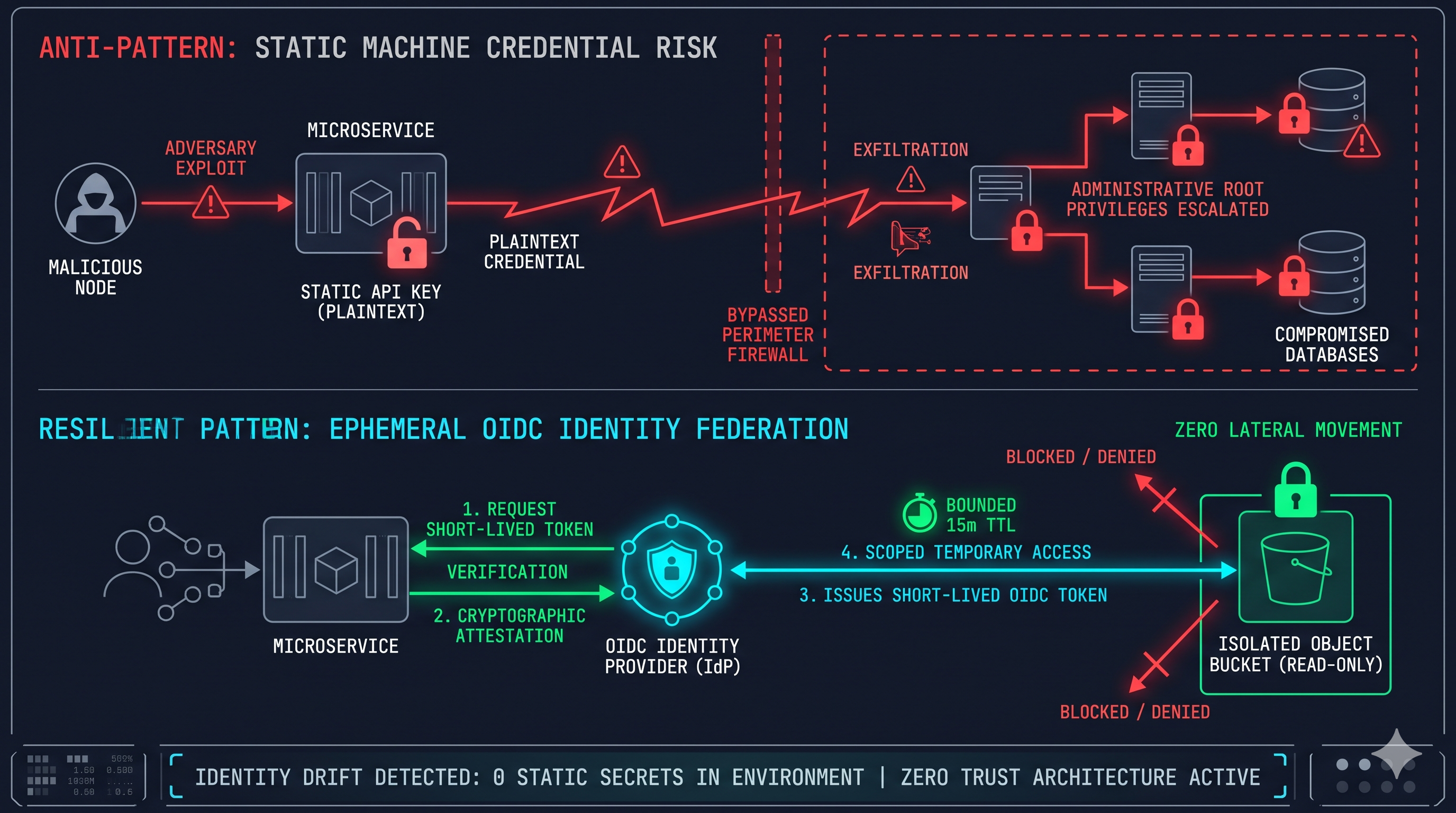
Traditional perimeter and endpoint security models assume the threat actor is trying to bypass network boundaries from the outside. In modern cloud-native infrastructures, the primary threat surface has migrated to Non-Human Identities (NHIs): long-lived OAuth tokens, machine-to-machine service principals, pipeline secrets, and automated agent keys.When a build runner, microservice, or automated agent is granted wildcard IAM policies (*), a single leaked credential in a staging environment allows an adversary to execute seamless lateral movement and privilege escalation across your production cloud cluster.[❌ The NHI Anti-Pattern: Over-Privileged Static Credentials]
Service Pod / CI Runner ──(Static API Key stored in .env)──> IAM Role: AdministratorAccess (*)
Adversary Action: Extract key from memory/log ──> Instant Root Escalation ──> Lateral DB Exfiltration
[✅ Zero-Trust NHI Architecture: Ephemeral OIDC Federation]
Workload / Agent ──(Requests OIDC Token)──> Cloud Identity Provider (AWS STS / Azure Managed ID)
│
(Cryptographic Attestation & Bound TTL)
▼
Least-Privilege Ephemeral Token (TTL: 15 mins) ──> Scoped Down Target Resource (Read-Only)
To eliminate machine-identity blind spots, implement this 3-tier hardening framework across your architecture:
1. Deprecate Long-Lived Static Machine SecretsNever store static cloud access keys (AKIA... or static service account JSON keys) inside container images, repo variables, or environment config files.Migrate CI/CD runners (GitHub Actions, GitLab CI, ArgoCD) to OpenID Connect (OIDC) identity federation.Workloads authenticate via cryptographically signed JWTs, exchanging claims for short-lived credentials (TTL $\le 1$ hour) that expire automatically without requiring manual key rotation.
2. Enforce Non-Human Identity Least Privilege via Activity AuditingDevelopers routinely assign broad roles (like AmazonS3FullAccess or Cloud Storage Admin) "just to get the microservice running."Deploy automated cloud security posture tools to compare assigned IAM permissions against actual runtime API calls.Strip unused mutation actions (Create*, Delete*, Update*) to prevent an exploited read service from turning into a destructive ransomware vector.
3. Establish Behavioral Anomaly Baselines for Machine AccountsHuman users log in during working hours from predictable geographical regions. Non-human identities run deterministic tasks from explicit VPC CIDR blocks:Alert immediately on geo-velocity anomalies (e.g., a backend service account suddenly calling an API from an external consumer IP).Flag out-of-band API calls (e.g., an invoice microservice attempting to call iam:CreateAccessKey or query cloud metadata endpoints).Securing the enterprise in modern environments requires recognizing that every machine identity is a full security principal—and unattended machine keys with infinite lifetimes are an open invitation for lateral compromise.
Discussion Question
How does your team currently audit and rotate machine identities, service principals, and CI/CD access tokens compared to human employee accounts?
CTA
Join Cybersecurity & Ethical Hacking to dissect live threat modeling scenarios, master cloud defense architectures, and level up your enterprise security engineering skills.
Stop Securing Just Passwords: How to Defend Against Non-Human Identity (NHI) Privilege Escalation in Cloud Workloads
Traditional perimeter and endpoint security models assume the threat actor is trying to bypass network boundaries from the outside. In modern cloud-native infrastructures, the primary threat surface has migrated to Non-Human Identities (NHIs): long-lived OAuth tokens, machine-to-machine service principals, pipeline secrets, and automated agent keys.When a build runner, microservice, or automated agent is granted wildcard IAM policies (*), a single leaked credential in a staging environment allows an adversary to execute seamless lateral movement and privilege escalation across your production cloud cluster.[❌ The NHI Anti-Pattern: Over-Privileged Static Credentials]
Service Pod / CI Runner ──(Static API Key stored in .env)──> IAM Role: AdministratorAccess (*)
Adversary Action: Extract key from memory/log ──> Instant Root Escalation ──> Lateral DB Exfiltration
[✅ Zero-Trust NHI Architecture: Ephemeral OIDC Federation]
Workload / Agent ──(Requests OIDC Token)──> Cloud Identity Provider (AWS STS / Azure Managed ID)
│
(Cryptographic Attestation & Bound TTL)
▼
Least-Privilege Ephemeral Token (TTL: 15 mins) ──> Scoped Down Target Resource (Read-Only)
To eliminate machine-identity blind spots, implement this 3-tier hardening framework across your architecture:
1. Deprecate Long-Lived Static Machine SecretsNever store static cloud access keys (AKIA... or static service account JSON keys) inside container images, repo variables, or environment config files.Migrate CI/CD runners (GitHub Actions, GitLab CI, ArgoCD) to OpenID Connect (OIDC) identity federation.Workloads authenticate via cryptographically signed JWTs, exchanging claims for short-lived credentials (TTL $\le 1$ hour) that expire automatically without requiring manual key rotation.
2. Enforce Non-Human Identity Least Privilege via Activity AuditingDevelopers routinely assign broad roles (like AmazonS3FullAccess or Cloud Storage Admin) "just to get the microservice running."Deploy automated cloud security posture tools to compare assigned IAM permissions against actual runtime API calls.Strip unused mutation actions (Create*, Delete*, Update*) to prevent an exploited read service from turning into a destructive ransomware vector.
3. Establish Behavioral Anomaly Baselines for Machine AccountsHuman users log in during working hours from predictable geographical regions. Non-human identities run deterministic tasks from explicit VPC CIDR blocks:Alert immediately on geo-velocity anomalies (e.g., a backend service account suddenly calling an API from an external consumer IP).Flag out-of-band API calls (e.g., an invoice microservice attempting to call iam:CreateAccessKey or query cloud metadata endpoints).Securing the enterprise in modern environments requires recognizing that every machine identity is a full security principal—and unattended machine keys with infinite lifetimes are an open invitation for lateral compromise.
Discussion Question
How does your team currently audit and rotate machine identities, service principals, and CI/CD access tokens compared to human employee accounts?
CTA
Join Cybersecurity & Ethical Hacking to dissect live threat modeling scenarios, master cloud defense architectures, and level up your enterprise security engineering skills.

 Arabic
 French
 Spanish
 Portuguese
 Deutsch
 Turkish
 Dutch
 Italiano
 Russian
 Romaian
 Portuguese (Brazil)
 Greek