


Beyond Directory-Based Hive Partitions: How to Architect Hidden Partitioning and Manifest Pruning in Modern Lakehouses
In legacy Hive-style data lakes, partition values were embedded directly into physical cloud object storage paths.
This creates two critical production failure modes:
Physical Coupling & Query Misalignment: When users write SQL filters against timestamps (WHERE event_time >= '2026-10-01'), but the storage engine is partitioned strictly by string date columns (WHERE date_str = '2026-10-01'), the query planner cannot deduce directory paths and is forced to perform a full-table scan across thousands of storage prefixes.
Catalog Metadata Bottlenecks: Query planning requires sending recursive filesystem LIST requests to cloud object storage (e.g., S3, ADLS, GCS), which are rate-limited, high-latency, and lack column-level statistical bounds.
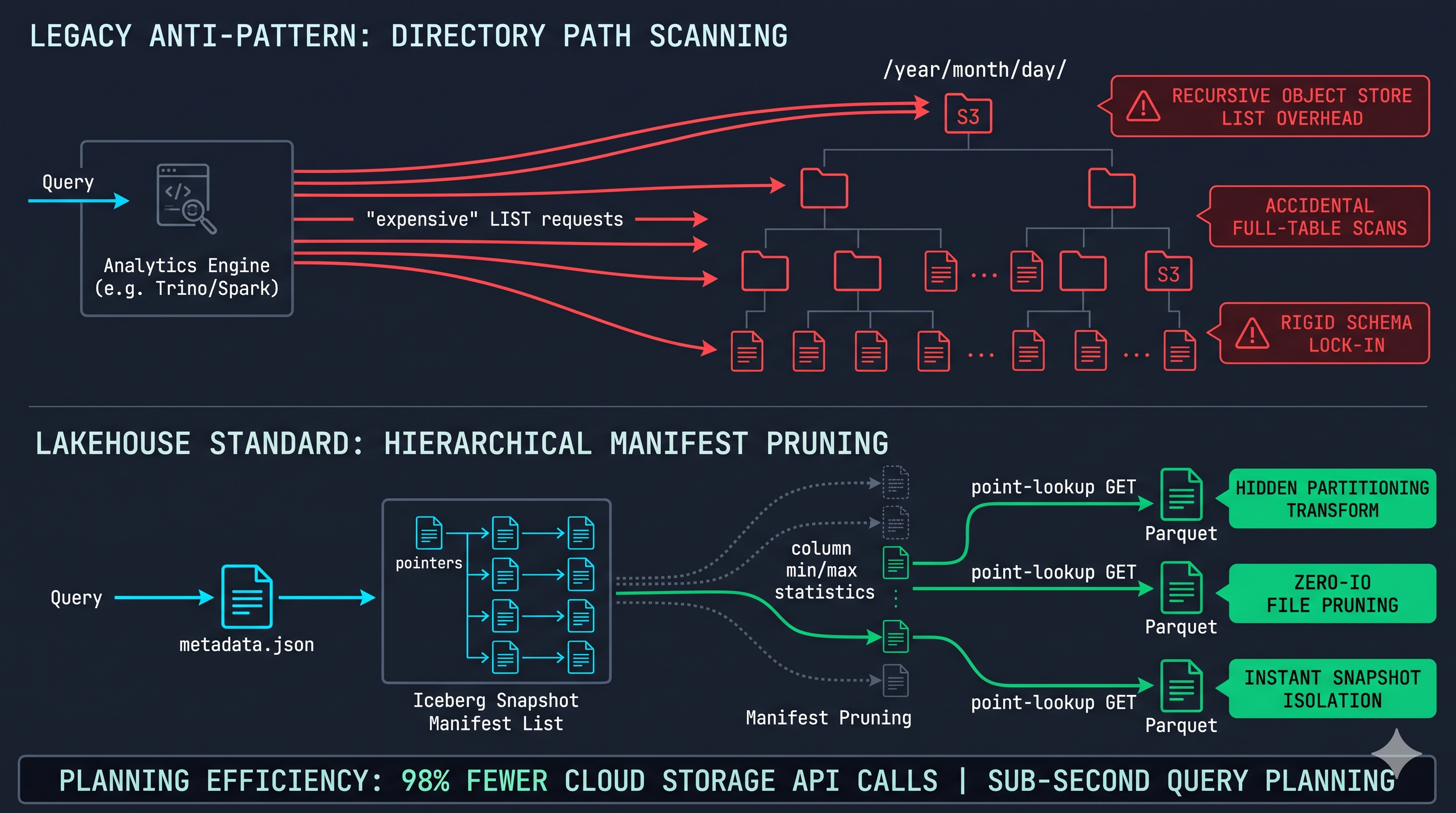
Modern open table formats (such as Apache Iceberg and Delta Lake) replace physical directory scanning with Hierarchical Metadata Trees and Hidden Partitioning.
[❌ Legacy Hive Partitioning: Path-Bound Full Scan Trap]
SQL Query: SELECT * FROM telemetry WHERE timestamp >= '2026-10-31 00:00:00'
Path: s3://lakehouse/telemetry/year=2026/month=10/day=31/
Planner: Must issue S3:LIST objects on thousands of prefixes.
Result: 45-second metadata discovery overhead; failed partition pruning on timestamp transforms.
[✅ Lakehouse Manifest Pruning: Hierarchical Snapshot Tree]
Catalog Pointer ──> metadata.json ──> Manifest List (Snapshot)
│
┌────────────────────────────┴────────────────────────────┐
▼ ▼
Manifest File A (Partitions: Oct 20-25) Manifest File B (Partitions: Oct 26-31)
[Evaluates Min/Max Stats: PRUNED] [Column Stats Match: SCANNED]
│ │
(0 Data Files Read) Data Files (Direct GET by path)
To optimize analytics queries across multi-engine lakehouses (Trino, Spark, DuckDB, Snowflake), implement this 3-tier table management architecture:
1. Leverage Hidden Partitioning via Transform Functions
Stop forcing data engineers to materialize redundant synthetic columns (date, month, hour) alongside canonical ISO timestamps.
Use partition transforms directly on source timestamp fields (e.g., days(event_time) or hours(event_time)).
The query engine automatically converts predicates on event_time into manifest filter operations. Analysts query the business column naturally without knowing the underlying storage partitioning scheme.
2. Eliminate Directory Rewrites with Partition Evolution
Business data volumes scale unpredictably. A table partitioned by day may grow to gigabytes per hour, while an over-partitioned table creates the dreaded "small-file crisis."
The table format assigns partition spec IDs per manifest. Old data queries use Spec 0, while new data routes through Spec 1, enabling zero-downtime schema and layout evolution.
3. Enforce Manifest Compaction and Snapshot Expiration
As streaming pipelines (Kafka/Flink) commit records every few minutes, small manifest files proliferate, degrading query planning time.
Schedule asynchronous metadata compaction routines:
SQL
-- Iceberg rewrite manifests to cluster data files by partition bounds
CALL system.rewrite_manifests('analytics.production_telemetry');
-- Expire obsolete historical snapshots older than 7 days to clean storage bloat
CALL system.expire_snapshots('analytics.production_telemetry', older_than => TIMESTAMP '2026-10-24 00:00:00');
Moving your lakehouse from primitive directory structures to snapshot-based metadata architectures decouples business query logic from physical file layouts, slashing time-to-first-byte across enterprise analytics workloads.
Discussion Question
How frequently does your data engineering team run manifest compaction and file bin-packing routines on streaming lakehouse tables to prevent query-planning degradation?
CTA
Join Data Science & Analytics to learn advanced data engineering architectures, lakehouse performance tuning, and scalable query optimization techniques with practitioners globally.
Beyond Directory-Based Hive Partitions: How to Architect Hidden Partitioning and Manifest Pruning in Modern Lakehouses
In legacy Hive-style data lakes, partition values were embedded directly into physical cloud object storage paths.
This creates two critical production failure modes:
Physical Coupling & Query Misalignment: When users write SQL filters against timestamps (WHERE event_time >= '2026-10-01'), but the storage engine is partitioned strictly by string date columns (WHERE date_str = '2026-10-01'), the query planner cannot deduce directory paths and is forced to perform a full-table scan across thousands of storage prefixes.
Catalog Metadata Bottlenecks: Query planning requires sending recursive filesystem LIST requests to cloud object storage (e.g., S3, ADLS, GCS), which are rate-limited, high-latency, and lack column-level statistical bounds.
Modern open table formats (such as Apache Iceberg and Delta Lake) replace physical directory scanning with Hierarchical Metadata Trees and Hidden Partitioning.
[❌ Legacy Hive Partitioning: Path-Bound Full Scan Trap]
SQL Query: SELECT * FROM telemetry WHERE timestamp >= '2026-10-31 00:00:00'
Path: s3://lakehouse/telemetry/year=2026/month=10/day=31/
Planner: Must issue S3:LIST objects on thousands of prefixes.
Result: 45-second metadata discovery overhead; failed partition pruning on timestamp transforms.
[✅ Lakehouse Manifest Pruning: Hierarchical Snapshot Tree]
Catalog Pointer ──> metadata.json ──> Manifest List (Snapshot)
│
┌────────────────────────────┴────────────────────────────┐
▼ ▼
Manifest File A (Partitions: Oct 20-25) Manifest File B (Partitions: Oct 26-31)
[Evaluates Min/Max Stats: PRUNED] [Column Stats Match: SCANNED]
│ │
(0 Data Files Read) Data Files (Direct GET by path)
To optimize analytics queries across multi-engine lakehouses (Trino, Spark, DuckDB, Snowflake), implement this 3-tier table management architecture:
1. Leverage Hidden Partitioning via Transform Functions
Stop forcing data engineers to materialize redundant synthetic columns (date, month, hour) alongside canonical ISO timestamps.
Use partition transforms directly on source timestamp fields (e.g., days(event_time) or hours(event_time)).
The query engine automatically converts predicates on event_time into manifest filter operations. Analysts query the business column naturally without knowing the underlying storage partitioning scheme.
2. Eliminate Directory Rewrites with Partition Evolution
Business data volumes scale unpredictably. A table partitioned by day may grow to gigabytes per hour, while an over-partitioned table creates the dreaded "small-file crisis."
The table format assigns partition spec IDs per manifest. Old data queries use Spec 0, while new data routes through Spec 1, enabling zero-downtime schema and layout evolution.
3. Enforce Manifest Compaction and Snapshot Expiration
As streaming pipelines (Kafka/Flink) commit records every few minutes, small manifest files proliferate, degrading query planning time.
Schedule asynchronous metadata compaction routines:
SQL
-- Iceberg rewrite manifests to cluster data files by partition bounds
CALL system.rewrite_manifests('analytics.production_telemetry');
-- Expire obsolete historical snapshots older than 7 days to clean storage bloat
CALL system.expire_snapshots('analytics.production_telemetry', older_than => TIMESTAMP '2026-10-24 00:00:00');
Moving your lakehouse from primitive directory structures to snapshot-based metadata architectures decouples business query logic from physical file layouts, slashing time-to-first-byte across enterprise analytics workloads.
Discussion Question
How frequently does your data engineering team run manifest compaction and file bin-packing routines on streaming lakehouse tables to prevent query-planning degradation?
CTA
Join Data Science & Analytics to learn advanced data engineering architectures, lakehouse performance tuning, and scalable query optimization techniques with practitioners globally.

 Arabic
 French
 Spanish
 Portuguese
 Deutsch
 Turkish
 Dutch
 Italiano
 Russian
 Romaian
 Portuguese (Brazil)
 Greek