


The Agentic Reality Check: Why 40% of Autonomous AI Deployments Fail Before Scaling
Industry data indicates that while over 38% of enterprise engineering teams are running AI agent pilots, barely 11% have successfully transitioned them into production. Gartner projects that nearly 40% of agentic workflows will fail before 2027.
The failure is not LLM reasoning quality; it is software system architecture.
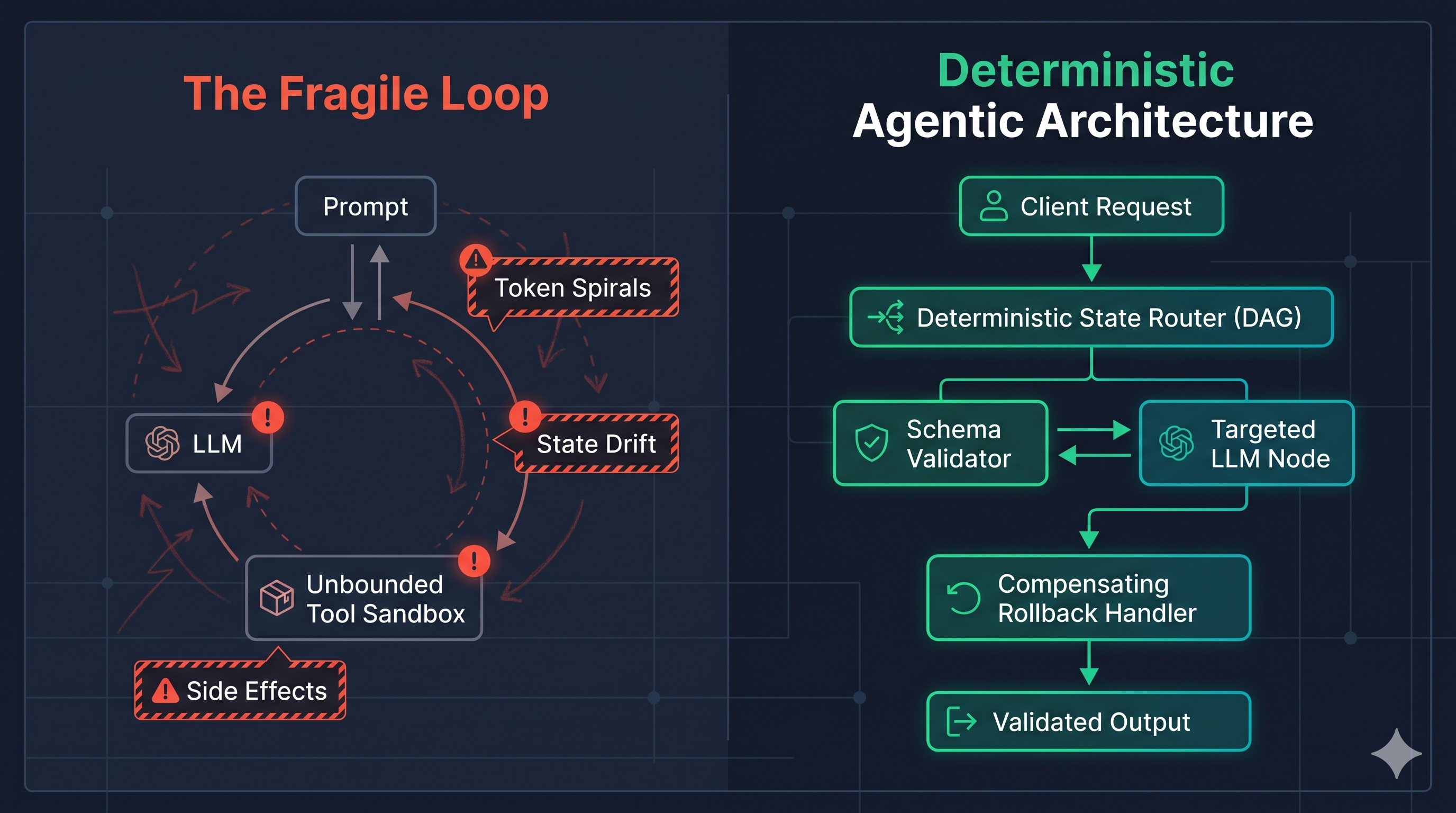
Most teams assemble agents around an uncontrolled loop:Input -> LLM Call -> Tool Execution -> Loop until solved
In a toy environment, this looks magical. In enterprise production, this naive pattern triggers three fatal failure modes:
Compounding Non-Determinism: If an individual step has a 90% success probability, a 6-step recursive chain yields barely a 53% chance of reaching the desired terminal state without hallucinating parameters or misfiring APIs.
Infinite Token Leaks: Without bounded state machines, edge-case network timeouts or malformed tool outputs force agents into self-correcting retry spirals that drain compute budgets.
Missing Telemetry & Rollback States: If an agent executes a destructive downstream API call (e.g., database mutation, payment trigger) mid-chain, standard retry loops cannot cleanly roll back partial writes.
The Architectural Fix: Directed Acyclic Graphs (DAGs) + Deterministic State Gates
Production-grade agentic design requires treating the LLM as an untrusted computation engine within a deterministic orchestrator, rather than an autonomous decision-maker:
Explicit State Hydration: Never maintain persistent unbounded chat histories. Pass only structured schema payloads (JSON-enforced) between explicit state nodes.
Deterministic Guardrails: Every tool invocation must validate schemas both before execution (preventing malformed parameters) and after execution (verifying the returned output matches expected contracts before handing control back to the model).
Compensating Transactions (Sagas): Model long-running agent workflows as distributed sagas. If Node 4 fails validation after 2 retries, trigger deterministic rollback handlers rather than allowing the model to hallucinate workarounds.
If you are automating a broken, brittle manual process with autonomous agency, you don't get automation—you get automated technical debt. Redesign your system boundaries first.
Discussion Question
When deploying multi-step autonomous agents in your stack, where do you draw the line between deterministic rules (code/DAGs) and dynamic model autonomy?
CTA
Join Techawks General Community: Connect with system architects, DevOps leads, and backend engineers discussing resilient architectures and real-world system designs. Link in bio/comments.
The Agentic Reality Check: Why 40% of Autonomous AI Deployments Fail Before Scaling
Industry data indicates that while over 38% of enterprise engineering teams are running AI agent pilots, barely 11% have successfully transitioned them into production. Gartner projects that nearly 40% of agentic workflows will fail before 2027.
The failure is not LLM reasoning quality; it is software system architecture.
Most teams assemble agents around an uncontrolled loop:Input -> LLM Call -> Tool Execution -> Loop until solved
In a toy environment, this looks magical. In enterprise production, this naive pattern triggers three fatal failure modes:
Compounding Non-Determinism: If an individual step has a 90% success probability, a 6-step recursive chain yields barely a 53% chance of reaching the desired terminal state without hallucinating parameters or misfiring APIs.
Infinite Token Leaks: Without bounded state machines, edge-case network timeouts or malformed tool outputs force agents into self-correcting retry spirals that drain compute budgets.
Missing Telemetry & Rollback States: If an agent executes a destructive downstream API call (e.g., database mutation, payment trigger) mid-chain, standard retry loops cannot cleanly roll back partial writes.
The Architectural Fix: Directed Acyclic Graphs (DAGs) + Deterministic State Gates
Production-grade agentic design requires treating the LLM as an untrusted computation engine within a deterministic orchestrator, rather than an autonomous decision-maker:
Explicit State Hydration: Never maintain persistent unbounded chat histories. Pass only structured schema payloads (JSON-enforced) between explicit state nodes.
Deterministic Guardrails: Every tool invocation must validate schemas both before execution (preventing malformed parameters) and after execution (verifying the returned output matches expected contracts before handing control back to the model).
Compensating Transactions (Sagas): Model long-running agent workflows as distributed sagas. If Node 4 fails validation after 2 retries, trigger deterministic rollback handlers rather than allowing the model to hallucinate workarounds.
If you are automating a broken, brittle manual process with autonomous agency, you don't get automation—you get automated technical debt. Redesign your system boundaries first.
Discussion Question
When deploying multi-step autonomous agents in your stack, where do you draw the line between deterministic rules (code/DAGs) and dynamic model autonomy?
CTA
Join Techawks General Community: Connect with system architects, DevOps leads, and backend engineers discussing resilient architectures and real-world system designs. Link in bio/comments.

 English
 Arabic
 French
 Spanish
 Portuguese
 Deutsch
 Turkish
 Dutch
 Russian
 Romaian
 Portuguese (Brazil)
 Greek