


The 80% SaaS Margin Era Is Dead: Why Unit-Economics-First Founders Are Winning Seed & Series A
For nearly two decades, traditional software thrived on near-zero marginal cost: build the product once, serve the next million users for pennies on the dollar, and bank 75% to 85% gross margins.
That playbook has officially expired.
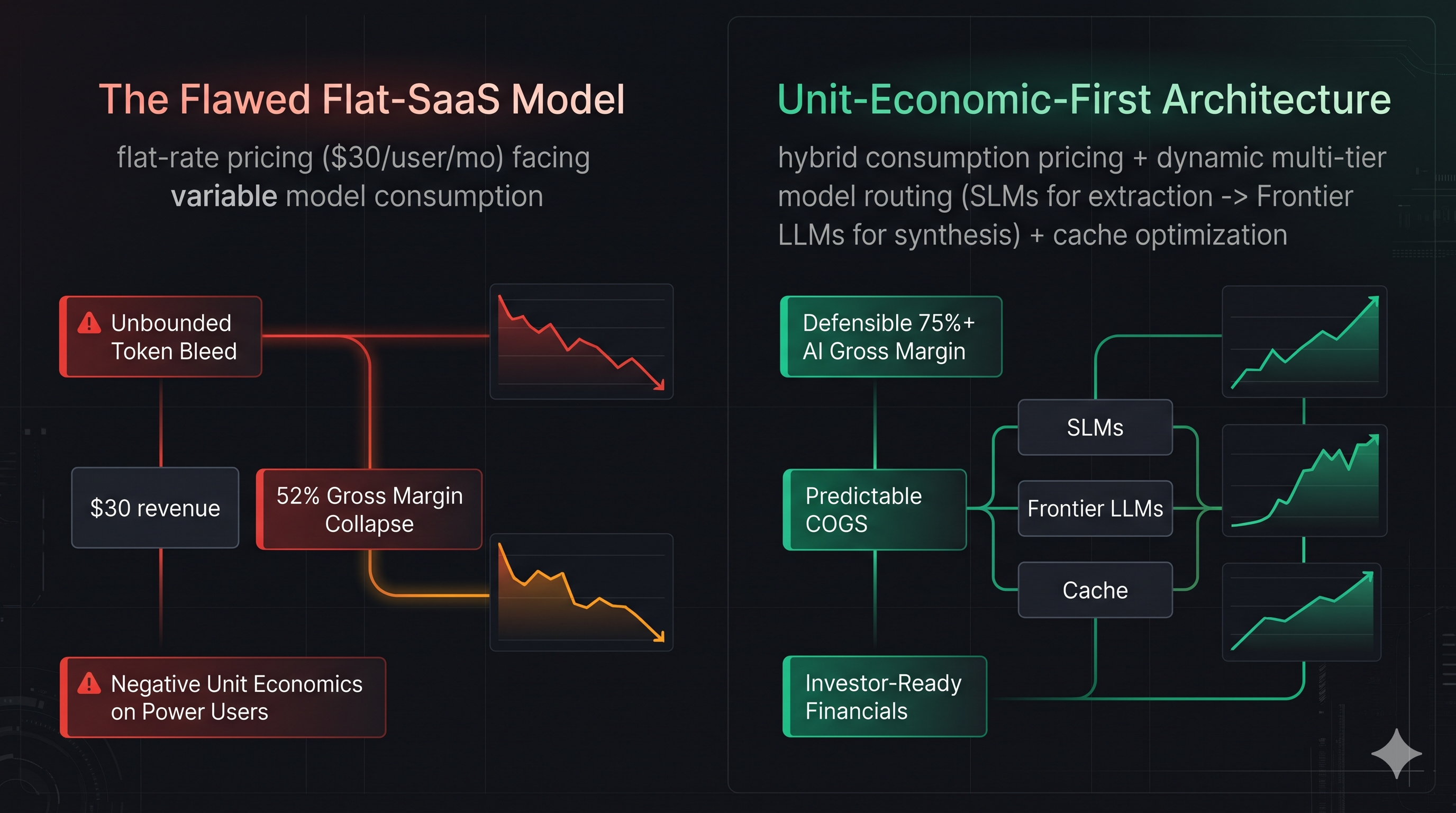
Industry benchmarks reveal that average gross margins for AI software products hover between 50% and 53%—and in uncontrolled agentic applications, margins can plunge below 30%.
The cause is not poor product-market fit; it is untracked variable COGS. In an AI-native stack, model inference, vector database lookups, self-critique loops, and recursive tool calls are not operational expenses—they are direct Costs of Goods Sold (COGS). When a heavy user triggers an autonomous workflow that makes 15 calls to resolve a query, a flat $30/month seat fee quietly turns into a money-losing account.
Founders raising institutional rounds today are being evaluated on AI-Adjusted Gross Margin and unit defensibility. Here is how top-tier founders protect their margin profile:
Decouple Billing from Flat Seats to Hybrid Consumption: Eliminate all-inclusive flat enterprise tiers for autonomous features. Shift to hybrid models: base platform access + metered credit allowances with automatic usage-based overages.
Implement Dynamic Inference Routing: Never send a classification, extraction, or summarization task to a flagship frontier model. Route 70%+ of standard utility tasks through specialized, small language models (SLMs) or quantized local endpoints, reserving high-tier reasoning engines strictly for complex multi-hop tasks.
Audit Per-Cohort Marginal Cost: Stop relying on blended platform-wide compute averages. Track unit margins per customer and per feature. If your top 5% power users are responsible for 60% of your inference spend, your pricing model has a structural leak.
Vanity ARR will get you upvotes; unit-economic discipline gets your company funded and keeps it solvent.
Discussion Question
For founders running AI products: have you shifted from flat-rate pricing to hybrid usage/outcome-based billing, and what has been the customer pushback during contract negotiations?
CTA
Join Startup Founders & Entrepreneurs: Discuss unit economics, pricing architecture, go-to-market strategies, and fundraising playbooks with active venture-backed founders inside the Techawks Startups community. Link in bio/comments.
The 80% SaaS Margin Era Is Dead: Why Unit-Economics-First Founders Are Winning Seed & Series A
For nearly two decades, traditional software thrived on near-zero marginal cost: build the product once, serve the next million users for pennies on the dollar, and bank 75% to 85% gross margins.
That playbook has officially expired.
Industry benchmarks reveal that average gross margins for AI software products hover between 50% and 53%—and in uncontrolled agentic applications, margins can plunge below 30%.
The cause is not poor product-market fit; it is untracked variable COGS. In an AI-native stack, model inference, vector database lookups, self-critique loops, and recursive tool calls are not operational expenses—they are direct Costs of Goods Sold (COGS). When a heavy user triggers an autonomous workflow that makes 15 calls to resolve a query, a flat $30/month seat fee quietly turns into a money-losing account.
Founders raising institutional rounds today are being evaluated on AI-Adjusted Gross Margin and unit defensibility. Here is how top-tier founders protect their margin profile:
Decouple Billing from Flat Seats to Hybrid Consumption: Eliminate all-inclusive flat enterprise tiers for autonomous features. Shift to hybrid models: base platform access + metered credit allowances with automatic usage-based overages.
Implement Dynamic Inference Routing: Never send a classification, extraction, or summarization task to a flagship frontier model. Route 70%+ of standard utility tasks through specialized, small language models (SLMs) or quantized local endpoints, reserving high-tier reasoning engines strictly for complex multi-hop tasks.
Audit Per-Cohort Marginal Cost: Stop relying on blended platform-wide compute averages. Track unit margins per customer and per feature. If your top 5% power users are responsible for 60% of your inference spend, your pricing model has a structural leak.
Vanity ARR will get you upvotes; unit-economic discipline gets your company funded and keeps it solvent.
Discussion Question
For founders running AI products: have you shifted from flat-rate pricing to hybrid usage/outcome-based billing, and what has been the customer pushback during contract negotiations?
CTA
Join Startup Founders & Entrepreneurs: Discuss unit economics, pricing architecture, go-to-market strategies, and fundraising playbooks with active venture-backed founders inside the Techawks Startups community. Link in bio/comments.

 Arabic
 French
 Spanish
 Portuguese
 Deutsch
 Turkish
 Dutch
 Italiano
 Russian
 Romaian
 Portuguese (Brazil)
 Greek