


The 80% Gross Margin Illusion: Why AI Startups Are Quietly Bleeding Runway
For fifteen years, B2B software companies traded on a single fundamental assumption: an 80%+ gross margin. You wrote the code once, hosted it on commodity cloud VMs, and served millions of requests for fractions of a cent.In AI products, this assumption has collapsed.
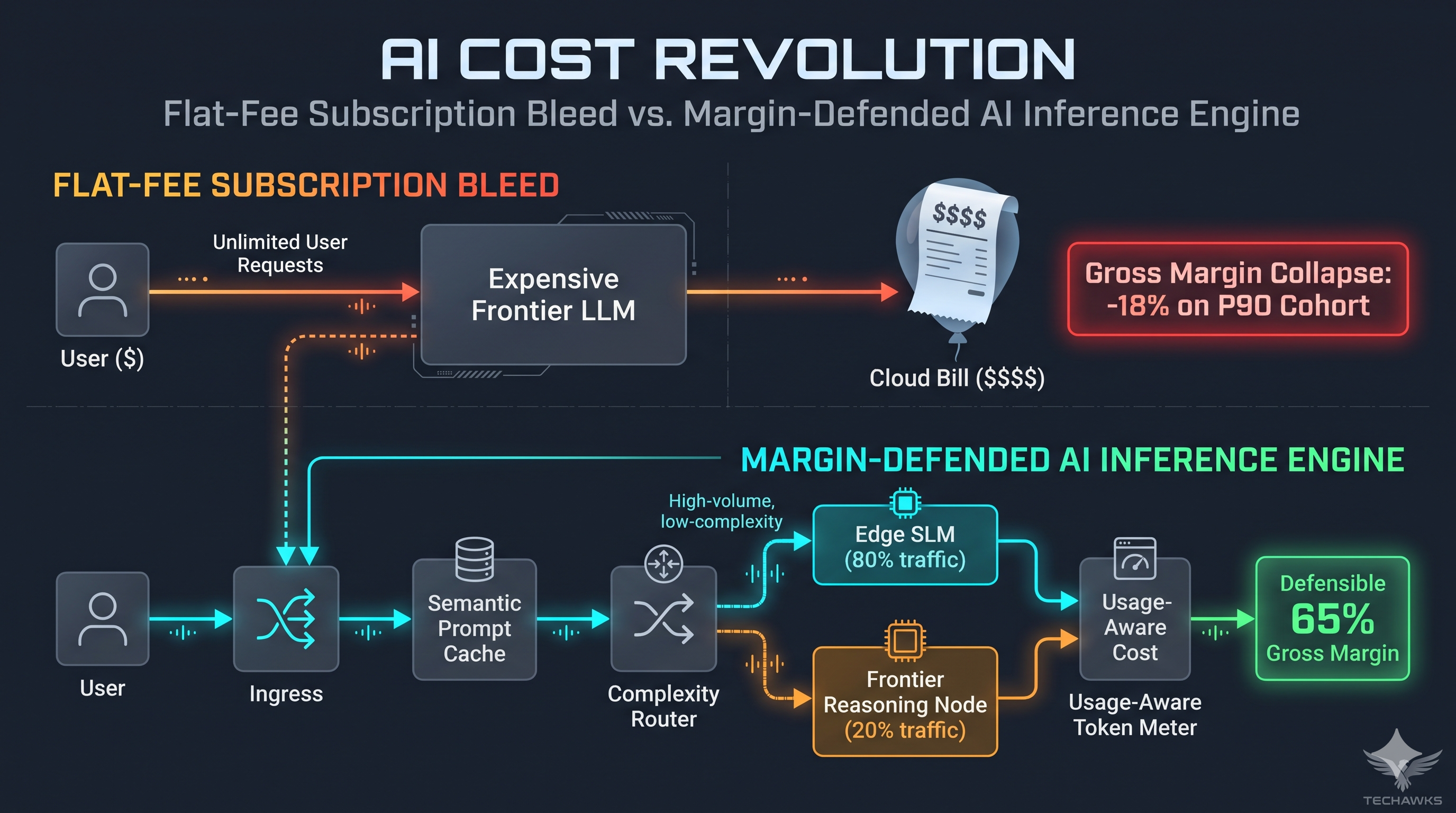
Recent enterprise benchmark data reveals that AI software operates at an average gross margin of 50% to 60% (with unoptimized architectures dipping below 40%). The culprit isn't marketing spend or customer acquisition—it is treating non-deterministic model inference like general operating expenses (OpEx) instead of direct Cost of Goods Sold (COGS).Plaintext[ ANTI-PATTERN: FLAT-FEE SUBSCRIPTION SQUEEZE ]
User Subscribes ($49/mo) ──► Unbounded LLM Calls ──► Top 10% Power Users (10x Token Load) ──► Serving Cost ($68/mo) ──► Negative Gross Margin / Cash Bleed
[ PRODUCTION PATTERN: MARGIN-DEFENDED VALUE ENGINE ]
User Ingress ──► Semantic Cache (Free Hit) ──► Complexity Classifier ──► Tiered Routing (SLM vs Frontier) ──► Usage-Aware Pricing Floor ──► Defensible 65%+ Margin
If you are building an AI startup, you cannot wait until your Series A data room to fix unit economics. Here is the operational framework to defend your margins from day one:
1. Measure AI-Adjusted Gross Margin (COGS Separation)Stop burying LLM API bills, fine-tuning compute, and vector database queries inside general cloud infrastructure.
Calculate your Inference Cost Ratio ($\frac{\text{Direct Inference Costs}}{\text{Gross Revenue}}$) per customer cohort.
Isolate your P90 and P99 users. In unmetered flat-fee models, the top decile of power users routinely consumes 10x the median token volume, turning enterprise contract wins into net-negative margin liabilities.
2. Implement Dynamic Cascading Model RoutingNever hit an expensive frontier model (e.g., $5 to $15 per million tokens) for tasks that a distilled, specialized small language model (SLM) can handle at a 90% discount.
Tier 1 (Deterministic/Cached): Semantic caching handles recurring user queries and system prompts before touching a model bus.
Tier 2 (Classification & Extraction): Lightweight, fine-tuned 1B–8B parameter models handle structural parsing, entity extraction, and intent classification.
Tier 3 (Complex Synthesis): Frontier models are invoked strictly for complex multi-hop reasoning or ambiguous edge cases.3. Shift from Seat-Based to Value-Metric & Hybrid BillingFlat per-seat pricing with uncapped generative capabilities is an open-ended liability. The SaaS pricing playbook has changed:
Transition to a base platform fee + consumption-aware credit tiers.Set strict internal soft-caps or token allowances tied directly to the contract price.
Anchor pricing on delivered customer value (e.g., per resolved ticket, per qualified lead, or per verified workflow) rather than passing raw token consumption through to the customer.
In the current funding climate, investors don't reward vanity top-line growth backed by subsidizing model compute. The founders who build resilient, lasting companies will be those who can defend durable unit economics at scale.
Discussion Question
Founders: How are you managing inference unit economics today—pure flat tiers with fair-use limits, credits-based billing, or dynamic model routing under the hood? What surprised you most about your P90 user costs?
CTA
Scaling an AI venture and navigating early-stage product economics, fundraising, and architecture?
👉 Join Startup Founders & Entrepreneurs to share playbooks, benchmark metrics, and build alongside fellow tech founders in the Techawks network.
For fifteen years, B2B software companies traded on a single fundamental assumption: an 80%+ gross margin. You wrote the code once, hosted it on commodity cloud VMs, and served millions of requests for fractions of a cent.In AI products, this assumption has collapsed.
Recent enterprise benchmark data reveals that AI software operates at an average gross margin of 50% to 60% (with unoptimized architectures dipping below 40%). The culprit isn't marketing spend or customer acquisition—it is treating non-deterministic model inference like general operating expenses (OpEx) instead of direct Cost of Goods Sold (COGS).Plaintext[ ANTI-PATTERN: FLAT-FEE SUBSCRIPTION SQUEEZE ]
User Subscribes ($49/mo) ──► Unbounded LLM Calls ──► Top 10% Power Users (10x Token Load) ──► Serving Cost ($68/mo) ──► Negative Gross Margin / Cash Bleed
[ PRODUCTION PATTERN: MARGIN-DEFENDED VALUE ENGINE ]
User Ingress ──► Semantic Cache (Free Hit) ──► Complexity Classifier ──► Tiered Routing (SLM vs Frontier) ──► Usage-Aware Pricing Floor ──► Defensible 65%+ Margin
If you are building an AI startup, you cannot wait until your Series A data room to fix unit economics. Here is the operational framework to defend your margins from day one:
1. Measure AI-Adjusted Gross Margin (COGS Separation)Stop burying LLM API bills, fine-tuning compute, and vector database queries inside general cloud infrastructure.
Calculate your Inference Cost Ratio ($\frac{\text{Direct Inference Costs}}{\text{Gross Revenue}}$) per customer cohort.
Isolate your P90 and P99 users. In unmetered flat-fee models, the top decile of power users routinely consumes 10x the median token volume, turning enterprise contract wins into net-negative margin liabilities.
2. Implement Dynamic Cascading Model RoutingNever hit an expensive frontier model (e.g., $5 to $15 per million tokens) for tasks that a distilled, specialized small language model (SLM) can handle at a 90% discount.
Tier 1 (Deterministic/Cached): Semantic caching handles recurring user queries and system prompts before touching a model bus.
Tier 2 (Classification & Extraction): Lightweight, fine-tuned 1B–8B parameter models handle structural parsing, entity extraction, and intent classification.
Tier 3 (Complex Synthesis): Frontier models are invoked strictly for complex multi-hop reasoning or ambiguous edge cases.3. Shift from Seat-Based to Value-Metric & Hybrid BillingFlat per-seat pricing with uncapped generative capabilities is an open-ended liability. The SaaS pricing playbook has changed:
Transition to a base platform fee + consumption-aware credit tiers.Set strict internal soft-caps or token allowances tied directly to the contract price.
Anchor pricing on delivered customer value (e.g., per resolved ticket, per qualified lead, or per verified workflow) rather than passing raw token consumption through to the customer.
In the current funding climate, investors don't reward vanity top-line growth backed by subsidizing model compute. The founders who build resilient, lasting companies will be those who can defend durable unit economics at scale.
Discussion Question
Founders: How are you managing inference unit economics today—pure flat tiers with fair-use limits, credits-based billing, or dynamic model routing under the hood? What surprised you most about your P90 user costs?
CTA
Scaling an AI venture and navigating early-stage product economics, fundraising, and architecture?
👉 Join Startup Founders & Entrepreneurs to share playbooks, benchmark metrics, and build alongside fellow tech founders in the Techawks network.
The 80% Gross Margin Illusion: Why AI Startups Are Quietly Bleeding Runway
For fifteen years, B2B software companies traded on a single fundamental assumption: an 80%+ gross margin. You wrote the code once, hosted it on commodity cloud VMs, and served millions of requests for fractions of a cent.In AI products, this assumption has collapsed.
Recent enterprise benchmark data reveals that AI software operates at an average gross margin of 50% to 60% (with unoptimized architectures dipping below 40%). The culprit isn't marketing spend or customer acquisition—it is treating non-deterministic model inference like general operating expenses (OpEx) instead of direct Cost of Goods Sold (COGS).Plaintext[ ANTI-PATTERN: FLAT-FEE SUBSCRIPTION SQUEEZE ]
User Subscribes ($49/mo) ──► Unbounded LLM Calls ──► Top 10% Power Users (10x Token Load) ──► Serving Cost ($68/mo) ──► Negative Gross Margin / Cash Bleed
[ PRODUCTION PATTERN: MARGIN-DEFENDED VALUE ENGINE ]
User Ingress ──► Semantic Cache (Free Hit) ──► Complexity Classifier ──► Tiered Routing (SLM vs Frontier) ──► Usage-Aware Pricing Floor ──► Defensible 65%+ Margin
If you are building an AI startup, you cannot wait until your Series A data room to fix unit economics. Here is the operational framework to defend your margins from day one:
1. Measure AI-Adjusted Gross Margin (COGS Separation)Stop burying LLM API bills, fine-tuning compute, and vector database queries inside general cloud infrastructure.
Calculate your Inference Cost Ratio ($\frac{\text{Direct Inference Costs}}{\text{Gross Revenue}}$) per customer cohort.
Isolate your P90 and P99 users. In unmetered flat-fee models, the top decile of power users routinely consumes 10x the median token volume, turning enterprise contract wins into net-negative margin liabilities.
2. Implement Dynamic Cascading Model RoutingNever hit an expensive frontier model (e.g., $5 to $15 per million tokens) for tasks that a distilled, specialized small language model (SLM) can handle at a 90% discount.
Tier 1 (Deterministic/Cached): Semantic caching handles recurring user queries and system prompts before touching a model bus.
Tier 2 (Classification & Extraction): Lightweight, fine-tuned 1B–8B parameter models handle structural parsing, entity extraction, and intent classification.
Tier 3 (Complex Synthesis): Frontier models are invoked strictly for complex multi-hop reasoning or ambiguous edge cases.3. Shift from Seat-Based to Value-Metric & Hybrid BillingFlat per-seat pricing with uncapped generative capabilities is an open-ended liability. The SaaS pricing playbook has changed:
Transition to a base platform fee + consumption-aware credit tiers.Set strict internal soft-caps or token allowances tied directly to the contract price.
Anchor pricing on delivered customer value (e.g., per resolved ticket, per qualified lead, or per verified workflow) rather than passing raw token consumption through to the customer.
In the current funding climate, investors don't reward vanity top-line growth backed by subsidizing model compute. The founders who build resilient, lasting companies will be those who can defend durable unit economics at scale.
Discussion Question
Founders: How are you managing inference unit economics today—pure flat tiers with fair-use limits, credits-based billing, or dynamic model routing under the hood? What surprised you most about your P90 user costs?
CTA
Scaling an AI venture and navigating early-stage product economics, fundraising, and architecture?
👉 Join Startup Founders & Entrepreneurs to share playbooks, benchmark metrics, and build alongside fellow tech founders in the Techawks network.

 English
 Arabic
 French
 Portuguese
 Deutsch
 Turkish
 Dutch
 Italiano
 Russian
 Romaian
 Portuguese (Brazil)
 Greek